

SPT SD-9254W vs Honeywell HDS18B: A Listing That Says 8 and 14
Two 18-inch built-ins in the same price band, 10 dB apart on stated noise. The bigger story is the Honeywell listing: its title says 8 place settings and a bullet point says 14, and our own review repeated the larger figure.
The two listings at a glance
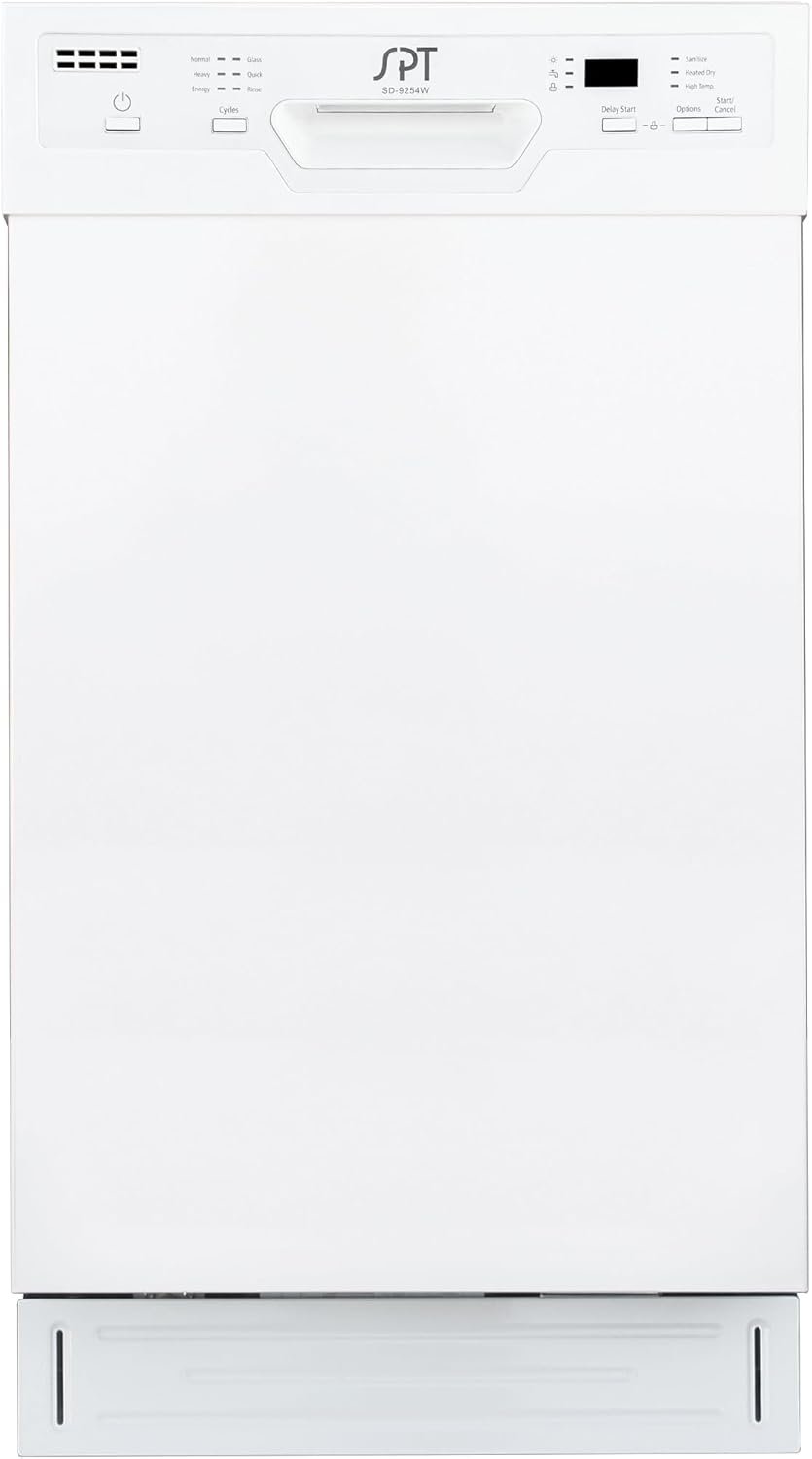
18-inch built-in, top-mount, heated dry
Read our review · Check price on Amazon
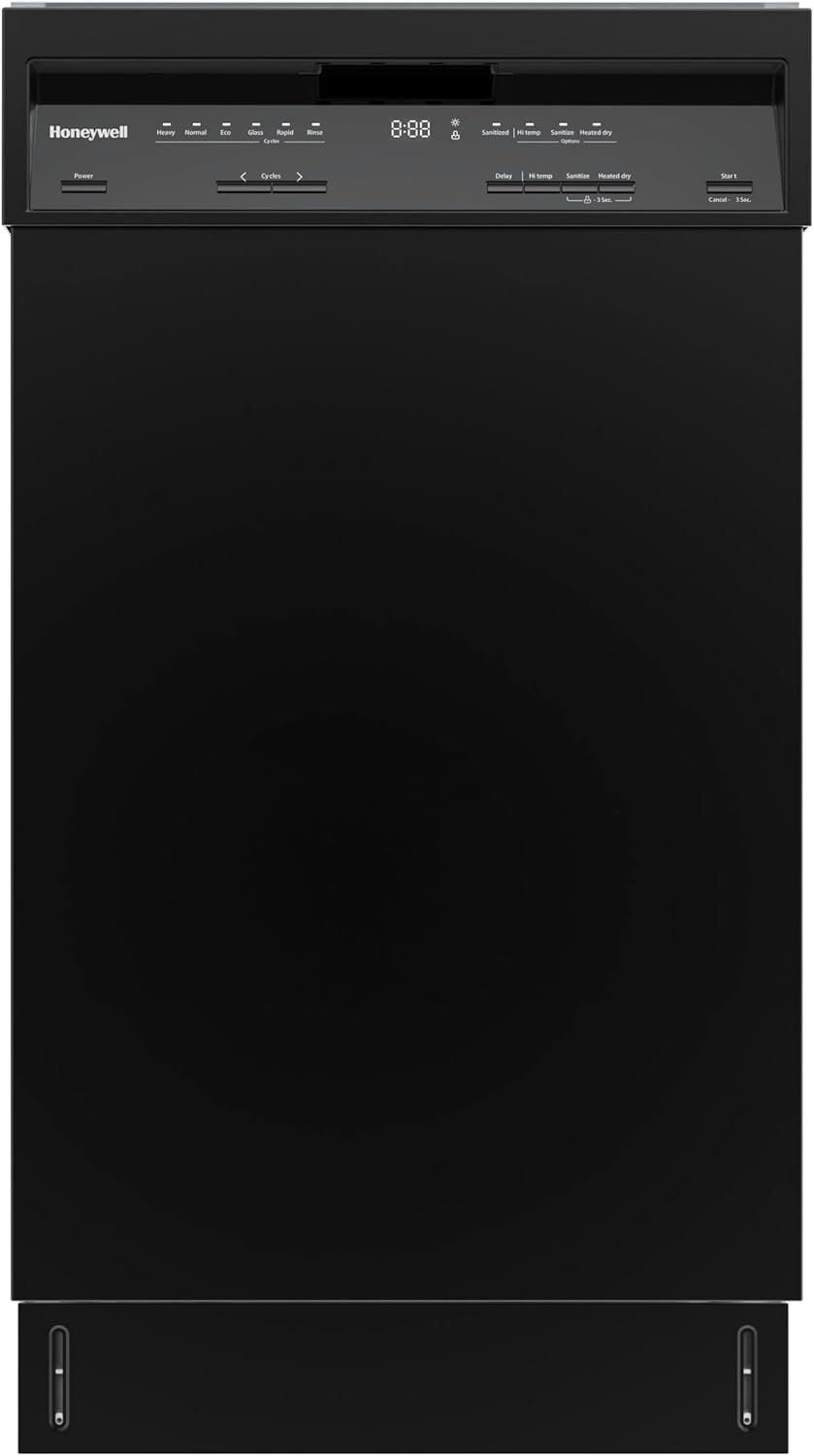
18-inch built-in, under counter
Read our review · Check price on Amazon
Both are 18-inch-wide built-ins in the same price band, which makes them a narrow-kitchen pair: apartments, small galley kitchens and replacements where a 24-inch machine will not fit. They differ by 10 dB on stated noise and, more quietly, on how honestly each listing describes its own capacity. Between these two, only the Honeywell’s listing gives several different capacity figures, and our own review picked one of them.
| Figure | SPT SD-9254W | Honeywell HDS18B | Class median |
|---|---|---|---|
| Size (W × D × H) | 17.6 × 22.6 × 32.4 in | 18 × 22.6 × 32.4 in | — |
| Exterior volume | 211.2 L | 216 L | two width groups |
| Weight | 24.5 kg (54 lb) | 31.8 kg (70 lb) | 38.8 kg |
| Stated noise | 52 dB | 42 dB | 49 dB |
| Place settings | 8 (both sources agree) | sources disagree: 8, 14 and 6 | 14 |
| Programs (Amazon’s count) | 6 | 6 | 7 |
| Controls | Full panel | Push button | — |
| Drying | Heated, 700 W heater (review) | Not specified by the maker (review) | — |
| Installation | Top-mount; top brackets included, side brackets not | Under counter; listing also states ADA compliance | — |
| Energy and water | 234 kWh a year, 4.9 gal per cycle (both sources) | 234 kWh a year (review only) | — |
| Warranty | 1 year, parts and labour | 1 year | — |
| Price band | $200-500 | $200-500 | — |
The listing that contradicts itself
The Honeywell’s title says 8 place settings. A bullet point in the same listing says “14 place settings: racks are suitable to fit 14 place settings of dishes”. Amazon’s own specification field says 6, which we already know to be unreliable: in the first three cases where we compared it with a place-setting count in a title, it disagreed every time. Our review of the Honeywell repeats the bullet point’s 14. That is a mistake in our review, made by copying one of the listing’s own contradictory figures, and we have not used it on this page.
Here is why the larger figure deserves suspicion, using only numbers from the listings. The Honeywell’s exterior volume is 216 litres. At 8 place settings that is 27 litres per place setting, almost exactly the SPT’s 26.4 at its agreed 8. At 14 it would be 15.4 litres per place setting. Among the built-ins in our catalogue whose place-setting count two sources agree on, the median is 23 litres per place setting and the tightest is 19.9. A 14-setting claim would put this 18-inch machine well below every unit in that group, including the 24-inch ones, which is hard to reconcile with a box this size. Eight is the figure the physical dimensions support. It is still a claim, and we have not counted racks.
A width that is labelled wrongly
The SPT listing gives its dimensions as 17.6 inches deep and 22.6 inches wide, and its own text says “at 18 inches wide”. The labels are transposed: 17.6 is the width and 22.6 the depth. Our review quotes it the right way round, but the structured field on Amazon does not, and anything that trusts that field would draw the wrong shape. The footprint below uses the width and depth the listing’s own words support.
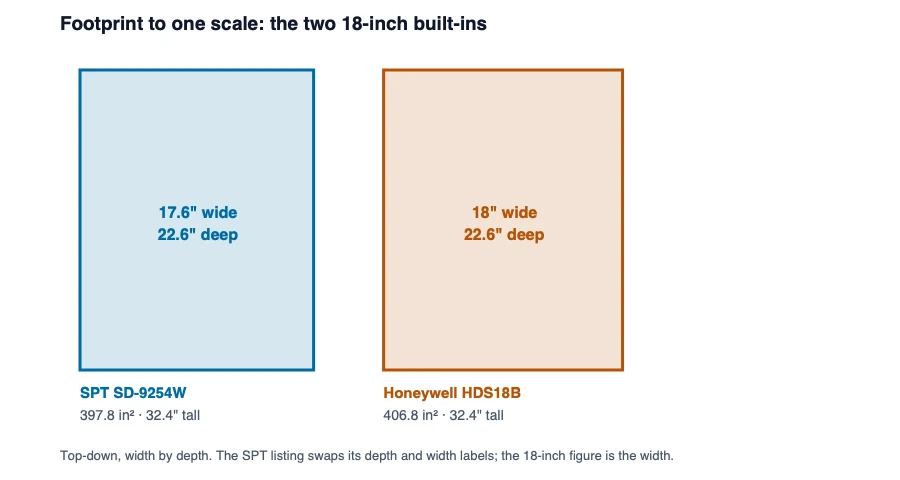
The SPT is 54 pounds, the lightest built-in with a stated weight in our catalogue; the Honeywell is 70. Both are the same 32.4 inches tall. The SPT is designed for top-mount installation, securing to the underside of the countertop, with top brackets included and side brackets explicitly not, which is worth reading before you buy if your countertop material does not take a fixing. The Honeywell’s listing states an under-counter install and ADA compliance, and gives no mounting details.
Noise: 10 dB, and a rare quiet result at this width
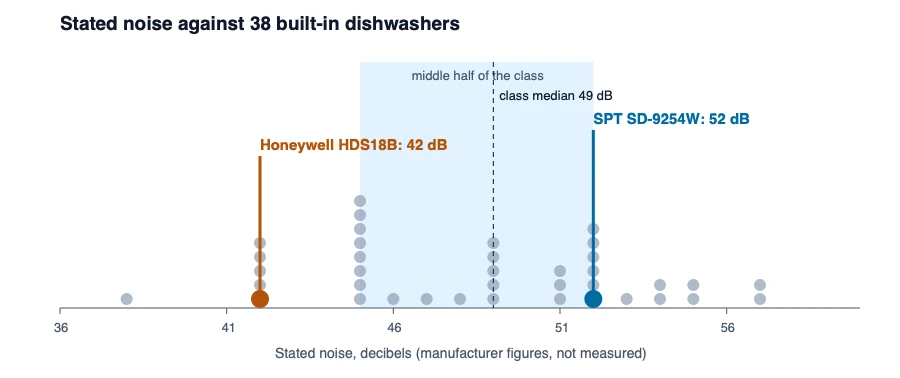
The SPT states 52 dB and the Honeywell 42 dB, both agreed. That gap is 10 times the sound power, or about twice the loudness by the rule of thumb. Across the class, 6 of the 38 built-ins that state a figure claim 42 dB or less, and of the 7 18-inch built-ins in the catalogue, 1 claim 45 dB or less. Most of the quietest stated figures belong to 24-inch units, which makes the Honeywell’s claim unusual for its width, and as with every claim in this class, nothing in the listing says how it was measured.
Fitting either one into a narrow opening
An 18-inch opening is the usual reason to buy either machine, so the physical fit is the first thing to settle. The SPT is 17.6 inches wide and the Honeywell 18, both deep 22.6 inches and both listed at 32.4 inches tall. That height is below the 34 inches of a standard full-size built-in, and the text we read does not say whether either machine has adjustable feet to reach a taller opening, so measure from the floor to the underside of the countertop before you order.
The mounting method is the larger difference. The SPT secures to the underside of the countertop with brackets that the listing supplies, and says plainly that side brackets are not included. That suits most countertops, though a stone or engineered surface may need an installer’s view, so ask. The Honeywell’s listing says nothing about mounting, which leaves it for you to check in the manual, and it states ADA compliance, which is a claim about accessibility that we have not verified.
What each listing does and does not say about drying and efficiency
The SPT is specific. Its listing gives a 700-watt drying heater, 234 kWh a year and 4.9 gallons per normal cycle, and two sources agree on the energy and water figures. The Honeywell’s listing is ENERGY STAR and our review quotes the same 234 kWh a year, but the review does not find a stated drying method, noting that a stainless-steel tub supports condensation or passive drying. Two machines quoting the identical annual figure is not proof that they use the same energy; we cannot tell from the listings whether the number was measured for each or carried over.
Which suits which
The SPT SD-9254W suits you if
- weight and ease of installation matter. At 54 pounds it is the lightest built-in with a stated weight that we have catalogued, and it includes top-mounting brackets;
- you want a stated heated-dry method and a documented energy and water figure, both agreed by two sources;
- the stated 52 dB, at the class’s upper quartile, is acceptable in your kitchen;
- your countertop can take top-mount brackets.
The Honeywell HDS18B suits you if
- the stated 42 dB matters most, and you accept it as an unverified claim;
- you prefer push-button controls to a full panel;
- under-counter installation with ADA compliance is what your kitchen needs;
- you are willing to confirm the capacity with the seller first. The listing gives 8, 14 and 6, and only 8 fits its size.
What this comparison cannot tell you
We did not test either machine, and no cycle was timed. We cannot tell you whether the Honeywell’s claimed quiet survives a real cycle, how dry dishes come out of a machine whose maker does not name a drying method, or how either handles a full load. For each machine in full, see our SPT SD-9254W review and our Honeywell review, and for the whole class the built-in class report.
Figures are the manufacturers’, as published on each listing and quoted in our reviews; none was measured by us. How we work · Affiliate disclosure