

Built-In Dishwashers: What 38 Spec Sheets Actually Say
Across 38 built-in dishwashers, stated noise runs from 38 to 57 dB, the quiet end is almost all 24-inch and, where a price band is known, in the higher one, and capacity follows width. Here is the class in numbers, with the claims we could and could not cross-check.
What we analysed, and how
This report covers every built-in dishwasher that our site has reviewed and kept: 38 machines from 15 brands. We decided which are built-in by Amazon’s own installation-type field, not by the category a review post was filed under, because the two disagree. 7 are 18 inches wide and 31 are 24 inches wide. For each we have two independent transcriptions of the listing, our review’s specification table and Amazon’s detail page, and the numbers below use a figure only when it is stated and, where both sources give it, agreed. Every figure is the manufacturer’s; none was measured by us.
We also cleaned the catalogue first. When we pulled Amazon’s detail page for every product we had reviewed, a dozen turned out not to be dishwashers at all (three butter dishes among them), and we removed them. They are not in these figures.
| Built-in dishwashers | Count | Notes |
|---|---|---|
| Reviewed and kept | 38 | 15 brands |
| 24 inches wide | 31 | the standard width |
| 18 inches wide | 7 | compact |
| State a noise figure | 38 | 100 percent |
| State a place-setting count | 31 | 82 percent |
| Carry an ENERGY STAR flag | 30 | 79 percent |
| Have a price band on record | 25 | used only to group, never shown as a price |
Noise: from 38 to 57 dB, with the quiet end expensive and wide
Across the 38 built-ins that state a figure, the median is 49 dB, and the middle half runs from 45 to 52. The whole range is 19 dB, which by the rule of thumb is roughly 3.7 times the loudness from the quietest stated figure to the loudest.
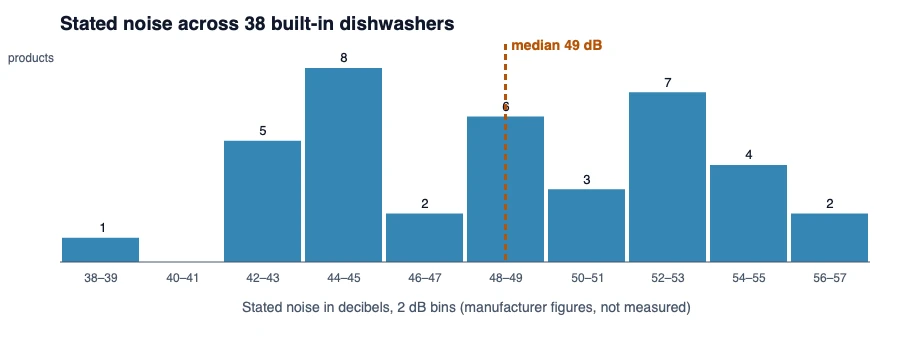
The quiet end has a shape. 14 of the 38 machines state 45 dB or less, and 13 of those 14 are 24-inch units. Only 1 of the 7 18-inch built-ins claim that little. Price is the other pattern. Among built-ins with a price band on record, the $500+ group states a median of 47.5 dB (16 machines) and the $200–500 group 52 dB (9 machines), a gap of 4.5 dB. Restricting to 24-inch units, to rule out width as the explanation, the gap is 47 against 55 dB across 15 and 5 machines. Those are small groups, so the pattern is a tendency, not a law. It is also the stated figure that differs, not necessarily the noise you would hear.
See it in a pair: the SPT SD-6501WA against the Kenmore Elite puts two identical-size 24-inch machines 13 dB apart across exactly that price step.
Width decides capacity more than anything else
| 24-inch built-ins | 18-inch built-ins | |
|---|---|---|
| Machines | 31 | 7 |
| Median stated place settings | 14 | 8 |
| Median stated noise | 49 dB | 52 dB |
| Median weight | 41 kg | 27.9 kg |
| ENERGY STAR flagged | 26 of 31 | 4 of 7 |
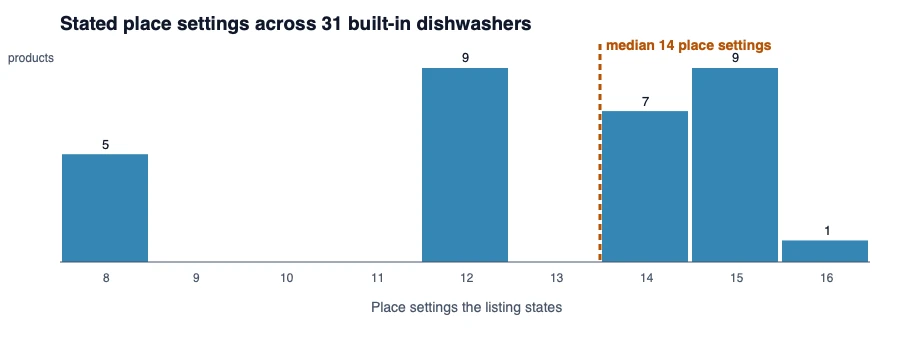
A 24-inch machine states a median of 14 place settings and an 18-inch one 8, which is about what the extra six inches of width would suggest. The 24-inch units are also the ones with an ENERGY STAR flag: 26 of 31, against 4 of 7 of the narrower ones. Dividing exterior volume by stated place settings for the 24-inch machines whose count two sources agree on gives a median of 23 litres per place setting.
Weight follows width too. The 24-inch machines state a median of 41 kilograms and the 18-inch ones 27.9, which is worth knowing before delivery day, and worth checking against the route from the door to the kitchen. Height is the dimension that varies least: nearly every built-in here is listed between 32 and 34 inches, so the opening you already have is the real constraint, and the cutout width is what decides between the two groups.
Who is in the catalogue
15 brands appear, but two of them dominate: Kenmore accounts for 10 of the 38 machines and Sharp for 6, together 42 percent. That is a fact about what this site has reviewed, not about the market, and it shapes every median above: a class statistic for built-ins here is partly a statistic about those two makers’ ranges. Most other brands contribute one or two models. Where a number on this page leans on a small group, the page says so.
Drying: a method, not a result
Of the 38 built-ins, 24 state a heated-dry method, 5 state condensation drying, 2 state air drying and 7 do not say. Those are three different designs. Heated dry uses an element to dry the load and usually costs more energy; condensation drying relies on a hot final rinse and the cold stainless wall to pull moisture off the dishes; air drying just leaves the door closed or cracked. A listing that names a method tells you what the machine does, not how dry the dishes come out. The 7 that name none may still dry well; they just do not say how.
Program counts are steadier: across the 34 built-ins that state one the median is 7 and the middle half runs from 6 to 8. A program count is a count of options, not a measure of how well any of them works.
How far to trust a place-setting count
15 of the built-ins state a place-setting count in their titles, and capacity is the figure a buyer leans on hardest. So we checked it. Across every dishwasher we have reviewed, in all three classes, there were 48 where our review table and the listing’s own text both give a count; 44 agreed and four did not, a rate of 92 percent. That is a good result, and it leaves a tail: the four that did not agree include a listing that states a different number in its title and in its bullet points. One is the Honeywell HDS18B, whose listing says both 8 and 14, and we discuss it in the SPT and Honeywell comparison.
Amazon’s own structured “number of settings” field is worse. In the first three cases where we compared it with a count stated in a title it was wrong every time, so we do not use it for any figure on this site.
What the stated figures cannot tell you
Energy and water are the figures a buyer would most like to compare, and they are the two we cannot. Across these listings “energy consumption” is a yearly total in kilowatt-hours on built-ins and a per-cycle figure on small machines, water is quoted in gallons, litres and gallons per hour, and many listings state neither. Drying is similar: a method is named, but almost never a result. All of it is what a manufacturer chose to publish, none of it was measured by us, and a dishwasher’s noise, drying and cleaning depend on the cycle and the load in ways a specification sheet does not record.
How to use this
- If the dishwasher is in an open-plan room, look at the quiet tail: 14 machines state 45 dB or less, nearly all 24-inch. Expect them in the higher price band, and treat every figure as a claim to verify with the seller or the manual;
- If your opening is 18 inches, plan on about 8 place settings and compare the 7 machines we have, starting with this pair;
- If an efficiency label matters, the ENERGY STAR flag is on 30 of 38: 26 of the 31 24-inch machines and 4 of the 7 narrow ones;
- If you want to narrow by your own answers, the dishwasher finder filters all of these by noise, drying and cycles.
Figures are the manufacturers’, as published on each listing and quoted in our reviews; none was measured by us. How we work · Affiliate disclosure