

Countertop Dishwashers: What 52 Spec Sheets Actually Say
15 of 52 countertop dishwashers share one size and weight across 9 brands, yet state noise anywhere from 40 to 60 dB. Here is the class in numbers, with the claims we could and could not cross-check.
What we analysed, and how
This report covers the countertop dishwashers our site has reviewed and kept. 54 reviewed products are countertop units by Amazon’s installation-type field, and we kept the 52 that are household-sized, meaning between 50 and 150 litres of exterior volume. Two were left out: a USB-rechargeable unit and a low-voltage battery unit, each about eight litres, which are closer to novelty appliances than to dishwashers. One freestanding 18-inch machine that Amazon files as countertop is a 243-litre, 52-kilogram box and was moved to the portable class. For each we have two independent transcriptions of the listing, our review’s table and Amazon’s detail page. A figure is used only when it is stated and, where both give it, agreed.
| Countertop dishwashers | Count | Notes |
|---|---|---|
| Household-sized, reviewed, kept | 52 | 2 small units left out, 1 reclassified |
| State a noise figure | 44 | 85 percent |
| State a place-setting count | 10 | 19 percent |
| Carry an ENERGY STAR flag | 8 | 15 percent |
| Have a price band on record | 29 | 26 of them $200–500 |
One box, many brands
Plot the exterior volume of every countertop dishwasher and most of the class sits on one spike. 15 of the 52 units, 29 percent, measure between 79 and 89 litres and weigh between 11.4 and 15.7 kilograms, and they come from 9 different brands. The class median is 83.3 litres.
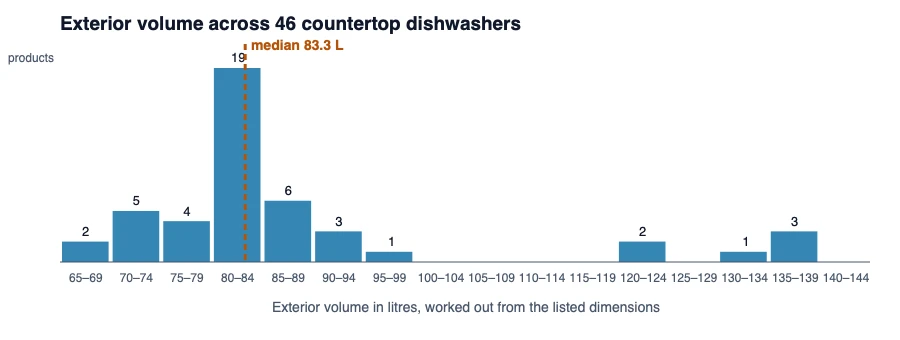
Dimensions alone cannot tell us whether these share a factory, and we do not claim they do. A common size can come from a common water-tank design or a shared set of tooling. What it does mean is that the physical specification gives you little reason to choose among them. You are choosing among claims. The NOVETE against the HAVA is an example: two of this cluster, identical in size and weight, differing in what their listings say.
Inside that box, stated noise spans 20 dB
Of the 15 cluster units, 14 state a noise figure, and they run from 40 to 60 dB, a spread of 20 dB between boxes of near-identical size and weight. That is 100 times the sound power. The hardware envelope does not explain a gap that large, which leaves a few possibilities: different pumps and insulation, different measurement conditions, or different ways of quoting. The listings give no way to tell which.
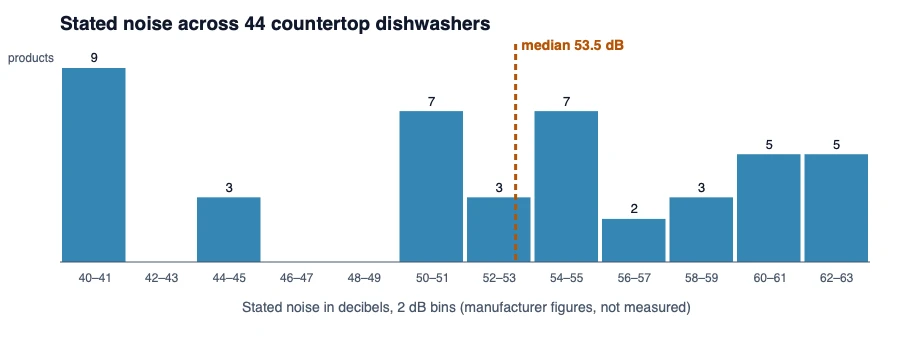
Across all 44 countertop units that state a figure, the median is 53.5 dB and the range 40 to 62. 12 claim 45 dB or less. The spike at the bottom deserves mention: 4 listings put “40dB” in the title, and every one states exactly 40. The quietest built-in in our catalogue states 38 dB, so a small tank-fed countertop machine claiming 40 sits beside the quietest full-size machines. The claim may be true. It is also a repeated marketing number, and we cannot verify it. The BLACK+DECKER and EUHOMY comparison looks at one case.
Tank, faucet or both
A countertop dishwasher needs water from somewhere. 28 of the 52 listings mention a built-in water tank or reservoir and 34 mention a faucet connection; 26 mention both, which is the flexible design. A tank lets you place the machine anywhere with a power outlet and fill it by hand. A faucet hookup removes the filling but ties the machine to a sink. If you are choosing for an apartment, a dorm or an RV, this is the question to ask before any other, and it is one the specification table usually does not put in a row of its own.
Capacity is rarely stated, and sometimes impossible
Only 10 of the 52 countertop dishwashers state a place-setting count, a rate of 19 percent, and those that do say between 2 and 6, with a median of 5. The rest describe a number of dishes or a tank volume, and neither converts into place settings. One listing states 30 place settings for a countertop unit of roughly the same size as the others. We left it out of the figures as physically implausible: a machine of that size cannot hold thirty place settings.
The other capacity unit that appears is litres of water: five-litre tanks are common, which is why “5 L” shows up in so many listings. It is a measure of how much water the machine can be given for one cycle, not of how many dishes it washes, and the two should not be confused.
What the tub is made of
Amazon’s material field gives a plastic body for 26 of the 52 machines, stainless steel for 9, a mix of the two for 9 and nothing for 8. The field describes the machine as a whole and does not always say which part is which, so a listing that says plastic may still have a stainless tub, and the reverse. What the split does show is that the class is mostly plastic, which is part of why these weigh about 13 kilograms and why the stainless exceptions, like the BLACK+DECKER, weigh more.
Drying
18 of the 52 countertop machines state a heated method, 14 state air drying, 3 state condensation drying and 17 do not say. Air drying is far more common here than among built-ins, where only a handful of machines rely on it. A countertop unit that only air-dries leaves the load to do its own evaporating, which in a small kitchen on a humid day can mean damp dishes for a long time. As with every drying claim on these pages, it is a method, and the listing does not say how dry anything comes out.
Programs, voltage, height and certification
Programs. Of the 45 listings that give a program count, 18 state five and 12 state six, and 6 state eight. A program count is a count of options, not a measure of how well any of them works.
Voltage. Most listings state 110 or 120 volts, as a US outlet supplies. 2 state 220 volts, which would not run from a standard outlet. One is the HAVA, which contradicts itself on the subject in the comparison linked above. Ask the seller before ordering any machine whose voltage field does not say 110 or 120.
Height. 29 of the 52 machines are at least 18 inches tall, and kitchens commonly leave about 18 inches between counter and wall cabinets. Measure the gap. The compact cluster above sits right at the limit.
Certification. Only 8 of the 52 carry an ENERGY STAR flag, 15 percent, against about four in five of the built-ins. Some use other wording, such as “ETL and DOE certified”, which is not the same label.
What the stated figures cannot tell you
Energy and water are the figures we would most like to compare and cannot: units mix a yearly kilowatt-hour total, a per-cycle figure and a heater wattage, sometimes with the wrong unit, as in a listing that gives 950 “KW”. Nothing here was measured by us, and a decibel figure on a listing says nothing about the cycle it describes. The price is also not something we state. Of the 29 with a price band on record, 26 are in the $200–500 band, which tells you the class clusters in price as well as in size.
How to use this
- Start with where the water comes from. Decide tank or faucet before you compare anything else;
- Treat stated noise below 45 dB as a claim to verify, not a feature. 12 machines make it, in a class whose median is 53.5;
- Check the voltage field and the height against your outlet and cabinets;
- Use the dishwasher finder to narrow by noise or cycles, and read the review before buying: countertop dishwasher reviews.
Figures are the manufacturers’, as published on each listing and quoted in our reviews; none was measured by us. How we work · Affiliate disclosure