
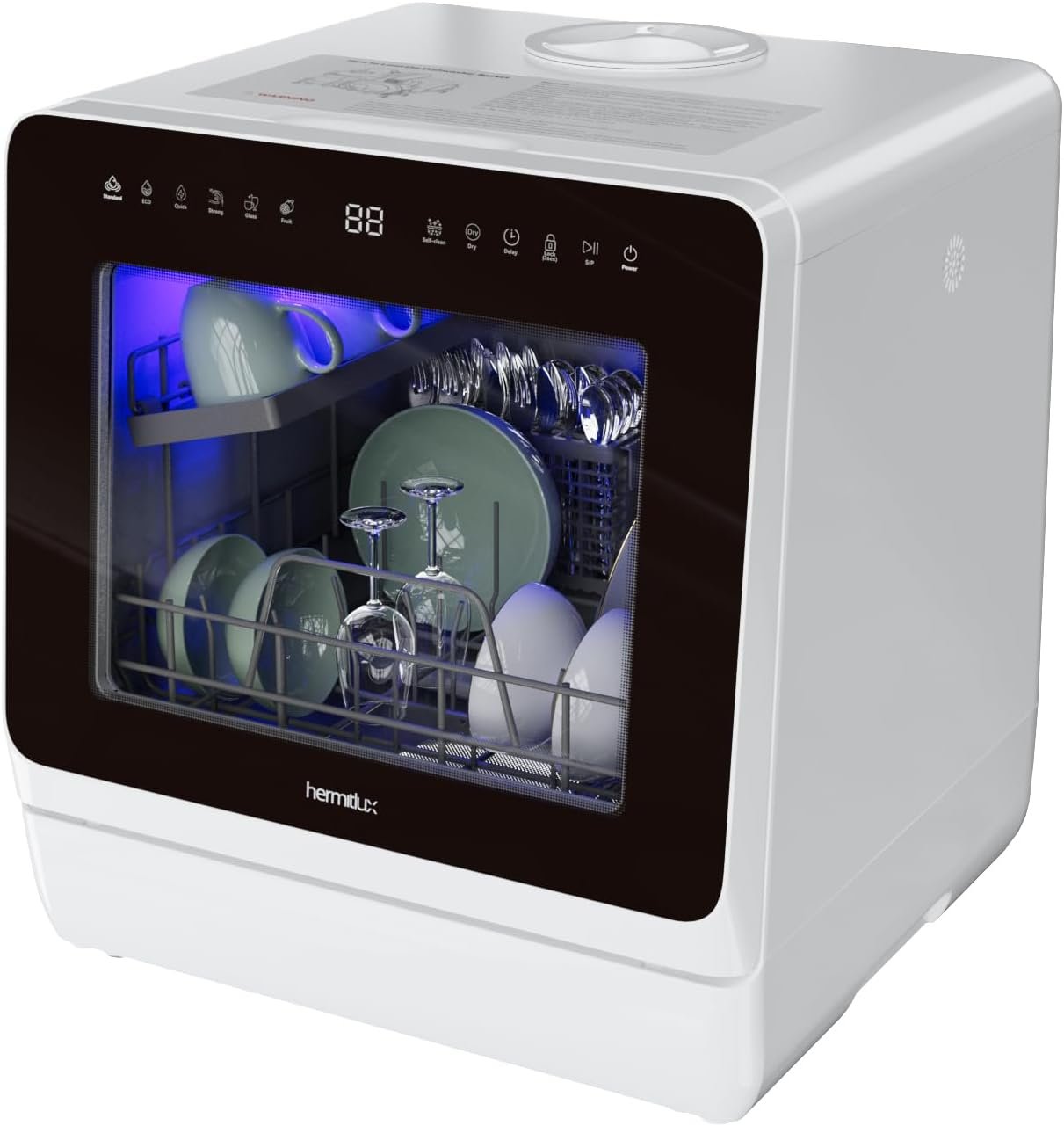
Compact Dishwashing for Apartments, Dorms, and RVs
Hermitlux built its countertop dishwasher around a single premise: full-size cleaning results do not require a full-size kitchen. The Hermitlux Countertop Dishwasher, 7 Washing Programs review that follows examines how a 5-liter water tank, a 14-jet spray system, and a glass-front cabinet come together in a unit small enough for a studio counter yet capable enough for a family of two or three. Households in apartments, dorm rooms, boats, and recreational vehicles often face a shared limitation: no dedicated water line, no floor space for a built-in unit, and a genuine need to cut down on hand-washing time. Noise sensitivity matters too, since a countertop unit typically runs a few feet from a living or sleeping area rather than tucked behind a cabinet door, unlike a built-in model concealed behind a cabinet panel. Wash frequency, dish variety, and drying expectations all factor into whether a compact model like this one fits daily routines or becomes an occasional-use appliance reserved for overflow loads after larger meals or gatherings. The sections below break down cleaning coverage, capacity, noise, drying, efficiency, and upkeep to help clarify where this model fits among 2026’s countertop dishwasher options.
Quick Overview
| Feature | Details |
|---|---|
| Dishwasher Type | Countertop / portable, no permanent hookup required |
| Capacity | 5 place settings, 30+ pieces of kitchenware, 10.25″ plates at an angle |
| Wash Programs | Standard, Quick, Strong, ECO, Fruit, Self-Clean, Glass (7 total) |
| Extra Functions | Delay Start (up to 18 hours), Child Lock, independent Dry cycle |
| Spray System | 14 water jets, dual top-and-bottom spray arms for 360° coverage |
| Drying Method | 60-minute hot air drying plus 72-hour automatic ventilation |
| Noise Level | 50 decibels |
| Water Supply | Built-in 5-liter tank or direct faucet connection |
| Energy Consumption | 0.38 kilowatt-hours per cycle |
| Dimensions | 16.85″W x 16.73″D x 18.23″H |
| Weight | 30.86 pounds |
| Materials | Glass door, plastic housing, PA-powder-coated metal racks |
| Controls | Touch panel with LED display |
| Warranty | 1-year manufacturer warranty |
These specifications point to a unit designed for compact living rather than high-volume households. The 5-liter tank system and sub-60-decibel operation suit apartments, dorms, and RVs where plumbing access is limited and quiet operation matters, while the 5-place-setting capacity and 7-program selection give small households enough flexibility to wash everything from daily dishware to delicate glass and baby bottles without hand-washing.

Cleaning Performance: How the Hermitlux Countertop Dishwasher’s 7 Washing Programs Perform
Cleaning outcomes in any dishwasher come down to water pressure, spray coverage, and cycle chemistry matched to soil level, and the Hermitlux unit approaches this with a dual spray-arm layout positioned above and below the rack rather than relying on a single rotating arm. Fourteen individual jets distribute water across both levels simultaneously, which is intended to reduce the shadowing effect that leaves streaks or residue on items blocked from a single spray source. Pairing that hardware with seven distinct programs allows the wash intensity, water volume, and cycle duration to be matched to the soil level and material of the load, rather than running every batch through one generic setting. This program depth is one of the more differentiated aspects of the unit relative to basic single-cycle countertop competitors.

360° Dual-Level Spray Arm System
The top-and-bottom jet arrangement is engineered to reach items placed at varying heights and angles within the rack, addressing one of the common criticisms of compact dishwashers where upper-rack or angled items receive inconsistent coverage. Water is distributed from both above and below the load simultaneously rather than in a single rotational sweep from one direction.
For households that regularly wash mixed loads containing tall glasses, shallow bowls, and flat plates in the same cycle, dual-direction spraying reduces the likelihood that any single item sits in a coverage gap. This matters more in a 5-liter system than in a full-size unit, since there is less water volume available to compensate for inefficient spray geometry.
Understanding the 7 Wash Programs
Standard, Quick, Strong, ECO, Fruit, Self-Clean, and Glass each target a different combination of soil level, material fragility, and cycle length. Strong is built for cookware and baked-on residue, while Quick favors lightly soiled dishes that need a fast turnaround between meals. ECO trades cycle speed for lower water and energy draw on routine loads.
Fruit and Glass serve more specialized purposes: Fruit is designed as a produce-rinsing cycle rather than a dishwashing one, and Glass uses gentler water pressure and temperature to reduce the risk of thermal shock or chipping on stemware. Self-Clean is a maintenance cycle rather than a dish-washing program, intended to flush residue from the tank and interior between regular uses.
Handling Baby Bottles, Glassware, and Delicate Items
The Glass program and the unit’s Fruit setting extend the appliance’s use case beyond standard tableware into categories that are typically hand-washed in small households, including baby bottles, wine glasses, and produce. Lower-pressure, lower-temperature cycles reduce thermal and mechanical stress on fragile items compared to a single all-purpose wash setting.
This program variety is particularly relevant for households with infants or those who entertain occasionally, since it removes the need to hand-wash a separate category of items after every automated cycle. It does not replace manufacturer-specific sterilization guidance for baby feeding equipment, which should still be followed independently, as a home dishwasher cycle is not equivalent to medical-grade sterilization even on a gentle setting.
Capacity, Rack Design, and Kitchen Footprint
At 5 place settings and roughly 30 pieces of kitchenware, the interior capacity positions this unit for one to three people rather than larger households running multiple daily loads. The rack and cutlery holder are arranged to accommodate 10.25-inch plates at an angle, a common workaround in compact dishwashers where full-size upright plate storage is not possible within the available interior volume. Exterior dimensions of 16.85 by 16.73 by 18.23 inches keep the footprint close to that of a large microwave, but the listed 20.08-inch clearance requirement between countertop and upper cabinets is a meaningful installation constraint that not every kitchen layout can accommodate without rearranging existing storage. At roughly 31 pounds, the unit is portable enough to move between a permanent counter spot and temporary storage when the workspace is needed for other tasks.

5-Place-Setting Capacity and Interior Layout
Five place settings translate to roughly one day’s worth of dishes for a single adult or a lighter day’s load for a couple, which frames this unit as a supplement to hand-washing during high-volume moments rather than a total replacement for it in larger households. The angled plate arrangement is a space-saving compromise rather than a full upright rack design.
Households accustomed to full-size dishwashers with adjustable tines and dedicated top racks should expect a simpler, more fixed layout here, prioritizing footprint reduction over rack flexibility. The trade-off is intentional: cramming adjustable rack hardware into a 16.85-inch-wide cabinet would reduce the usable interior volume that the angled-plate design is already working to maximize.
Cutlery Basket and Small-Item Organization
A dedicated cutlery basket is included to keep utensils separated from plates and bowls during the wash cycle, reducing the nesting problem where flatware stacks together and blocks water contact on some pieces. This is a standard inclusion across most countertop and built-in dishwashers but remains a meaningful organizational feature in a compact unit where interior space is already limited.
Small item organization becomes more important as capacity shrinks, since there is less margin for inefficient loading before items begin blocking spray paths for neighboring dishes. A separated basket also reduces the chance of utensils shifting into the spray arm’s rotation path during a cycle, a common cause of interrupted or uneven cleaning in compact dishwasher designs.
Compact Countertop Dimensions and Clearance Requirements
The 30.86-pound unit is light enough to reposition occasionally but heavy enough to warrant a stable, dedicated counter section rather than a temporary storage spot. The listed clearance requirement of at least 20.08 inches between the countertop surface and any upper cabinetry is a specification that should be measured against the intended kitchen space before installation, since not all apartment or RV counter configurations provide that vertical clearance.
Placement near an accessible outlet and, if faucet mode is used, near the kitchen sink further narrows suitable counter locations in smaller kitchens. Renters and RV owners weighing counter real estate against a fixed appliance footprint should measure both depth and overhead clearance before committing a permanent spot on the counter.
Noise Level, Drying System, and Moisture Control
A 50-decibel noise rating places this unit in a range comparable to a quiet conversation or ambient background noise, which is relevant for open-concept apartments, studio layouts, and RVs where the kitchen is not separated from living or sleeping space. Drying performance is handled through a 60-minute hot air cycle paired with 72 hours of automatic post-cycle ventilation, an approach aimed at preventing the residual moisture and odor buildup that can occur in compact, less-ventilated dishwasher cabinets. Because the drying element and the ventilation system work on a timed cycle rather than a condensation-based approach common in larger built-in units, moisture control here depends more on active air movement than on internal surface condensation and drainage. Together, these two specifications describe an appliance built around unobtrusive operation and a small, sealed interior rather than the higher-capacity airflow of a full-size built-in dishwasher.

50-Decibel Operation in Shared Living Spaces
Operating near 50 decibels means the unit is unlikely to interfere with conversation, media, or sleep in adjoining rooms, which is a relevant consideration for RVs and studio apartments where the dishwasher runs within a few feet of the main living area. This is quieter than many older or budget countertop models, though still audible in a silent room.
Households sensitive to overnight appliance noise may still prefer running cycles during waking hours despite the 18-hour delay start feature, simply due to the audible presence of any operating appliance in a small enclosed living space. In an RV or single-room dorm layout, even a modest hum can register more noticeably than the same sound in a larger, multi-room apartment.
60-Minute Hot Air Drying Cycle
The dedicated 60-minute hot air drying function can be layered onto any wash program except Fruit, or run independently as a standalone drying pass. This flexibility allows users to dry a load that was already washed by hand or air-dry a load that finished its wash cycle with the drying option skipped to save time.
Hot air drying is generally less thorough on plastics than on glass or ceramic, a limitation common across countertop dishwasher categories due to plastic’s lower heat retention and tendency to trap water droplets in textured surfaces. Loads dominated by plastic storage containers or children’s cups may benefit from an additional air-dry period on an open rack after the cycle completes.
72-Hour Automatic Ventilation for Odor Prevention
Beyond the active drying cycle, a 72-hour automatic ventilation function is intended to keep air circulating through the cabinet after a wash completes, reducing the musty odor that can develop in a sealed, humid interior. This is particularly relevant for a compact glass-door unit where interior air volume is small and moisture has fewer surfaces to disperse across compared to a full-size built-in cabinet.
Regular use of this feature, combined with periodic interior wipe-downs, is likely to matter more in this category of appliance than in larger dishwashers with more airflow and drainage capacity. Leaving the glass door slightly ajar between cycles, where practical, can further support the automatic ventilation function in fully dispersing trapped humidity.
Water and Energy Efficiency, Installation, and Maintenance
The dual water-supply design is one of the more distinctive aspects of this model: a built-in 5-liter tank allows the unit to run without any plumbing connection at all, while an optional faucet-mode hookup offers continuous supply for higher-frequency use. Manufacturer figures cite up to 83 percent water savings per cycle compared to hand-washing, alongside a 0.38-kilowatt-hour energy draw per cycle, both of which position the unit as a low-resource-consumption appliance relative to running a tap continuously through a full hand-wash session. No permanent installation is required in tank mode, which is central to the “no hookup needed” positioning aimed at renters and RV owners who cannot modify existing plumbing. Touch controls with an LED display manage cycle selection and the delay-start timer across either water supply mode.

Dual Water Supply Modes: Tank vs Faucet Connection
Tank mode requires manually filling the 5-liter reservoir using the included funnel before each cycle, offering full portability at the cost of a manual refill step between uses. Faucet mode connects directly to a compatible tap using the provided inlet and outlet hoses, both listed at 59.06 inches, enabling continuous operation without repeated refilling.
The choice between modes depends on counter proximity to a sink: RV and dorm users without consistent sink access will likely default to tank mode, while apartment kitchens with sink-adjacent counter space may prefer the convenience of a direct faucet connection. Both hose lengths measure just under five feet, which sets a practical limit on how far the unit can sit from the faucet connection point.
Energy Consumption and Water Savings Per Cycle
At 0.38 kilowatt-hours and 5 liters per cycle, per-load resource consumption is modest relative to running a kitchen tap through a full manual dishwashing session, which the manufacturer estimates can use significantly more water than a filled cycle. Actual savings will vary by household water pressure and typical hand-washing habits, since the comparison depends heavily on individual water use patterns.
Frequent use of Strong or Standard cycles, which run longer and at higher intensity than ECO or Quick, will increase both water and energy draw per session accordingly. Households prioritizing minimal resource use for lightly soiled daily loads may find ECO or Quick sufficient for most cycles, reserving Strong for occasional cookware or baked-on residue.
Self-Clean Program, Filter Care, and Build Materials for Durability
The Self-Clean program is designed to flush mineral deposits and food residue from the tank, spray arms, and interior lining between regular wash cycles, a maintenance step that becomes more important in tank-fed systems where standing water can encourage buildup faster than a continuously flushed plumbed system. Racks and the cutlery basket are constructed from PA-powder-coated metal, a coating intended to resist corrosion and chipping better than uncoated wire racks over repeated cycles.
The glass door and plastic housing are typical materials for this appliance category, balancing visibility into the wash chamber with lighter overall weight; long-term durability will depend on how consistently the Self-Clean cycle and manual residual-water drainage are performed, since the manufacturer notes some residual water is normal after cycles and periodic manual attention helps prevent buildup.

Pros & Cons
Pros
- The dual water-supply system offers genuine installation flexibility, letting the unit run from a filled tank in locations without plumbing access or connect directly to a faucet for continuous use.
- Seven distinct wash programs, including dedicated Glass and Fruit settings, provide more granular cycle selection than many single- or dual-cycle countertop competitors.
- A 50-decibel noise rating is well suited to open-concept apartments, dorms, and RVs where the appliance operates close to living space.
- The 14-jet, dual-direction spray arm layout is designed to reduce coverage gaps common in compact single-arm dishwashers.
- Combined 60-minute hot air drying and 72-hour ventilation address moisture and odor concerns specific to small, sealed dishwasher cabinets.
- An 18-hour delay start allows cycles to be scheduled around household routines or off-peak electricity periods.
- PA-powder-coated racks are intended to resist the corrosion that affects uncoated wire racks in humid, compact interiors over time.
- Child lock functionality adds a safety consideration relevant to households with young children near countertop appliances.
Cons
- The 5-place-setting capacity limits the unit to smaller households or supplemental use rather than serving as a full replacement dishwasher for larger families.
- Tank mode requires manual refilling before each cycle, adding a recurring maintenance step that plumbed dishwashers do not require.
- The 20.08-inch cabinet clearance requirement may not fit every countertop layout, particularly in galley kitchens with lower upper cabinets.
- Hot air drying is generally less effective on plastic items than on glass or ceramic, a limitation inherent to the drying method rather than a defect.
- A 1-year manufacturer warranty is comparatively short relative to the multi-year coverage often available on built-in dishwasher models.
Final Verdict: Who This Dishwasher Is Best For (and Who Should Skip It)
The Hermitlux Countertop Dishwasher fits most naturally into households where plumbing modifications are not possible and counter space is limited but present: apartment renters, dorm residents, boat owners, and RV travelers stand to benefit most from its no-hookup tank mode, sub-60-decibel operation, and program variety. Individuals or couples generating a moderate daily dish volume, along with anyone who regularly hand-washes delicate glassware or baby bottles, will find the Glass and Fruit-adjacent programs a reasonable extension of the unit’s day-to-day usefulness. The combination of touch controls, an 18-hour delay start, and a child lock also suits households that want scheduling flexibility without a permanently installed appliance.
Larger families running multiple loads daily, or kitchens without at least 20.08 inches of vertical counter clearance, are likely to find the 5-place-setting capacity and physical footprint constraining rather than convenient. Buyers who wash large stockpots, sheet pans, or oversized serving dishes regularly will also find the compact rack better suited to standard tableware than to bulky cookware. Compared with other countertop dishwashers available in 2026, this model’s combination of dual water-supply modes and seven wash programs stands out for flexibility, though buyers prioritizing maximum capacity or extended warranty coverage may want to weigh those factors against a full-size built-in alternative before deciding.

Frequently Asked Questions (FAQs)
How many dishes can a countertop dishwasher like the Hermitlux hold?
This model accommodates roughly 5 place settings, or more than 30 individual pieces of kitchenware, including plates up to 10.25 inches when loaded at an angle. That capacity generally suits one to three people generating a moderate daily volume of dishes rather than a larger household running multiple loads per day. Households needing greater capacity typically look toward full-size built-in models instead.
Does a countertop dishwasher need a permanent water hookup?
Not necessarily. Many countertop models, including this one, offer a built-in water tank that allows operation without any plumbing connection, alongside an optional faucet-mode hookup for continuous water supply. Tank mode requires manually refilling before each cycle using a funnel, while faucet mode connects via inlet and outlet hoses to a nearby sink for uninterrupted use without repeated filling, making the appliance workable in rentals and vehicles alike.
How loud are countertop dishwashers during operation?
Noise levels vary by model, but many compact countertop units, including this one, operate around 50 decibels, comparable to a quiet conversation. This level is generally suitable for open-concept apartments, RVs, and studio layouts where the appliance runs close to living or sleeping space. Households highly sensitive to appliance noise may still prefer running cycles during active daytime hours rather than relying solely on scheduled overnight delay options.
Are countertop dishwashers effective at drying dishes?
Drying performance depends on the method used; hot air drying cycles, like the 60-minute option on this model, are generally effective on glass and ceramic but less thorough on plastic items due to lower heat retention. Supplemental ventilation features, such as extended automatic airflow after a cycle, help reduce residual moisture and prevent musty odors from developing in the sealed cabinet.
How much water and energy does a countertop dishwasher use per cycle?
This model consumes approximately 5 liters of water and 0.38 kilowatt-hours of energy per cycle, figures the manufacturer positions as significantly lower than a comparable hand-washing session under a running tap. Actual savings depend on individual water use habits and which wash program is selected, since longer, higher-intensity cycles such as Strong draw more resources than shorter, lower-intensity ones like ECO or Quick.
What maintenance does a countertop dishwasher require?
Compact tank-fed dishwashers typically include a self-clean program designed to flush mineral deposits and food residue from the tank, spray arms, and interior lining between regular use. Periodic manual wipe-downs and attention to any residual water left after a cycle are also recommended, since standing water in a small sealed cabinet can encourage buildup faster than in a continuously plumbed system.
Can a countertop dishwasher clean baby bottles and delicate glassware safely?
Many countertop dishwashers include dedicated gentle cycles for glassware, using lower water pressure and temperature to reduce the risk of thermal shock or chipping compared to standard wash settings. This makes them suitable for stemware and similar delicate items, though manufacturer-specific sterilization guidance for baby feeding equipment should still be followed independently rather than relying solely on a standard wash cycle.
What size counter space is needed for a countertop dishwasher?
Beyond the appliance’s own footprint, most countertop dishwashers require additional vertical clearance above the unit for the door to open and for ventilation, often around 20 inches between the counter surface and upper cabinets. This clearance requirement should be measured against the intended installation space before purchase, since not every apartment, dorm, or RV counter layout provides sufficient overhead room.