
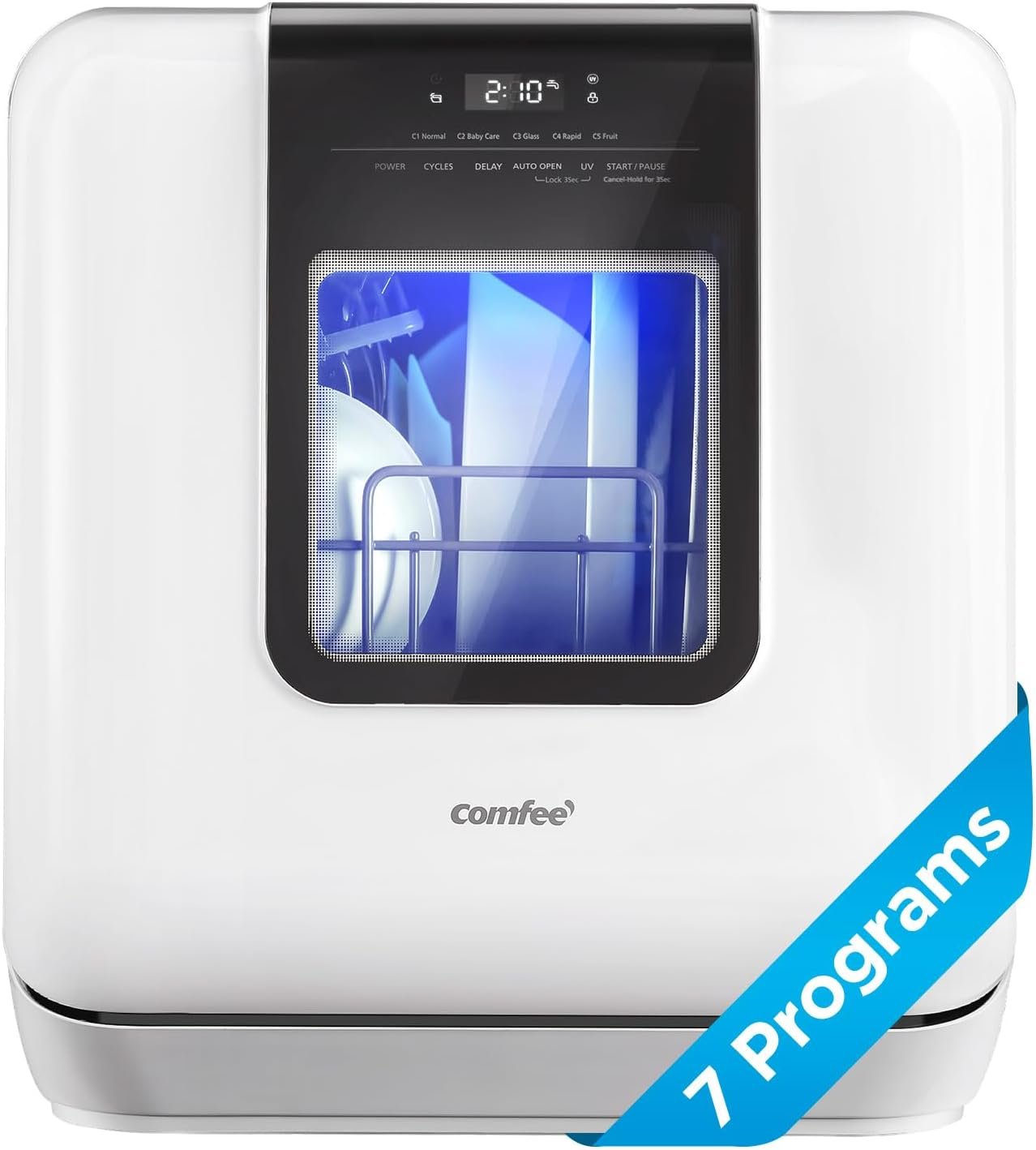
COMFEE’ Countertop Dishwasher: A Compact Solution for Small-Kitchen Cleaning
COMFEE’ countertop dishwasher distinguishes itself with a 6-liter built-in water tank that lets the unit run without any permanent plumbing connection, a detail that separates it from countertop dishwashers built solely around fixed hookups. Sold under model designation CDC17P2AWW, this portable dishwasher with a compact footprint targets apartments, dorm rooms, boats, and recreational vehicles where a full-size built-in dishwasher would not physically fit or a water line is not accessible. Household size and kitchen layout shape which dishwasher makes sense: a single occupant or couple generating one or two loads of dishes daily has different cleaning-frequency needs than a family relying on a full-size unit, and an appliance sized around a single stack of plates, cups, and utensils reflects that smaller-scale use case. Noise sensitivity also factors in, since countertop units operate close to living and sleeping areas rather than tucked below a cabinet. Efficiency expectations shift too, since a machine drawing a fixed volume of water per cycle behaves differently than a plumbed-in model. Evaluating a compact dishwasher therefore means weighing cycle design, drying method, noise output, and water and energy draw against the realities of a small kitchen rather than full-size benchmarks.
Quick Overview
| Feature | Details |
|---|---|
| Dishwasher Type | Countertop / portable, no installation required |
| Model | COMFEE’ CDC17P2AWW (Miniplus) |
| Capacity | Fits plates up to 10.5 inches; roughly one place setting per load |
| Wash Programs | 5 cycles — Normal, Rapid, Hygiene, Fruit, Glass |
| Enhanced Functions | Auto-Open drying assist; UV Hygiene program |
| Hygiene Cycle Temperature | Rinse up to 162°F; maximum 192°F |
| Drying Method | Auto-Open door release with built-in turbofan |
| Noise Level | 62 decibels |
| Water Consumption | Approximately 6 liters (about 1.58 gallons) per cycle |
| Energy Consumption | 0.35 kWh on the Normal cycle |
| Dimensions | 17.13″D x 16.53″W x 18.3″H |
| Weight | 41.3 pounds |
| Water Source | Built-in 6L tank or direct faucet connection via quick-connect hose |
| Included Accessories | Tableware basket, fruit basket, water pitcher, drain hose, inlet hose with adapter |
| Warranty | 1-year manufacturer warranty |
These specifications position the unit as a supplementary or primary cleaning appliance for kitchens too small for standard built-in dishwashers. The tank-fed design removes dependency on existing plumbing, the noise rating keeps operation tolerable in studio-style living spaces, and the modest energy draw per cycle keeps electricity use in check. Because capacity is limited to roughly one place setting at a time, households should judge suitability by daily dish volume rather than by family size alone.

Cleaning Performance of the COMFEE’ Countertop Dishwasher’s Wash Cycle Technology
Cleaning performance in a compact dishwasher depends on spray coverage, water temperature, and program design rather than sheer water volume. The COMFEE’ countertop dishwasher offers five wash programs — Normal, Rapid, Hygiene, Fruit, and Glass — each calibrated to a different soil level and item type, plus two enhanced functions layered on top for hygiene and drying. The Hygiene cycle raises rinse water to roughly 162°F and can reach a maximum of 192°F, a temperature range associated with dissolving grease and reducing bacterial load on heavily soiled cookware, baby bottles, and children’s tableware. Lower-intensity programs such as Glass and Fruit are tuned for delicate or lightly soiled items where high heat could cause damage or is simply unnecessary. This program-based approach compensates for the smaller water reservoir by directing cleaning energy toward the specific soil type rather than relying on one generic wash cycle for every load.

Wash Program Selection and Soil-Specific Cycles
The five-program lineup gives users a way to match cycle intensity to what is actually being washed rather than defaulting to one setting for every load. Normal handles everyday mixed loads of plates, bowls, and utensils, while Rapid shortens cycle time for lightly soiled items that need a quick turnaround between uses.
Fruit and Glass programs use gentler spray pressure and lower temperatures, suiting produce-washing tasks and stemware that could chip or cloud under aggressive high-heat cycles. Hygiene sits at the opposite end, combining extended wash time with elevated temperature for cookware and baby-feeding items that warrant more thorough sanitization.
UV Hygiene Function and Bacterial Reduction
The UV Hygiene function operates as a supplemental step layered onto the standard wash programs rather than a standalone cycle, applying ultraviolet exposure intended to reduce residual bacteria on dishware after the water-based wash and rinse stages are complete. This positions the feature as most relevant to households prioritizing sanitization for infant feeding items, cutting boards used for raw proteins, or dishware belonging to immunocompromised family members.
Because UV exposure works on surfaces rather than penetrating stacked items, its effectiveness depends on loading that leaves item surfaces reasonably exposed rather than tightly nested together, a consideration common to UV-equipped countertop appliances generally.
Capacity, Rack Design, and Place Settings
Interior capacity is the factor most likely to determine whether a compact dishwasher fits a household’s daily routine, and the COMFEE’ unit addresses this with an upgraded interior layout that accommodates a 10.5-inch plate, larger than many mini dishwashers in its size class. The single adjustable rack holds a mixed load of plates, bowls, cups, and utensils rather than segregating items into upper and lower racks the way full-size dishwashers do. This single-level design keeps the footprint compact for countertop placement while still allowing vertical clearance for taller items like mugs and glasses. Because total capacity is roughly equivalent to one place setting plus a few extra pieces, the unit suits users who run frequent, smaller loads rather than accumulating a full day’s dishes before washing, a pattern more typical of one- or two-person households.

Adjustable Rack and Loading Flexibility
The adjustable rack allows some reconfiguration to accommodate taller items such as travel mugs or mixing bowls alongside standard plates and cutlery, which helps offset the absence of a dedicated second rack. Loading flexibility matters more in a single-rack design than in full-size dishwashers because every item competes for the same limited spray zone and vertical space.
Users accustomed to spreading loads across two racks in a standard dishwasher will need to plan more deliberately here, prioritizing which items go in first and orienting soiled surfaces toward the spray arm.
Best-Suited Load Sizes for Daily Use
Given the single 10.5-inch plate capacity ceiling, the unit is best matched to load sizes generated by one or two people eating at home regularly rather than a family of four accumulating dishes across multiple meals. Running the dishwasher once or twice daily keeps loads within its realistic capacity and avoids overloading that can block spray arm rotation.
Larger cookware such as full sheet pans or oversized stockpots will not fit regardless of rack adjustment, so households that regularly cook with large-format pans should plan to hand-wash those items separately.
Noise Levels and Suitability for Open-Concept Kitchens
Noise output matters disproportionately for countertop dishwashers because they operate at counter height in the same room as dining, living, or sleeping areas rather than concealed beneath a cabinet with sound-dampening insulation. Rated at 62 decibels, the COMFEE’ unit falls in a range comparable to normal conversation or background office noise, quieter than many older built-in dishwashers but still audible in a small studio or open-plan apartment. This noise level is generated by the internal pump and spray arm rotation rather than a motor mounted against cabinetry, which is typically how manufacturers dampen sound in permanently installed units. For households running cycles during work-from-home hours or near a sleeping infant, the timing of wash cycles becomes as relevant as the decibel rating itself.

How 62 Decibels Compares to Built-In Dishwashers
Most modern built-in dishwashers marketed as quiet operate between 38 and 50 decibels, achieved through layers of insulation, a fully enclosed cabinet, and vibration-dampening mounts. A countertop unit generating 62 decibels sits noticeably above that range, closer to the sound of a running dishwasher heard from an adjacent room than one that fades into background noise.
This gap exists largely because portable units lack the surrounding cabinetry and insulation that built-in models rely on for sound dampening, not because the internal mechanics are inherently louder.
Placement Strategies to Reduce Perceived Noise
Positioning the unit away from shared walls, home office spaces, or bedroom-adjacent counters can reduce how disruptive the noise feels in daily use, even though the decibel output itself remains fixed. Running cycles during active daytime hours rather than overnight also limits how noticeable the sound becomes relative to ambient household activity, since background noise tends to mask machine operation more effectively than a quiet nighttime environment.
Placing the dishwasher on a stable, level countertop rather than a surface prone to vibration transfer can additionally prevent rattling sounds that would otherwise compound the base operating noise.
Drying System and Moisture Control
Drying performance in compact dishwashers has historically lagged behind cleaning performance because small units generate less residual heat than full-size models and often lack a dedicated heating element for drying. The COMFEE’ countertop dishwasher addresses this gap with an Auto-Open function that releases the door automatically at the end of a cycle, combined with a built-in turbofan that vents steam out of the wash chamber rather than allowing it to condense back onto dishware. This combination targets the two main causes of poor drying in enclosed dishwashers: trapped humidity and lack of airflow. Rather than relying purely on residual heat to evaporate moisture, the mechanical door-and-fan approach actively removes humid air from the chamber, which is particularly relevant given the unit’s compact interior volume where moisture would otherwise concentrate quickly.

Auto-Open Door and Turbofan Drying
The Auto-Open mechanism triggers once the wash and rinse stages finish, cracking the door to let the built-in turbofan pull humid air out of the chamber rather than leaving dishes to sit in a sealed, steam-filled compartment. This active-venting approach is a departure from passive condensation drying, where dishes simply air-dry using residual heat after the cycle ends with the door closed.
Because the fan actively displaces moisture rather than waiting for it to dissipate naturally, cycle-to-cabinet-ready time is generally shorter than in dishwashers without a comparable drying assist, though glassware and plastics may still retain some surface moisture.
Handling Plastic and Lightweight Items
Plastic containers and lightweight items are historically the hardest items for any dishwasher to dry completely, since plastic does not retain heat the way ceramic or metal does and therefore cools before residual moisture can evaporate. The Auto-Open and turbofan system improves airflow around these items compared to a fully sealed cabinet, but plastic items may still emerge with light surface moisture requiring a brief towel-dry.
This is a characteristic shared across nearly all dishwasher categories rather than a shortfall specific to this unit, and households running frequent loads of plastic containers should expect to supplement mechanical drying with occasional manual wiping.
Water and Energy Efficiency Expectations
Efficiency in a countertop dishwasher is best understood in absolute terms rather than compared against handwashing habits, since a fixed-tank system draws a consistent quantity of water regardless of load size. The unit consumes approximately 6 liters, or roughly 1.58 gallons, of water per wash cycle and draws about 0.35 kilowatt-hours of electricity on the Normal program, figures that reflect the compact wash chamber volume rather than aggressive efficiency engineering alone. Because the tank is manually filled or connected to a faucet via the included quick-connect hose, water usage is directly observable and controllable in a way that plumbed-in dishwashers, which draw from a continuous line, are not. These figures position the appliance as a low-draw kitchen device suited to users mindful of utility consumption in small-footprint living situations such as apartments or RVs with limited water storage.

Per-Cycle Water Draw and Tank Refilling
The 6-liter tank capacity means a full wash-and-rinse cycle draws roughly that amount regardless of how full the rack is loaded, so running smaller partial loads more frequently uses proportionally more water per dish washed than consolidating into fuller loads. Manual tank filling adds a preparation step absent from plumbed-in dishwashers, though it also means the appliance can operate anywhere a water pitcher can reach, independent of fixed plumbing.
For users connecting via the faucet adapter instead, water draw is regulated by internal cycle programming rather than manual pouring, offering more consistent fill levels.
Electricity Consumption per Wash Cycle
At 0.35 kWh for a Normal cycle, electricity draw is modest compared to many kitchen appliances, though the Hygiene cycle’s elevated water temperature likely increases consumption above the Normal-cycle figure due to the added energy required for heating water to 192°F. Households running the Hygiene program routinely for baby bottles or cookware sanitization should expect somewhat higher per-cycle energy use than the baseline figure suggests.
Running fewer, fuller loads rather than frequent partial loads generally improves the ratio of energy consumed to dishes cleaned, a principle that holds across compact and full-size units alike.
Maintenance, Installation, and Long-Term Durability
Long-term reliability in a countertop dishwasher depends heavily on routine maintenance, since compact units typically lack the redundant filtration and drainage systems found in built-in models. Installation itself requires no plumbing modification: the appliance can run entirely from its 6-liter internal tank or connect to a kitchen faucet using the included quick-connect hose and adapter, with a separate drain hose directing wastewater to a sink or receptacle. The plastic housing keeps the unit’s weight to roughly 41.3 pounds, light enough for repositioning between a counter and storage but also a material choice that trades some of the vibration-dampening mass of stainless-steel builds found in full-size dishwashers. A one-year manufacturer warranty covers the unit against defects, standard for the compact dishwasher category generally.

Filter Cleaning and Routine Upkeep
Compact dishwashers rely on a basic filter to catch food debris before wastewater is pumped out through the drain hose, and this filter requires periodic cleaning to prevent clogging that could reduce spray pressure or trigger drainage errors. Because the unit lacks macerating disposal systems found in some full-size dishwashers, users should scrape larger food particles from dishes before loading rather than relying on the appliance to break down solid waste.
Regular tank cleaning and drain hose checks help prevent mineral buildup or standing water odor, particularly for units that see frequent faucet-connected use with hard water.
Installation Requirements for Renters and Small Spaces
Because the unit needs no permanent plumbing connection, installation is limited to placing it on a stable, level countertop near an outlet and either filling the tank manually or attaching the quick-connect hose to a compatible faucet. This makes it a practical option for renters who cannot modify existing plumbing, as well as for dorm rooms, boats, and RVs where a fixed water line is unavailable.
The tradeoff is that the appliance occupies active counter space rather than being tucked below it, a consideration for kitchens already short on workspace before the dishwasher is added.

Pros & Cons
Pros
- No-installation setup — The 6-liter built-in tank and included faucet adapter let the unit run without any plumbing changes. This suits renters, dorm residents, and RV owners lacking dedicated water lines.
- Five soil-specific programs — Normal, Rapid, Hygiene, Fruit, and Glass cycles match wash intensity to item type. This variety exceeds many single-cycle countertop competitors.
- High-temperature Hygiene cycle — Rinse temperatures reach up to 192°F for heavily soiled cookware and baby-feeding items. Few compact dishwashers offer comparable heat levels.
- Active drying assist — The Auto-Open door and built-in turbofan vent steam rather than relying on passive residual heat. This reduces trapped moisture inside the small wash chamber.
- Upgraded interior space — The rack accommodates a 10.5-inch plate, larger than typical mini dishwashers. Daily loads feel less restrictive as a result.
- Modest energy draw — Normal-cycle consumption of 0.35 kWh keeps electricity use low. This suits energy-conscious, small-footprint households.
- Added safety and monitoring features — A child lock, leak protection, LED display, and see-through window give visibility into each cycle. These extras are uncommon on compact countertop models.
Cons
- Elevated noise level — At 62 decibels, operation is noticeably louder than most built-in dishwashers. This matters most in studio apartments or open-plan layouts.
- Limited single-rack capacity — The unit holds roughly one place setting at a time. Larger households will need to run multiple daily cycles.
- Plastic housing construction — The lightweight plastic body trades some vibration-dampening mass for portability. Long-term surface durability may lag behind stainless-steel builds.
- Manual tank refilling — Users not connecting to a faucet must refill the 6-liter tank by hand before each cycle. This adds a preparation step absent from plumbed-in dishwashers.
Final Verdict: Who This Dishwasher Is Best For (and Who Should Skip It)
The COMFEE’ countertop dishwasher is best suited to individuals, couples, and small households in apartments, dorm rooms, or recreational vehicles where installing a built-in dishwasher is not feasible or existing plumbing cannot be modified. Its no-installation setup, five soil-specific wash programs, and high-temperature Hygiene cycle make it a capable stand-in for full-size dishwashers in households generating one or two loads of dishes daily, particularly where sanitizing baby bottles or heavily soiled cookware is a recurring need. The Auto-Open drying system and upgraded interior space further support this use case by reducing the drying shortfalls and capacity limits common to smaller countertop units.
Households that regularly cook for four or more people, generate large volumes of dishes daily, or rely on oversized cookware are likely to find the single-rack capacity restrictive regardless of program flexibility. Noise-sensitive households in tight studio layouts should also weigh the 62-decibel operating level against timing cycles around work or sleep schedules. Compared with other compact dishwashers available in 2026, this model distinguishes itself through program variety and active drying rather than raw capacity, making it a stronger fit for cleaning-performance-focused buyers than for those prioritizing maximum load size.

Frequently Asked Questions (FAQs)
How many place settings does the COMFEE’ countertop dishwasher hold?
The interior is sized to fit roughly one place setting at a time, including a plate up to 10.5 inches along with accompanying bowls, cups, and utensils. This capacity is larger than many comparably sized mini dishwashers but remains well below the multi-rack capacity of full-size built-in models. Households generating one or two dishwashing loads daily are the best match for this capacity range, while larger families may need multiple cycles per day.
Does the COMFEE’ countertop dishwasher need to be connected to a water line?
No permanent plumbing connection is required. The unit can run entirely from its 6-liter built-in water tank, which is filled manually, or it can connect directly to a kitchen faucet using the included quick-connect hose and adapter for automatic fill during each cycle. This flexibility is why the appliance is marketed toward renters, dorm residents, and RV owners who cannot modify existing water lines.
How loud is the COMFEE’ countertop dishwasher during operation?
The unit is rated at 62 decibels, a level comparable to normal conversation or background office noise. This is louder than most modern built-in dishwashers, which typically operate between 38 and 50 decibels thanks to cabinet insulation and vibration dampening that countertop units lack. Households sensitive to noise near sleeping or working areas may want to time cycles around active daytime hours.
What is the difference between the Normal and Hygiene wash cycles?
The Normal cycle handles everyday mixed loads of plates, bowls, and utensils at standard wash temperatures, delivering routine cleaning without extended run time. The Hygiene cycle instead raises rinse water to roughly 162°F and can reach a maximum of 192°F, an elevated temperature range aimed at heavily soiled cookware, cutting boards, and baby-feeding items that benefit from more intensive sanitization than a standard wash cycle typically provides on its own.
How does the Auto-Open drying function work?
At the end of a wash cycle, the appliance’s door releases automatically while a built-in turbofan vents steam and humid air out of the wash chamber rather than letting it condense back onto dishware. This active-airflow approach is designed to reduce trapped moisture more effectively than passive drying methods that rely solely on residual heat with the door sealed shut, which is common in many smaller compact dishwashers.
Can the COMFEE’ countertop dishwasher wash large pots and pans?
Capacity is limited to items that fit within a single-rack chamber sized around a 10.5-inch plate, so oversized cookware such as full sheet pans, large stockpots, or wide roasting trays will generally not fit regardless of how the adjustable rack is configured. Households that regularly cook with large-format pans should plan to hand-wash those specific items separately rather than relying on the countertop unit for every piece of cookware in rotation.
What maintenance does the COMFEE’ countertop dishwasher require?
Routine upkeep includes periodically cleaning the internal filter to prevent food debris from clogging the drainage system and reducing spray pressure over time, along with occasional tank and drain hose cleaning to prevent mineral buildup or standing water odor, particularly in hard-water areas. Scraping large food particles from dishes before loading is also recommended, since the unit lacks a macerating disposal system found in some full-size dishwashers.
Is the COMFEE’ countertop dishwasher suitable for a family kitchen?
Its single-rack, one-place-setting capacity makes it better suited to individuals, couples, or small households running frequent smaller loads than to a family generating a full day’s worth of dishes across multiple meals. Families with higher daily dish volume are more likely to find its capacity limiting even with efficient soil-specific wash programs available, and may need to run several cycles per day to keep pace with demand.