
Why dishwasher selection matters
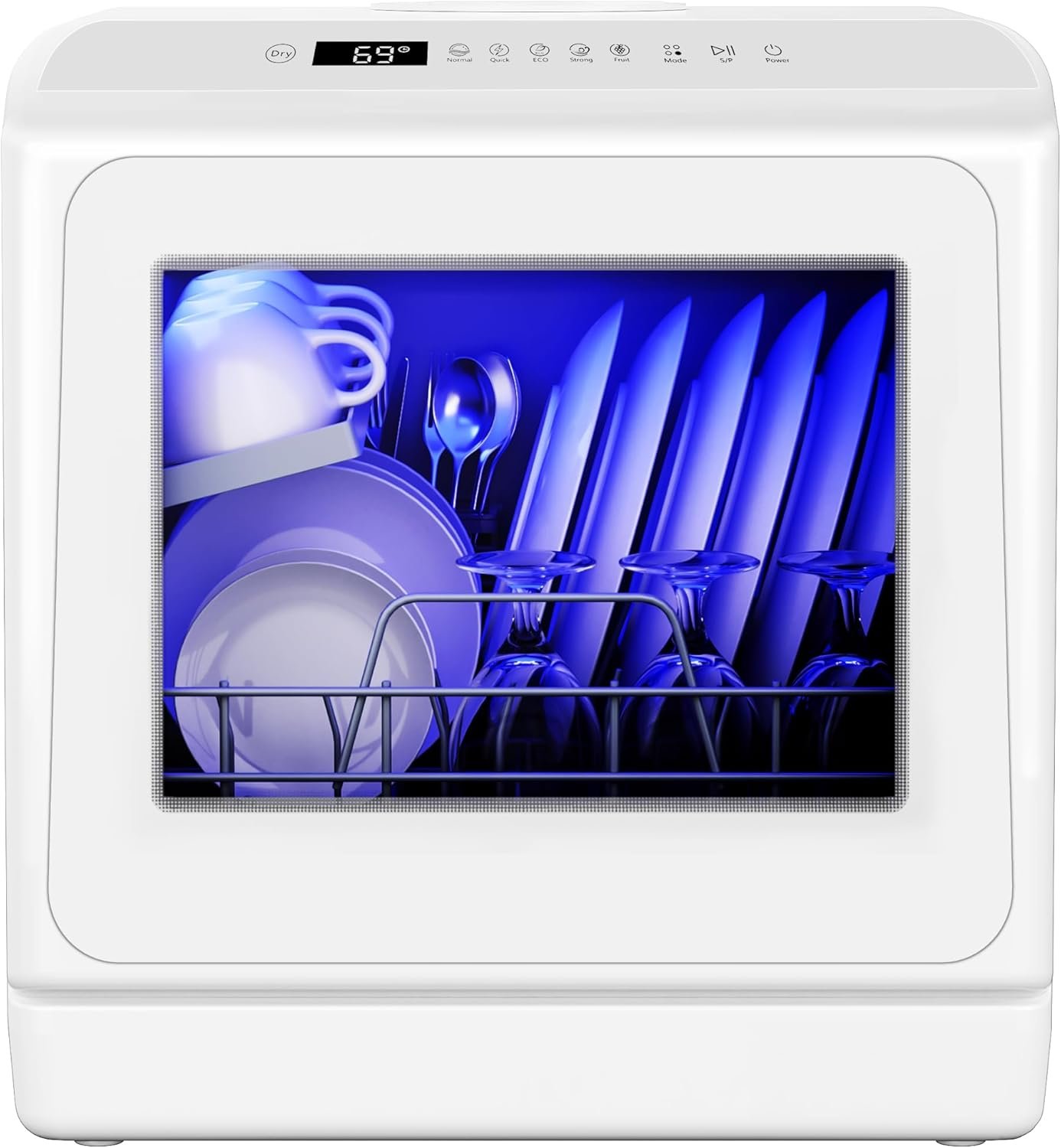
Dishwasher selection influences day-to-day kitchen workflow, household water and energy use, and noise exposure in shared living spaces. For apartments, dorms, RVs, and small kitchens, a countertop unit must balance cleaning performance with space constraints and user habits. Key decision factors include the machine’s ability to remove food soils and sanitizing residues, the rack layout relative to typical dishware, the unit’s acoustic footprint near living areas, and how drying and ventilation control residual moisture. Buyers who prioritize low water usage and predictable maintenance will evaluate reservoir capacity, indicated water use per cycle, annual energy figures, and filter access. Noise-sensitive households should compare published decibel ratings and understand that build materials and pump design influence perceived sound. Ease of connection—tank mode vs faucet hookup—also affects suitability for renters and intermittently used kitchens. This review describes how the EUHOMY DW001-5A aligns with those criteria using stated specifications, materials, and common appliance engineering principles.
Quick Overview
| Feature | Details |
|---|---|
| Dishwasher type | Countertop portable (no permanent hookup required) |
| Capacity / place settings | Interior accommodates plates up to 10.25″, holding an estimated 30 items (4 large plates, 4 small plates, 4 small cups, 4 bowls, 2 glasses, 7 sets of cutlery) |
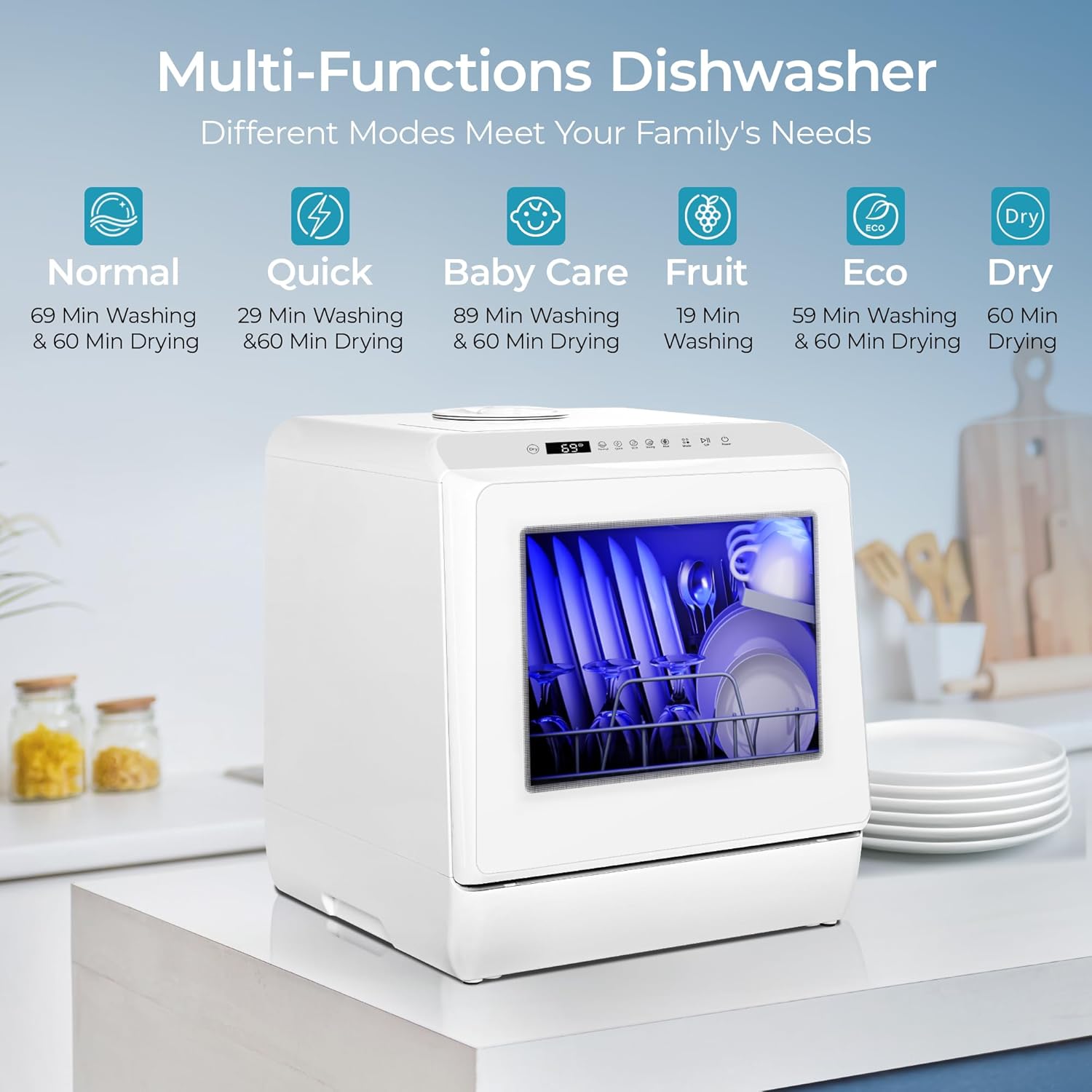
| Wash cycles | 6 programs: Normal, Quick (29 min), ECO, Baby Care/Strong, Fruit, Dry |
| Cleaning technology | Dual 360° spray arms, touch controls, LED interior light |
| Drying method | 60-minute hot air drying plus extended automatic ventilation (73 hours) |
| Noise level | Rated at 40 decibels |
| Energy / water efficiency | Annual energy: 106 kWh/year; built-in 5L reservoir per tank (approx. 1.32 gallons) |
| Dimensions & installation | 16.85″D x 16.73″W x 18.03″H; countertop placement; two water supply modes: tank and faucet |
| Materials & safety | ABS and PP plastic interior/racks; ETL and DOE certifications |
| Warranty & components | 1-year warranty; includes inlet and drain hoses, adapter, cutlery basket |
The specification set positions this unit for small households that need a self-contained cleaning appliance without a fixed plumbing hookup. Tank mode enables portable use where faucet access is limited, while faucet mode allows continuous refill for longer loads; compact dimensions make it suitable for small counters but capacity should be matched to typical dish loads to avoid overfilling or repeated cycles.

Cleaning performance and wash coverage
Cleaning efficacy for a compact unit depends on spray arm design, water temperature, cycle duration, and filtration. The DW001-5A uses a dual spray arm system rated for 360° coverage, which, combined with its high-temperature Baby Care/Strong cycle at 167°F, targets sanitizing and grease removal through thermal and mechanical action. Shorter cycles such as the 29-minute Quick mode rely on higher agitation and detergent concentration, while ECO and Normal cycles trade time and temperature for energy efficiency. The small interior and close spray arm proximity can increase impingement force on items compared with larger machines, improving cleaning on smaller loads but requiring careful loading to avoid shadowing. Plastic rack materials and the included cutlery and fruit baskets influence water access and turbulence; dense stacking will reduce coverage and may require pre-rinsing or selecting a stronger program.

Spray systems, pressure, and coverage
Spray arm geometry and pump capability control water distribution and impingement velocity. Dual 360° spray arms increase the chance of reaching horizontally and vertically oriented items in a compact cavity by generating intersecting jets that encourage turbulent flow. In a small chamber, jets reflect off nearby surfaces, potentially improving soil removal compared with wider machines at equal pump power. However, consistent performance depends on unobstructed spray paths; large utensils or overlapping plates can create shadow zones. Detergent selection also affects surfactant activity—manufacturer guidance to use dishwashing detergent is important for chemical action. For heavier soils, the Baby Care/Strong or Intensive-equivalent settings that combine elevated temperature and longer soaking will provide more reliable removal.
Filtration, soil removal, and maintenance
Filtration design determines how well particles are contained and how often the system needs attention. Plastic basket and rack materials simplify cleaning but can trap food in corners; an accessible removable filter is essential for routine debris removal and to prevent redeposition on dishes. The product includes a drain hose for forced drainage and mentions waterproof testing; regular inspection of inlet/drain hoses and the base for pooling will protect pump seals and prolong motor life. Recommended maintenance intervals align with appliance norms: remove and rinse the filter after multiple cycles with noticeable food residue, check spray arm ports for obstruction, and inspect hoses for kinks or mineral buildup when using faucet mode.
Temperature, sanitization, and detergent considerations
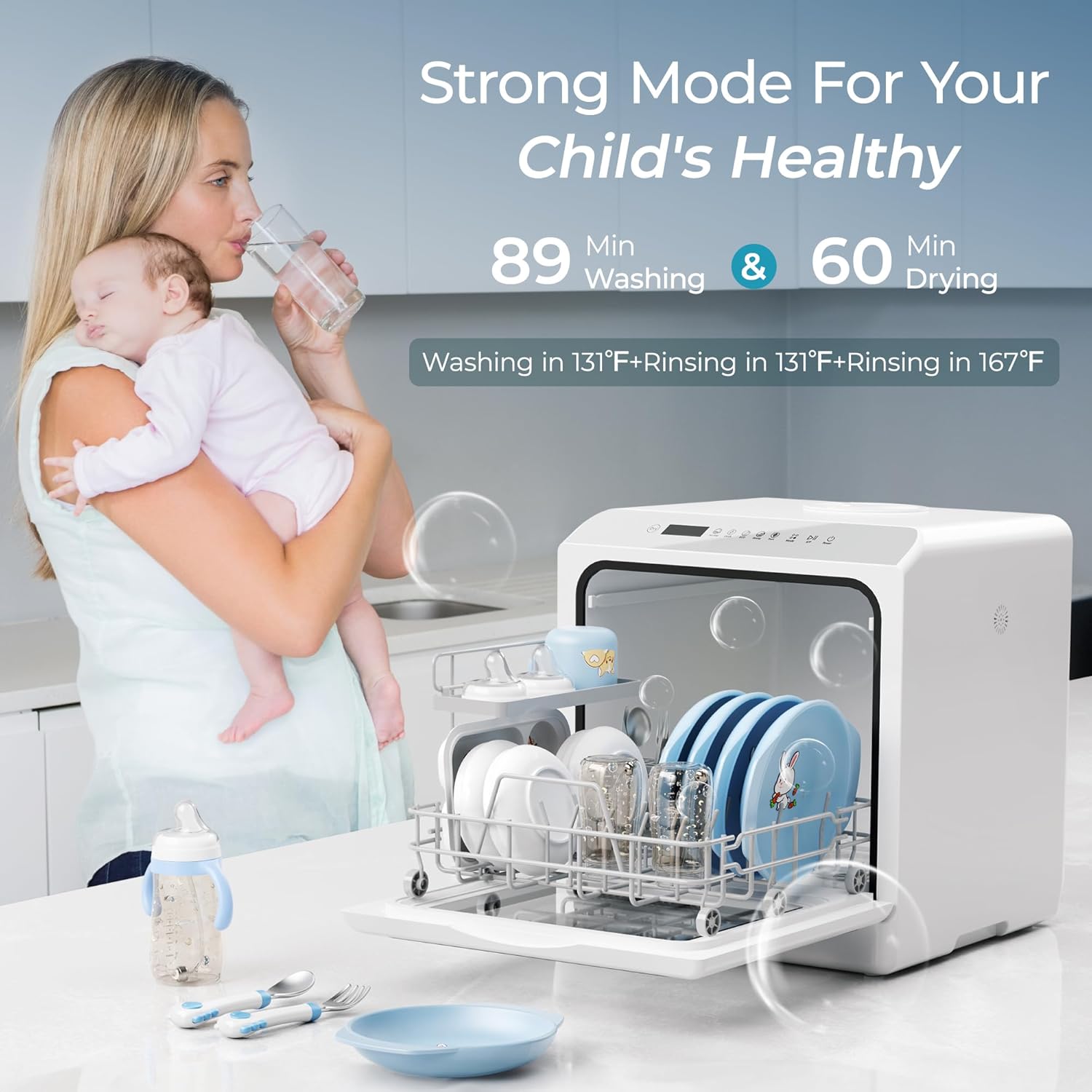
High-temperature cycles increase thermal sanitization and help dissolve greases and protein residues. The Baby Care/Strong program reaching 167°F is suitable for higher sanitization needs for infant feeding items, but effectiveness depends on cycle duration and detergent chemistry. Lower-temperature ECO cycles reduce energy use but may require more mechanical action or stronger detergents for comparable cleanliness. Fruit and delicate modes are intended for lighter soils and should be used with gentle detergents to avoid foaming. Manufacturer instructions to use dishwasher-specific detergent are consistent with avoiding foaming and ensuring proper filtration and pump performance.
Capacity, rack design, and place settings
Capacity considerations for countertop units revolve around internal layout, maximum plate diameter accommodation, and how many varied items can be staged per cycle. The DW001-5A lists a capacity example of multiple plates, cups, bowls, and cutlery with plate support for up to 10.25-inch dishes. Plastic racks and a dedicated cutlery basket offer modularity but will handle fewer large serving pieces than full-size models; a kettle and fruit basket are noted accessories, which supports versatility for small-item washing. Rack pitch, tine spacing, and the ability to fold or reconfigure tines influence how bowls and glasses sit relative to spray arms, affecting both cleaning and the risk of chipping. For households that load a mix of dinnerware and occasional pots, testing typical load patterns against the stated capacity will inform whether single-cycle throughput or multiple cycles per day are needed.

Rack arrangement, accessory use, and loading tips
Plastic rack tines and dedicated holders for cutlery and small cups enable organized loading but are less tolerant of heavy cookware. The presence of a fruit basket and kettle cradle suggests intentional space for nonstandard items, which can be an advantage for users who wash baby items, pet bowls, or small utensils. Proper orientation—facing concave surfaces downward and tilting glasses—improves drainage and spray access. Avoiding stack overlap and positioning taller items away from spray arm arcs reduces blocking. For mixed loads, placing heavily soiled items on the lower area closest to the main spray arm and lighter items on upper positions generally improves outcomes.
Effective place settings and throughput expectations
Stated capacity equates to roughly 7 place settings in compact terms, but real throughput depends on item mix and soil level. Small households and couples will often run near-full loads to maximize water and energy efficiency, while larger households may find the unit best as a secondary appliance. The 5L reservoir supports multiple cycles before refill in tank mode, but continuous faucet mode enables back-to-back cycles without interruption. Matching cycle selection to load size—Quick for light, mixed-use loads and Normal or Strong for heavier or more soiled ware—helps manage daily dish turnover while keeping repeat cycles minimal.
Limitations for large cookware and specialty items
Countertop form factors restrict clearance height and internal volume, limiting the ability to wash large pots, sheet pans, or oversized serving platters. The appliance’s plastic racks also place limits on repeated exposure to heavy pots, which may warp or stress tines over time. Specialty items requiring flat drying or long drying cycles may not fit or may need to be towel-dried after an economy run. Users who regularly cook for large groups or who use many oversized items should consider full-size units or complementary washing strategies.
Noise levels and suitability for open kitchens
Noise output for dishwashers is commonly reported in decibels, but perceived loudness in a living space depends on frequency content, vibration isolation, and distance. The unit’s 40 dB rating positions it in the quiet range for compact machines, making it suitable for open-plan environments where moderate background noise is acceptable. Material choices—ABS and PP—and internal pump mounts contribute to vibration damping; however, countertop placement on different surfaces will alter transmitted sound. Shorter quick cycles produce bursts of higher acoustic activity, while longer eco modes typically run at steadier, sometimes lower sound levels. For noise-sensitive settings, placing the unit on a rubber mat and ensuring hoses and vents are secured will reduce rattles and resonance.

Decibel rating context and perception
A 40 dB rating provides a reference that is lower than conversational levels in many kitchens, but perception varies by frequency and the human ear’s sensitivity. Lower-frequency pump hums travel farther and penetrate cabinetry more than higher-frequency spray noise. In open-plan apartments or studio layouts, the unit’s quiet rating supports daytime use without overwhelming normal activities; at night, brief spikes during drainage or pump acceleration might be noticeable. Comparing decibel ratings across manufacturers helps, but attention to installation surface and proximity to sleeping areas yields practical noise mitigation.
Installation surface, vibration isolation, and placement tips
Countertop placement directly affects vibration transfer. Placing the dishwasher on a stable, level surface and using rubber feet or a thin anti-vibration mat reduces transferred energy to cabinets or counters, which can otherwise amplify perceived sound. Ensuring hoses are not tugging against cabinetry and that the appliance is not touching walls will prevent sympathetic vibrations. Manufacturer-supplied inlet and drain hoses should be routed to avoid tension and kinks, both to preserve quiet operation and to protect seals.
Cycle selection and noise trade-offs
Faster cycles often require higher pump speeds and exhibit louder short-term noise, while ECO cycles may be quieter but longer. Buyers who require minimal daytime disruption can choose ECO or Normal modes for typical loads and reserve Quick or Strong cycles for urgent or heavily soiled items. Awareness that drying fans or ventilation in the post-wash period can run for extended intervals—this model includes long ventilation periods—helps set expectations for residual sound after the wash finishes.
Drying systems and moisture control
Drying performance reflects the chosen method—condenser, vented hot air, or fan-assisted heating—and how the cycle integrates with residual ventilation. The DW001-5A specifies a 60-minute hot air drying phase followed by up to 73 hours of automatic ventilation, which aims to reduce trapped moisture and odors after the wash. Hot air drying accelerates water evaporation from dish surfaces but increases energy draw compared with passive or condensation drying; extended low-power ventilation assists moisture removal and air exchange when the unit remains closed. Effective drying also depends on loading orientation to allow water to drain away from crevices, the use of rinse aids in lower temperature cycles, and the avoidance of tightly nested items that trap water. Fruit mode excludes drying, likely to avoid heat-sensitive produce exposure.

Hot air drying vs condenser or passive drying
Hot air drying uses a blower and heating element to move warm air across surfaces, improving drying speed and reducing spotting but consuming additional energy. Condenser or passive drying relies on residual heat and condensation within the cavity, consuming less energy but requiring longer open-door ventilation or towel-drying. For apartments and settings where immediate dry dishes are preferred, hot air drying provides convenience; for users prioritizing energy efficiency, reliance on ECO cycles with manual airing may be more suitable. Manufacturer claims of extended ventilation indicate an attempt to balance post-cycle moisture control with occupant convenience and odor prevention.
Moisture control, ventilation, and odor prevention
Automatic ventilation periods exchange internal air to reduce humidity and volatile odor compounds after washing. The extended 73-hour ventilation window suggests intermittent or low-power fans cycling to slowly dry internal surfaces and prevent stale smells when the unit is unused. Moisture control also depends on gasket design, door seal gaps, and how the unit is stored; leaving the door slightly ajar after a cycle when safe can accelerate drying. For baby items and glassware, ensuring the chosen cycle includes drying or following with a short hot-air-only run will reduce the chance of residual dampness.
Drying impacts on fragile items and energy use
High-temperature drying and prolonged ventilation may affect delicate plastics or coatings over time; manufacturer materials (ABS, PP) are durable but repeated thermal cycling can accelerate wear. For heat-sensitive items, selecting a no-dry or low-heat program and then towel-drying is an option. Energy-conscious households should be aware that active drying increases per-cycle energy consumption versus passive drying methods; the annual energy figure should be weighed with the frequency of hot-air usage when comparing long-term efficiency.
Pros & Cons
Pros
- Compact, self-contained design with tank and faucet modes: The 5L built-in reservoir and optional faucet hookup provide flexibility for renters and users without permanent plumbing, enabling use in apartments, dorms, and RVs. This reduces installation complexity and adapts to intermittent kitchen access.
- Multiple wash programs including high-temperature cycle: Six program options, including a Baby Care/Strong cycle at 167°F and a 29-minute Quick mode, allow selection tailored to soil level and sanitization needs, improving versatility for mixed household demands.
- Dual 360° spray arms for enhanced coverage: The dual spray arm configuration increases the likelihood of uniform water distribution within the compact cavity, improving cleaning performance for closely spaced items when loaded correctly.
- Quiet operation rated at 40 dB: The low decibel rating supports use in open-plan living spaces and near living areas, minimizing disruption during typical daytime operation.
- Built-in drying and extended ventilation: A 60-minute hot air drying phase plus prolonged ventilation helps control residual moisture and odors, providing convenience for users seeking ready-to-use tableware.
- ETL and DOE certifications with a 1-year warranty: Recognized safety and energy program certifications paired with a warranty provide baseline assurance regarding compliance and manufacturer support.
- Lightweight and portable at 28.6 lbs: The unit can be relocated as needed, which is beneficial for flexible living spaces.
Cons
- Limited capacity for large cookware: The compact internal volume and plastic racks limit the ability to wash large pots, sheet pans, and oversized serving pieces, making it less suitable as a primary unit for larger households.
- Plastic rack and component materials: ABS and PP are durable and lightweight but may show wear over time with frequent high-temperature cycles and exposure to heavy items, potentially reducing long-term resilience compared with stainless-steel interiors.
- Extended ventilation may still allow residual odors if loading or maintenance is neglected: Proper filter cleaning, unobstructed drainage, and periodic airing remain necessary to prevent stale smells despite automated ventilation.
- Faucet adapter requirement for some taps: Faucet mode compatibility depends on a G3/4-inch connection; buyers with different tap fittings will need to procure an adapter, adding a small barrier to immediate hookup.
Final Verdict: Who This Dishwasher Is Best For (and Who Should Skip It)
The EUHOMY DW001-5A countertop dishwasher suits small households prioritizing portability, quiet operation, and versatile cleaning programs without a fixed plumbing connection. It is a practical option for one- to three-person apartments, dorms, RVs, and shared kitchens where counter space is available and loads are composed mainly of plates, bowls, glasses, and small cookware. The combination of a 5L reservoir, dual spray arms, and a high-temperature sanitizing mode addresses hygiene needs for baby items, pet bowls, and daily dishware, while the 40 dB rating supports use in open-plan living areas with minimal disturbance.
This model is not recommended as a primary solution for families that routinely wash large pots, frequent bulk cooking equipment, or extensive serving ware due to limited internal clearance and plastic rack constraints. Buyers focused on the longest possible durability or stainless-steel interiors should consider full-size alternatives. Additionally, those who require strict energy-minimization may wish to moderate use of the hot-air drying feature and compare annual energy figures against competing models to align with efficiency goals.
Frequently Asked Questions (FAQs)
How many place settings can this countertop dishwasher handle?
The manufacturer provides a sample capacity that accommodates approximately 30 small items—equivalent to several plates, bowls, cups, glasses, and cutlery—often described as the equivalent of around 7 compact place settings. Real-world throughput depends on item sizes and loading patterns; large pots or oversized platters will reduce the number of place settings that fit in a single cycle.
Is the unit suitable for apartments and RVs without a permanent water hookup?
Yes. The unit supports two water supply modes: a built-in 5L reservoir for tank-mode operation and a faucet mode using the included inlet hose. Tank mode allows use where faucet hookup is not available, while faucet mode enables continuous refill for consecutive cycles. Faucet compatibility may require an adapter if the tap thread differs from the G3/4-inch connector.
How quiet is the dishwasher during operation?
The dishwasher carries a 40-decibel noise rating, which places it in the quiet range for compact appliances. Perceived loudness depends on surface mounting and room acoustics; placing the unit on a level, vibration-damping surface and securing hoses reduces rattles and transmitted noise, improving suitability for open-plan living spaces.
Does the dishwasher sanitize baby bottles and feeding items?
The appliance offers a high-temperature Baby Care/Strong program reaching around 167°F, which uses elevated water temperature and mechanical action to remove soils and assist sanitization. Effectiveness for sanitizer-level claims depends on cycle duration, detergent chemistry, and proper loading; follow manufacturer guidance for detergent selection and loading to optimize cleaning of infant feeding items.
What maintenance is required to keep performance consistent?
Routine maintenance includes emptying and rinsing the removable filter after cycles with heavy food debris, checking spray arm ports for clogs, inspecting inlet and drain hoses for kinks or mineral buildup, and wiping seals and interior surfaces to prevent residue. Regular maintenance preserves pump life and prevents redeposition of soils on dishes.
How effective is the drying system and does it use a lot of energy?
The unit uses a 60-minute hot-air drying phase followed by extended low-power ventilation to control residual moisture and odors. Active hot-air drying improves speed and reduces spotting but increases per-cycle energy consumption compared with passive or condenser drying. Users balancing energy use and convenience can opt to skip active drying on low-soil loads or use ventilation-only settings where available.
Are there items that should not be washed in this dishwasher?
Large cookware such as oversized pots, sheet pans, and very long utensils may not fit due to limited internal clearance. Heat-sensitive plastics and certain delicate stemware may also be affected by high-temperature cycles or hot-air drying; selecting gentler cycles or hand-washing those items is advisable to prevent warping or damage.