
Why Dishwasher Choice Matters for Small Kitchens
Selecting a compact dishwasher for a small kitchen, apartment, dorm, or RV requires balancing cleaning performance, space constraints, and operational impact on daily life. Dishwashers designed for countertop or portable use target households that lack permanent plumbing connections or undercounter space; their utility is dictated by capacity relative to typical load sizes, cycle options for varied soils and delicate items, and drying strategies that limit residual moisture. Noise output and vibration characteristics matter in open-plan layouts or studio living where kitchen sounds carry. Energy and water use figures influence utility expectations and environmental trade-offs, while controls, filtration, and material choices affect maintenance frequency and longevity. Evaluating these factors against routine dish quantities, sensitivity to sound, and available counter depth helps determine whether a countertop model meets daily needs without introducing recurring operational compromises.
Quick Overview
| Feature | Details |
|---|---|
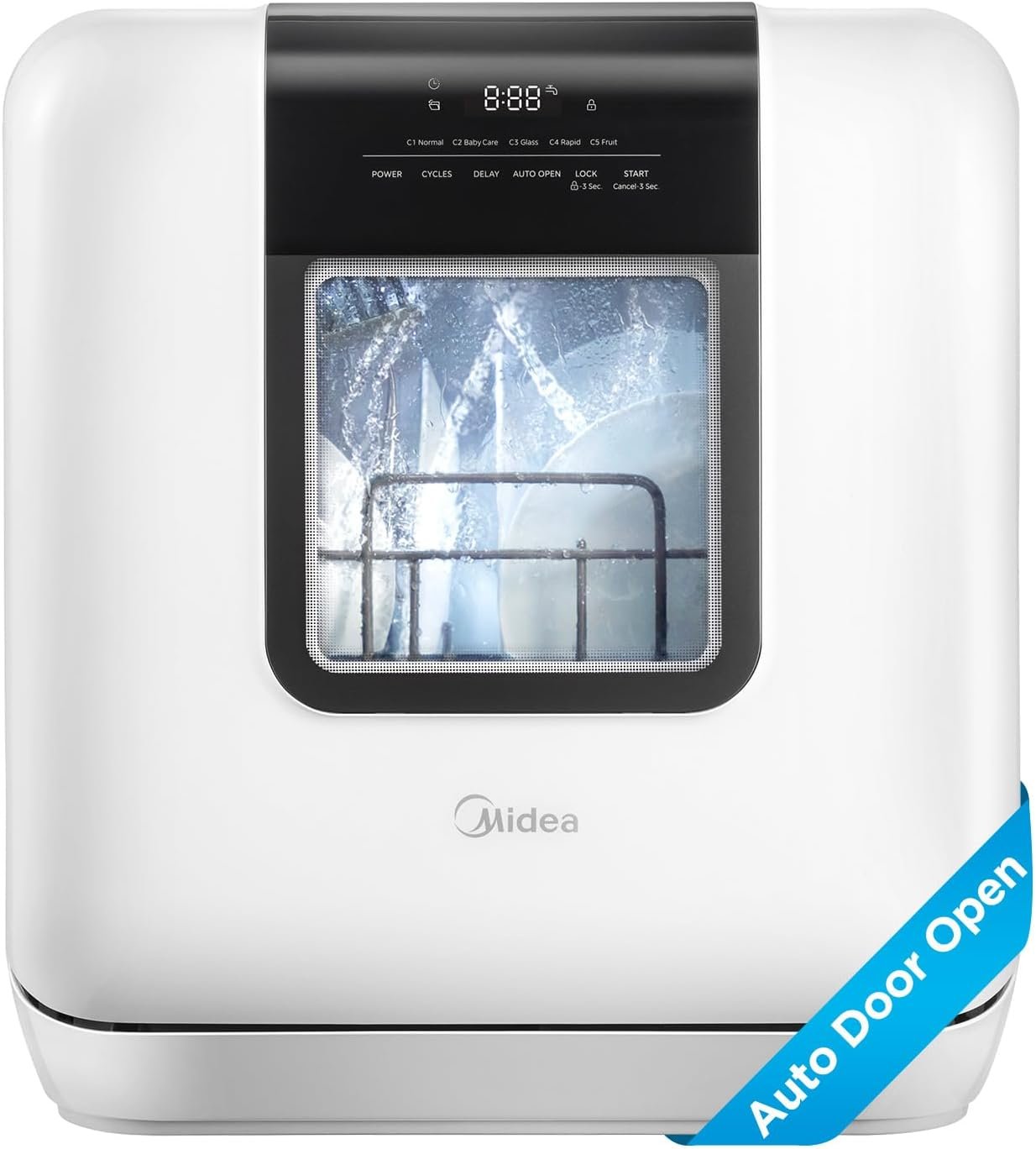
| Dishwasher type | Countertop/portable with built-in water tank |
| Capacity | Up to 10.6-inch plates; holds 30+ items; 1.59 gal built-in tank |
| Wash cycles | 5 primary wash programs (Normal, Rapid, Hygiene, Fruit, Glass) + Delay/Auto-open options |
| Drying method | Auto-open door with built-in turbofan (dual drying system) |
| Noise level | 62 decibels (manufacturer rating) |
| Energy & water | Annual energy: 150 kWh/year; water use: 1.58 gal per cycle (manufacturer) |
| Dimensions & weight | 17.5″ D x 16.5″ W x 18.44″ H; 45 lb |
| Installation | Countertop placement; manual tank filling or optional faucet/drain hose connections |
| Controls & materials | LED touch controls; plastic interior/exterior components |
| Included components | Water pitcher (filling guide), drain hose, turbofan drying system |
| Warranty | Not specified by provided specifications |
The table condenses core specifications that determine household fit: the compact footprint and built-in tank enable countertop placement without plumbing, while the listed cycles and turbofan-assisted auto-open drying aim to balance cleaning and moisture control. Energy and water figures suggest low per-cycle consumption, and the 62 dB rating provides an initial reference for suitability in shared or open living spaces.

Cleaning performance and wash coverage
Cleaning effectiveness in compact countertop dishwashers depends on spray arm design, pump pressure, cycle temperatures, and internal spray pattern coverage. The Midea countertop model lists multiple cycle types—Normal, Rapid, Hygiene, Fruit, Glass—that indicate program-specific flow and heat profiles. Spray coverage is influenced by internal volume and plate layout; smaller interiors can concentrate jets more effectively but require strategic rack placement to avoid shadowing. Filtration and soil extraction method also affect repeat rinse needs; compact units typically use a combination of coarse filters and recirculating pumps rather than multi-stage microfiltration, which can influence performance on baked-on soils. For buyers prioritizing hygiene and glass care, cycle selection and recommended loading patterns are primary determinants of expected cleaning outcomes.

Spray system, pump capacity, and wash arm configuration
Spray system performance in compact countertop units relies on pump flow rate, spray arm geometry, and nozzle placement to maintain turbulent water flow across dishes. The Midea model’s specifications do not list pump GPM directly, so expected spray coverage is inferred from cycle variety and the ability to accommodate 10.6-inch plates. Compact machines often use a single lower spray arm and strategically placed upper jets to reach stacked items; this can produce adequate mechanical action for typical food soils but may be less effective on heavily encrusted pots compared with full-size dishwashers that have multiple targeted jets. Consistent jetting and cyclical water circulation remain the primary mechanisms for detergent distribution and soil suspension in this form factor.
Filtration, soil removal, and residue management
Filtration schemes in countertop dishwashers are typically simplified compared with larger units, using a coarse removable filter to trap food particles while the pump recirculates water. The manufacturer lists included drain hose and standard filtration components; routine emptying of the sump area and cleaning of the coarse filter are essential to avoid redeposition of solids. Because these units recirculate a small volume of water (about 1.58 gallons per cycle as specified), the filtration and occasional manual debris removal play an outsized role in maintaining consistent cleaning performance. For stronger soiling, pre-rinsing or scraping can reduce filter load and improve cycle outcomes.
Cycle temperatures, detergents, and special programs
Cycle effectiveness is influenced by programmed temperatures and detergent chemistry; the presence of a Hygiene program suggests higher temperature or extended exposure aimed at microbial reduction, while Glass and Fruit cycles imply gentler temperature and reduced mechanical action to protect delicate items. Rapid cycles trade time for intensity, often reducing soak and heat to shorten cycle duration. Dishwashers of this size are engineered to work with standard dishwasher detergents and rinse aids, but detergent dosing and placement affect suds and rinse clarity. Users aiming for optimal soil removal should follow cycle recommendations and avoid overloading, which can block jets and reduce thermal transfer during heated segments of the cycle.
Capacity, rack design, and place settings
Capacity evaluation for countertop units must consider both plate diameter accommodation and total item count per cycle. The Midea portable dishwasher quotes compatibility with up to 10.6-inch plates and the ability to wash 30+ items in a single cycle, which positions it toward the higher end of countertop capacity. Interior dimensions and rack layout determine whether larger utensils, mugs, and shallow pans fit without obstructing spray arms. Plastic rack materials and fold-down tines are common in this segment to save space while offering some flexibility. The 17.5″ depth and 16.5″ width create a compact internal volume; careful loading patterns that separate plates and avoid nesting are necessary to maximize effective place settings while maintaining adequate wash coverage.

Rack configuration, flexibility, and loading strategies
Rack design in compact dishwashers balances fixed slots and adjustable tines to accommodate mixed loads. This Midea model’s specification of handling 10.6″ plates implies standard plate slots and reserve space for glassware and small bowls. Folding tines or removable baskets increase versatility for odd-shaped items, but plastic racks have limits on weight-bearing compared with metal-coated racks found in larger units. Optimal loading places taller items away from door hinges and fan outlets to avoid blocking airflow for the auto-open drying. Strategic placement of cutlery baskets to avoid jet shadowing improves rinsing efficiency and reduces the need for repeat cycles.
Realistic place settings and item types to expect
A countertop dishwasher that lists capacity as 30+ items typically counts small items—cups, utensils, and small plates—as discrete placements. Expect realistic place settings to include 4–6 full place settings for a casual household, with additional space for glassware and small cookware. Large pots, oversized baking sheets, and long utensils may not fit or may limit the number of plates that can be washed simultaneously. The internal height, door angle, and spray arm clearance are the controlling dimensions; buyers prioritizing regular washing of large cookware should consider full-size or slimline built-in models instead.
Loading for delicate items and specialized cycles
Cycles such as Glass and Fruit indicate gentler mechanical action and lower temperatures for delicate items, but careful placement remains necessary to prevent contact and chipping. Glassware benefits from stable rack placement that isolates stems and prevents movement during the wash and drying phases. Fragile plastics that are not dishwasher-safe should be excluded because plastic components and cycle temperatures may cause warping. The presence of a Babycare or Hygiene program suggests capability for higher temperature sanitization for baby feeding items, though confirm recommended cycle parameters and detergent choices when selecting cycles for sanitization goals.
Noise levels, installation placement, and open-kitchen suitability
Noise ratings provide a baseline for household impact but should be interpreted alongside operational vibration and duty cycle characteristics. The manufacturer-rated 62 dB places the unit in a moderate sound range for countertop appliances; this level is generally noticeable in quiet environments but may be acceptable in kitchens with ambient noise or for users tolerant of background appliance sound. Countertop placement on stable, vibration-dampening surfaces reduces resonance that can amplify perceived noise. For open-plan living, location relative to seating and sleeping areas matters: enclosing the unit within a cabinet or using a thicker countertop can lower perceived volume, whereas placement near open living areas will make the sound more prominent. Noise rating alone does not convey frequency distribution, which influences annoyance levels.

Interpreting the 62 dB rating and comparative expectations
A 62 dB rating represents an average sound power level under manufacturer test conditions and is higher than ultra-quiet built-in dishwashers that often rate below 50 dB. In practice, 62 dB is comparable to typical conversation levels in a busy room and can be perceptible but not intrusive for many users. Acoustic perception depends on the frequency content of the noise; high-frequency whine from fans or pumps may be more noticeable than low-frequency hum. Buyers sensitive to noise or those with sleeping areas adjacent to the kitchen should weigh this rating against alternative low-noise models.
Vibration, mounting surface, and mitigation strategies
Vibration transmission affects both noise and wear. With a 45-pound unit and plastic exterior, stable placement on a level countertop with non-slip feet is important to reduce rattles and movement during pump operation. Isolation pads or a small rubber mat beneath the dishwasher can attenuate transmitted vibration and reduce audible resonance. Ensuring the unit sits clear of adjacent cabinetry and that the drain hose and water guide are not in contact with other surfaces will also limit incidental noise caused by vibration transmission.
Suitability for open-plan kitchens and small living spaces
For studio apartments, dorms, or RVs where the kitchen is adjacent to living or sleeping areas, the 62 dB rating and fan-assisted drying activity will be a key consideration. The auto-open drying fan may operate toward the end of cycles and introduce additional sound beyond wash cycles; buyers should consider cycle scheduling for times when noise impact is minimal. In small homes where background noise is common, the unit’s operational sound profile is likely manageable, but in noise-sensitive households or where silent appliances are prioritized, a quieter built-in or a unit with a lower dB rating may be preferable.
Drying systems, energy & water efficiency, and maintenance expectations
Drying approach, energy use, and routine maintenance intersect to shape daily convenience and long-term operating cost. The Midea countertop dishwasher includes an auto-open door combined with a turbofan to vent steam and accelerate evaporative drying, a practical solution in compact cabinets with limited internal surface area. Energy and water figures—1.58 gallons per cycle and an annual energy consumption of 150 kWh as provided—suggest low per-cycle resource use, but drying strategies that use active fans will draw additional electricity. Maintenance of coarse filters, door seals, and the turbofan requires periodic inspection to maintain airflow and prevent odors. Plastic interior materials simplify weight and corrosion resistance but may be less resistant to long-term heat stress than stainless steel interiors.

Auto-open and turbofan drying: expected moisture control and limitations
The auto-open door function reduces trapped steam and encourages air exchange, improving evaporative drying compared with closed-cavity passive systems. The addition of a turbofan provides forced convection to hasten moisture removal from dish surfaces and interior walls. While effective for many loads, auto-open systems can expose interiors to ambient humidity, potentially reducing drying effectiveness in very humid environments. Additionally, forced-air drying may require items to be positioned to avoid blocking airflow; overstacked loads or tall items near the hinge can impede air circulation and prolong drying times.
Energy and water efficiency implications for small households
With a specified water consumption of approximately 1.58 gallons per cycle, this countertop dishwasher presents a lower water footprint relative to handwashing assumptions and many full-size models, making it attractive for small households aiming to minimize water use. The annual energy figure of 150 kWh gives a dataset for comparing efficiency across compact models; actual energy use depends on cycle selection and frequency. Active drying and heated cycles increase energy draw, so selecting eco-friendly or rapid cycles when appropriate can moderate consumption. Buyers should match typical cycle frequency to household routines to assess realistic annual usage.
Maintenance, filter care, and durability considerations
Maintenance tasks for countertop dishwashers generally include emptying and rinsing the coarse sump filter, inspecting door gaskets for debris that can cause leaks, and ensuring the turbofan inlet remains clear to preserve drying efficiency. Plastic interior components resist corrosion but can show wear from repeated thermal cycling; hinge mechanisms and the auto-open actuator should be inspected periodically for alignment and function. Drain hose routing and proper sealing at connection points reduce leak risk. Long-term reliability in compact units often hinges on quality of pump and motor components and adherence to recommended cleaning routines; replacement parts availability and manufacturer support are factors that influence serviceability over time.

Pros & Cons
Pros
- Compact, installation-free placement: The built-in 1.59-gallon water tank and included filling guide allow countertop placement without hard plumbing, enabling use in apartments, dorms, and RVs where permanent installation is not possible. This flexibility suits renters and small-space dwellers.
- Variety of wash programs: Multiple cycles including Normal, Rapid, Hygiene, Fruit, and Glass provide program choices tailored to common household needs, balancing soil removal and care for delicate items. Specialized cycles support glassware and hygiene-focused loads.
- Low per-cycle water use: The manufacturer-stated consumption of about 1.58 gallons per cycle is modest for dishwashing, making the unit suitable for users prioritizing water efficiency in small-load scenarios.
- Fan-assisted auto-open drying: The dual drying approach—automatic door opening plus an internal turbofan—promotes faster moisture release and reduces residual dampness compared with simple passive drying in confined interiors.
- Touch LED controls and viewing window: Digital controls and a see-through window provide operational clarity for cycle selection and progress monitoring without lifting the door during operation.
- Portable weight and footprint: At approximately 45 pounds and compact dimensions (17.5″D x 16.5″W x 18.44″H), the unit is transportable and fits shallow counters, making it practical for limited spaces.
Cons
- Moderate noise level: The 62 dB manufacturer rating is higher than many built-in low-noise models, making the dishwasher more noticeable in quiet or open living areas and potentially unsuitable where silent operation is desired.
- Plastic interior components: While lighter and corrosion-resistant, plastic interiors and racks may be less durable under frequent high-temperature cycles than stainless steel alternatives, potentially affecting long-term resilience.
- Limited heavy-soil performance: Compact recirculating systems with simplified filtration are generally less effective on heavily burnt-on or large cookware, necessitating pre-rinsing or choosing larger models for frequent heavy-duty use.
- Drying effectiveness dependent on load and humidity: Auto-open and fan drying accelerate moisture removal but can be less effective in high ambient humidity or if airflow is blocked by overloaded racks, leaving some items damp.
- Warranty and service details not specified: Manufacturer warranty information was not provided in the available specifications, which can complicate expectations for repairs and parts replacement.
Final Verdict: Who This Dishwasher Is Best For (and Who Should Skip It)
This Midea countertop dishwasher targets small households that prioritize space flexibility, water efficiency, and a variety of wash programs without committing to built-in installation. Its compact footprint and built-in 1.59-gallon tank suit renters, dorm residents, RV users, and small apartments where plumbing access is limited. The range of cycles—including Hygiene and Glass—and the turbofan-assisted auto-open drying provide practical options for mixed loads of everyday dishware and delicate glassware. However, households that regularly wash large pots, heavy cookware, or require ultra-quiet operation should consider larger or lower-noise built-in alternatives. The 62 dB rating and plastic interior materials indicate trade-offs between portability, weight, and durability compared with higher-end full-size machines.
Overall, the unit fits buyers seeking a portable, water-efficient solution for routine small to moderate loads, offering flexibility and a reasonable set of features for 2026 compact-appliance expectations. Buyers who need frequent heavy-duty cleaning, stainless steel interiors, or the lowest possible noise levels should look toward slimline or full-size integrated models instead.

Frequently Asked Questions (FAQs)
How effective is the Midea countertop dishwasher at cleaning everyday dishes?
Cleaning performance depends on spray coverage, cycle selection, and loading. The unit offers multiple cycles (Normal, Rapid, Hygiene, Fruit, Glass) that tailor mechanical action and temperature. Compact spray systems use recirculating pumps and a lower spray arm plus upper jets to produce turbulent flow; proper rack placement and occasional pre-rinsing for heavy soils improve outcomes. A coarse removable filter captures solids but requires regular cleaning to maintain consistent soil removal.
Can the dishwasher handle full-size plates and how many place settings fit?
The manufacturer specifies accommodation of up to 10.6-inch plates and capacity for 30+ items, which translates to roughly 4–6 full place settings in realistic loading scenarios. Internal rack configuration, folding tines, and basket placement determine exact fit. Large pots, oversized baking sheets, and tall utensils may not fit or will reduce total plate capacity.
Is a 62 dB noise rating suitable for open-plan living spaces?
A 62 dB rating is moderately audible and comparable to typical conversational levels. In open-plan layouts or studio apartments this level will be noticeable; whether it is acceptable depends on household noise tolerance and proximity to living or sleeping areas. Placement on a stable countertop and use during periods of higher ambient noise can reduce perceived intrusion.
How does the auto-open and turbofan drying system perform compared to heated dry?
Auto-open combined with a turbofan promotes evaporative drying by venting steam and adding forced convection, which can speed drying without relying solely on resistive heating. This approach is energy-conscious and effective for many loads, but performance can vary with ambient humidity and blocked airflow from overloaded racks. Heated dry may deliver more consistent dryness for heavy loads but uses more energy.
What maintenance is required to keep this countertop dishwasher operating well?
Regular maintenance includes emptying and rinsing the coarse filter to prevent redeposition of solids, wiping door gaskets to maintain seals, checking the turbofan inlet for debris, and ensuring drain hose routing is clear. Periodic inspection of hinges and the auto-open mechanism helps detect alignment or wear issues. Following manufacturer cleaning guidance preserves performance and reduces odor risk.
How energy and water efficient is this model for a small household?
The specifications list approximately 1.58 gallons of water per cycle and an annual energy consumption of 150 kWh. These figures indicate low per-cycle water use and a modest annual energy footprint when compared with full-size machines, especially if cycle selection and frequency align with household needs. Actual usage depends on chosen programs and operational habits.
Who should avoid a countertop dishwasher like this Midea model?
Households that frequently wash large cookware, require the quietest possible operation, or need stainless steel interiors for heavy-duty longevity may prefer slimline or full-size built-in dishwashers. The 62 dB noise rating and plastic interior components represent trade-offs for portability and weight that are less suitable for high-volume or noise-sensitive environments.