
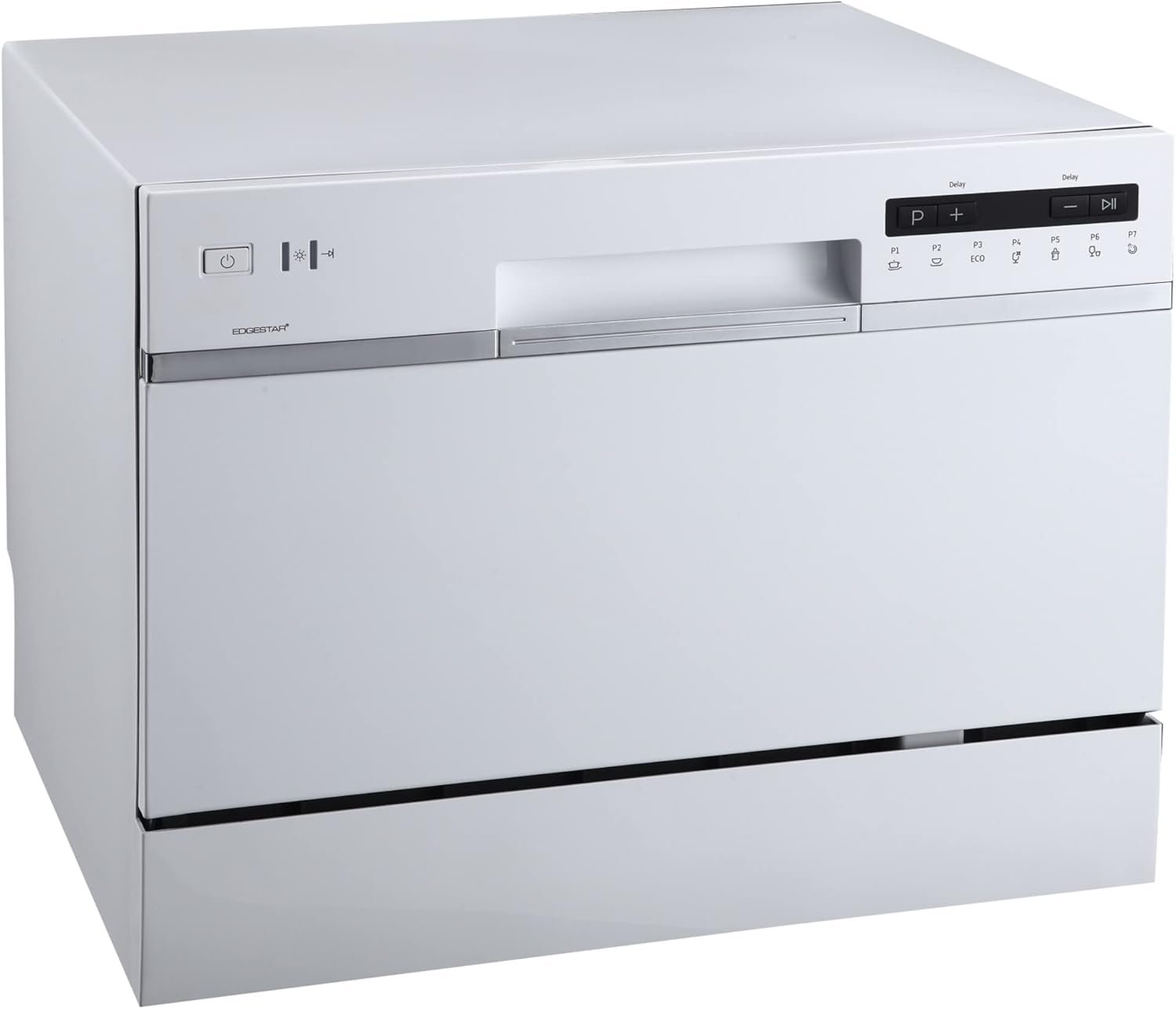
Why Dishwasher Selection Matters for Small Kitchens and Busy Households
Choosing a dishwasher affects daily routines, kitchen layout, and long-term utility expenses. For small households, apartments, or kitchens with limited cabinetry, a compact countertop unit must balance cleaning performance, water and energy use, and noise control. Frequency of use—daily versus occasional—changes expectations for cycle variety and drying capability, while sensitivity to noise influences placement and appliance style. Countertop models are judged not only on wash coverage but also on how rack design supports common tableware sizes and how easily the unit connects to existing faucets. Durability and serviceability matter when stainless interiors and motor specifications determine likely longevity. Evaluating a portable dishwasher requires matching technical specs like place settings, water consumption, power draw, and stated noise level to household needs rather than brand claims. Understanding these trade-offs helps select a unit that fits physical constraints, cleaning demands, and lifestyle priorities without overestimating capabilities.
Quick Overview
| Feature | Details |
|---|---|
| Dishwasher type | Countertop / Portable |
| Capacity | 6 standard place settings; plates up to 10.5″ |
| Wash cycles | 7 cycles (including Intensive and Normal) |
| Cleaning technology | Stainless steel interior; sanitary rinse option |
| Drying method | Not explicitly specified by manufacturer |
| Water consumption | Normal wash: 2.85 gallons |
| Noise level | 52.3 dB (manufacturer rating) |
| Power & voltage | 1160 W / 5.7 A; 120 V / 60 Hz |
| Dimensions & installation | 21 5/8″ W x 19 5/8″ D x 17 5/16″ H; countertop, quick-connect faucet adapter |
| Warranty & safety | Limited warranty; UL specifications |
These specifications indicate a compact countertop model designed for small households and temporary installations. The six-place setting capacity and 10.5-inch plate accommodation suit couples or small families with limited kitchen space, while the 2.85-gallon normal-cycle water use positions it as an efficient option relative to handwashing. The quick-connect faucet adapter simplifies temporary hookup but requires compatible faucet hardware. The stainless steel interior supports higher-temperature rinses and corrosion resistance, contributing to cleaning consistency and longevity in compact formats.

Cleaning performance and wash coverage
The EdgeStar DWP62WH lists seven wash cycles and a sanitary rinse, paired with a stainless steel interior and a 2.85-gallon normal wash water use. These specifications suggest a focus on flexible cycle selection for different soil levels, from intensive wash settings for baked-on soils to gentler cycles for glassware. Water consumption and cycle count imply engineered trade-offs between coverage and conservation: shorter cycles may use less water but rely on higher spray pressure and temperature to maintain soil removal. Stainless steel interiors help stabilize wash temperatures and resist staining, while the appliance’s 1160 W power rating supports consistent pump and heater performance. Real-world wash coverage depends on spray geometry and rack loading; the listed features indicate the unit is capable of handling typical everyday dishware when loaded according to capacity.

Wash cycles, spray behavior, and soil removal
EdgeStar specifies seven cycles including Intensive and Normal, which allows tailoring wash time, water temperature, and pump activity to soil level. In countertop designs, spray distribution is managed by one or more rotating spray arms and targeted jets; while exact spray arm count is not disclosed, the combination of a mid-range power rating and stainless interior supports effective heat retention for detergent activation. Sanitary rinse capability indicates a higher rinse temperature or extended rinse stage to assist in reducing microbial presence on dishes, in line with manufacturer disclosures. Effective soil removal in this class depends on correct cycle choice, pre-rinse practices for heavy soils, and strategic rack placement to avoid blocking spray patterns.
Filtration, detergent interaction, and stain control
Filtration in compact dishwashers typically uses a removable mesh or cartridge filter system to trap larger particles and protect the sump and pump. Although specific filter details are not provided, the presence of a stainless interior paired with a sanitary rinse suggests manufacturer attention to preventing residue buildup and maintaining rinse clarity. Detergent chemistry and water hardness influence stain control and spotting; the DWP62WH’s moderate water use places more reliance on mechanical action and rinse temperature to clear residues. Regular filter maintenance and adherence to recommended detergent dosing can improve long-term cleaning consistency and reduce redepositing during cycles.
Capacity, rack design, and place settings
Capacity metrics for the DWP62WH list six standard place settings and the ability to accommodate plates up to 10.5 inches in diameter, combined with an included dish rack, cup shelf, and cutlery basket. These elements indicate an interior layout optimized for compact usability, where careful arrangement directly affects the number of items washed per cycle. The stainless steel interior contributes to dimensional stability and load support, while the cutlery basket and cup shelf allow separation of utensils and stemware to improve spray access. In compact countertop units, the vertical clearance and rack spacing are the main constraints for larger cookware, so understanding plate diameter limits and rack configuration helps determine whether common household plates and a few small pans will fit without obstructing water flow.

Rack flexibility and loading strategies
The fixed and removable components—rack, cup shelf, and cutlery basket—offer basic flexibility for arranging diverse items. Folding tines or removable shelves are common in portable dishwashers to increase clearance for taller items; manufacturer disclosures indicate a standard dish rack plus cup shelf but do not describe fold-down features. Achieving full spatial efficiency requires placing taller items along the sides or back, keeping lightweight glassware secure, and avoiding overlap that blocks spray paths. For mixed loads, placing heavily soiled cookware on lower rack areas and delicate items on elevated shelves preserves wash performance across different load types.
Suitability for cookware, glassware, and mixed loads
The 10.5-inch plate limit and included accessories make this model suitable for everyday plates, bowls, cups, and most small to medium cookware. Larger pots, oversized baking sheets, and some tall stemware may not fit or could interfere with spray coverage. The Normal and Intensive cycle options provide the necessary range for mixed loads—delicate glassware can be cycled separately on gentler settings while pots and pans use more aggressive cycles. Users prioritizing frequent heavy cookware washing should evaluate dimensional constraints against typical cookware sizes to avoid repeated manual washing of large items.
Noise levels and suitability for open kitchens
A manufacturer-stated noise rating of 52.3 dB positions the DWP62WH within the moderate range for countertop dishwashers. Decibel ratings are measured under specific laboratory conditions and provide a comparative baseline for household appliances; in practical settings, perceived loudness depends on kitchen acoustics, adjacent room layout, and ambient activity. For open-plan layouts, a 52 dB rating is likely audible but not disruptive during active daytime use. Placement on a countertop close to seating areas or open living spaces will increase subjective audibility, whereas running cycles during higher-activity periods can mask operational sound. Consideration of vibration isolation, countertop material, and proximity to conversation zones will inform suitability in open kitchens.

Translating decibel ratings to real-world perception
Decibel ratings follow a logarithmic scale, so differences of a few decibels can change perceived loudness. At approximately 52 dB, the unit is roughly comparable to moderate background conversation or an office environment, making it noticeable but not intrusive for many households. Vibration-transmitting mounting or resonance against cabinetry can amplify perceived sound; the stainless steel interior and build quality influence mechanical damping. For noise-sensitive households or those intending to run cycles during evenings when occupants are quiet, a lower dB rating may be preferable.
Placement, installation, and ambient noise considerations
As a countertop portable dishwasher that connects via a quick-connect faucet adapter, installation flexibility is high but placement options are limited by drain routing and faucet reach. Close proximity to seating areas increases apparent noise; positioning the unit on a stable, non-resonant surface and ensuring faucet and drain connections do not transmit vibration will reduce perceived sound. The compact form factor allows relocation between uses, which can be used strategically to minimize impact on living areas during critical times.
Drying systems and moisture control
Manufacturer materials do not explicitly describe an active heated drying system for the DWP62WH, which leaves drying behavior to be inferred from comparable countertop designs and the presence of a sanitary rinse. Many compact countertop dishwashers rely primarily on condensation drying—using high rinse temperatures and stainless steel interiors to encourage water to bead and drain—rather than energy-intensive active heating elements or forced-air fans. The absence of a clearly stated drying method suggests users should expect some residual moisture on flatware and plastics unless a dedicated heated dry or rinse aid is used. Understanding the drying approach is important for households prioritizing fully dry dishes at cycle completion.

Managing residual moisture and spotting
To reduce moisture retention and spotting, common strategies include using a rinse aid to lower water surface tension, selecting higher rinse temperatures where available, and opening the door slightly at the end of a cycle if ventilation allows. Stainless steel interiors assist with faster heat transfer away from dish surfaces during cooling, which supports condensation drying. Plastics and lightweight items retain heat poorly and often remain wetter than ceramics or glass, so arranging such items where airflow is greatest and on upper racks can help. Recognizing that countertop units may not always match the drying performance of larger built-in dishwashers informs realistic expectations.
Implications for cycle selection and post-cycle handling
Choosing cycles with higher rinse temperatures or extended final rinse stages will generally improve drying results, albeit with potential increases in cycle time and energy use. For households that require fully dry tableware immediately after a cycle, manual towel drying or allowing additional air-dry time may be necessary. Inclusion of a sanitary rinse is beneficial for higher-temperature rinses that also contribute to improved drying by elevating final rinse water temperature.
Energy and water efficiency expectations
The DWP62WH specifies a normal wash water consumption of 2.85 gallons and lists energy consumption as 200 kilowatt hours (manufacturer disclosure). These figures suggest a low per-cycle water footprint typical of countertop models and an annualized energy metric that depends on usage frequency. The unit does not list an ENERGY STAR certification in provided disclosures, which means efficiency should be judged by per-cycle water use, cycle length, and energy draw (1160 W when active) rather than a third-party label. For users prioritizing conservation, the low water use per cycle is favorable, but aggregated energy consumption will vary according to cycle selection and number of runs per week.

Balancing cycle selection with efficiency goals
Lower-water cycles and eco modes—if present among the seven options—will reduce water and energy per run but may lengthen cycle times or shift cleaning reliance to detergents and higher-temperature rinses. The 1160 W heater and pump indicate moderate instantaneous power use during active stages; however, overall energy draw depends on average cycle duration and frequency. Users aiming to minimize household energy or water use should select appropriate cycles for soil level and consolidate loads to maximize items per cycle without compromising spray access.
Expectations without third-party efficiency labels
In the absence of ENERGY STAR or similar certifications, buyers should compare the DWP62WH’s stated 2.85-gallon normal wash and 200 kWh energy disclosure against competing models to assess relative efficiency. Water savings versus handwashing are often significant for compact units, but energy performance varies. Monitoring cycle times, choosing shorter or eco cycles when suitable, and avoiding excessive pre-rinsing can preserve the intended efficiency advantages of a countertop dishwasher.
Maintenance, filter requirements, and durability
The DWP62WH features a stainless steel interior and includes a cutlery basket and user manual, with UL specifications and a limited warranty noted in manufacturer disclosures. Stainless steel interiors are associated with improved corrosion resistance and structural stability compared with polymer linings, contributing to nominal long-term durability and stable wash temperatures. Compact dishwashers typically incorporate removable coarse filters to trap food particles; while specific filter type is not described, regular filter cleaning and occasional descaling are standard maintenance tasks to prevent buildup and protect the pump. The limited warranty and UL listing indicate baseline safety and manufacturer-backed coverage for common defects.

Routine maintenance and common service points
Maintenance expectations for countertop dishwashers generally include regular emptying and cleaning of filter baskets, inspecting spray arms for blockages, cleaning door seals, and using appropriate descaling agents if local water hardness warrants. The DWP62WH’s included user manual should specify filter removal intervals and approved cleaning agents; adherence to those instructions reduces the likelihood of clogging and maintains wash performance. Accessibility of components like the filter and spray arms affects ease of maintenance and potential service costs over time.
Long-term reliability considerations
Durability in compact appliances hinges on motor and pump quality, control electronics, and watertight seals. The stainless steel interior supports resistance to staining and thermal cycling, while the unit’s moderate power rating suggests balanced mechanical stress during operation. Limited warranties are common in this category; potential buyers should weigh warranty length against expected usage patterns. For prolonged reliability, attention to installation (secure, level placement and correct faucet adapter usage), regular maintenance, and adherence to load limits will help preserve performance over time.
Pros & Cons
Pros
- Compact six-place setting capacity: Supports couples and small households with dishes up to 10.5 inches, making it a practical countertop option for limited kitchens. The included dish rack, cup shelf, and cutlery basket provide organized loading and separation of items.
- Water-efficient normal cycle: A manufacturer-stated 2.85-gallon normal wash offers low water consumption relative to handwashing and some larger units, appealing to water-conscious users in apartments or rental situations.
- Multiple cycle options: Seven wash cycles, including Intensive and Normal, allow tailoring of wash intensity to soil levels and item types, increasing versatility for mixed loads.
- Stainless steel interior: Enhances heat retention, resists staining and corrosion, and tends to support better drying and longevity compared with polymer interiors.
- Portable countertop installation: Quick-connect faucet adapter and compact dimensions enable installation without permanent plumbing changes, useful for temporary or rented spaces.
- Moderate noise output: A 52.3 dB manufacturer rating is within a tolerable range for many households, balancing motor performance and convenience.
- UL specification and limited warranty: Manufacturer disclosures include safety listing and warranty coverage, providing baseline consumer protections.
Cons
- Limited capacity for large cookware: The six-place setting layout and 10.5-inch plate limit restrict washing of oversized pots, large baking sheets, and very tall stemware, which may necessitate manual washing of certain items.
- Drying method not specified: Manufacturer materials do not clearly identify an active heated drying system, which may lead to residual moisture on plastics and lightweight items without supplemental drying measures.
- No ENERGY STAR disclosure: The absence of a third-party efficiency label requires comparison of stated kWh and gallons per cycle with competing units to fully assess energy performance.
- Countertop placement can increase perceived noise: Although the 52.3 dB rating is moderate, placement near open living areas or on resonant surfaces may make operation more noticeable than freestanding built-in models.
- Faucet compatibility required: The quick-connect adapter simplifies hookup but depends on compatible faucet types and may limit placement if faucet reach is restricted.
Final Verdict: Who This Dishwasher Is Best For (and Who Should Skip It)
The EdgeStar DWP62WH is well-suited to couples, small families, and apartment dwellers seeking a portable countertop dishwasher that balances cleaning flexibility with compact convenience. Its six-place setting capacity, seven-cycle range, and 2.85-gallon normal-cycle water use make it an efficient choice for everyday dishware and glassware, while the stainless steel interior supports durability and thermal stability. The included cup shelf and cutlery basket add practical loading options for mixed household needs. Portable installation via a quick-connect faucet adapter makes it attractive for renters or those without permanent dishwasher plumbing.
Households that frequently wash large pots, oversized baking sheets, or tall stemware should consider larger built-in or freestanding models instead, as the 10.5-inch plate limit and compact interior constrain heavy cookware handling. Noise-sensitive users who require near-silent operation for open-plan living during evening hours may prefer models with lower decibel ratings. Buyers prioritizing certified energy efficiency should compare the stated 200 kWh figure and lack of ENERGY STAR disclosure against alternatives available in 2026. Overall, the DWP62WH provides a pragmatic, space-conscious option for users prioritizing portability, water savings, and basic wash versatility.

Frequently Asked Questions (FAQs)
How many place settings does the EdgeStar DWP62WH hold?
The dishwasher is specified to hold six standard place settings and accommodates plates up to 10.5 inches in diameter. The included dish rack, cup shelf, and cutlery basket are intended to maximize usable capacity for everyday dining ware while remaining compact for countertop installation.
What is the water usage per cycle for the DWP62WH?
Manufacturer disclosures list a normal wash water consumption of 2.85 gallons. This per-cycle figure positions the model as relatively water-efficient compared with handwashing and some larger dishwashers, though total household water use will depend on frequency of runs and chosen wash cycles.
Is the drying system heated or condensation-based?
The manufacturer does not explicitly describe a dedicated heated-dry system for this model. In countertop units, drying typically relies on condensation aided by higher rinse temperatures and stainless steel interiors, so some residual moisture—especially on plastics—may be expected without supplemental drying measures or the use of a rinse aid.
How loud is a 52.3 dB dishwasher in a typical kitchen?
A 52.3 dB rating is in the moderate range and is generally comparable to background conversation. Perceived loudness depends on kitchen acoustics, proximity, and ambient activity; in open-plan layouts the unit may be noticeable, while in busier kitchens the noise may be less intrusive.
Does this dishwasher require special installation or plumbing changes?
The DWP62WH uses a quick-connect adapter that fits standard-sized kitchen faucets, making it suitable for temporary or non-permanent installations without dedicated plumbing modifications. Faucet compatibility and reach should be confirmed prior to purchase to ensure convenient placement and drainage.
What maintenance tasks are recommended for long-term performance?
Routine maintenance typically includes cleaning removable filters, inspecting and clearing spray arm orifice blockages, wiping door seals, and descaling if local water hardness is high. The stainless steel interior supports easier cleaning and heat stability, and adherence to manufacturer-specified maintenance intervals helps preserve wash performance.
Is the EdgeStar DWP62WH energy efficient compared to other models?
Manufacturer materials disclose an energy consumption figure of 200 kilowatt hours but do not list an ENERGY STAR certification. Efficiency should be evaluated by comparing the stated annualized energy figure and per-cycle water use against competing models, keeping in mind that actual energy use varies with cycle choice and frequency of operation.