Quiet Portable Countertop Dishwasher for Small Households
Why dishwasher selection matters for compact kitchens
Selecting the right dishwasher is a practical decision that affects daily convenience, water and energy use, and kitchen layout. Households with limited counter space, shared apartments, or small families need a unit that balances capacity against footprint while meeting cleaning expectations for plates, glassware, and utensils. Noise sensitivity is a critical factor when placing a dishwasher on a countertop in an open-plan kitchen or studio apartment; perceived loudness and frequency of cycles affect when and where the machine can run. Efficiency expectations center on low water consumption and a heating system that delivers hygienic temperatures without excessive power draw. Durability and straightforward maintenance—access to filters, accessible spray arms, and robust materials—matter for long-term ownership. Evaluating these factors against manufacturer specifications, spray design, and common user feedback helps buyers match model features to household routines, cleaning intensity, and installation constraints.
Quick Overview
| Feature | Details |
|---|---|
| Dishwasher type | Countertop / Portable |
| Capacity | 4–6 place settings (12–20 pieces) / 7.8 L tub capacity |
| Wash cycles and cleaning tech | 3 modes: Fast (30 min/55°C), Standard (40 min/60°C), Strong (50 min/65°C); 360° rotating lower spray arm |
| Drying method | Residual temperature drying + air-cooled drying |
| Noise level | 65 dB (manufacturer specification) |
| Energy efficiency certifications | Not specified by manufacturer |
| Dimensions & installation | 17.72″ W x 15.75″ D x 17.3″ H; countertop plug-in (110V / US) |
| Warranty | Not specified |
These specifications indicate a compact solution suited for small households, rentals, or secondary kitchen spaces where full-size dishwashers are impractical. The three-cycle design and 360° spray aim to cover light to moderately soiled loads, while the slim footprint and included hose make temporary or fixed countertop placement straightforward. Noise and drying characteristics will influence suitability in open-plan rooms and for users who load the unit multiple times per day.

Cleaning performance and wash coverage
Cleaning performance for compact countertop dishwashers depends on spray geometry, water temperature, and filtration. The advertised 360° rotating lower spray arm increases spray coverage relative to static nozzles by directing pressurized jets around stacked items, which helps dislodge food particles and grease. Heat is supplied via a heating plate, and selectable cycles reach 55°C, 60°C, and 65°C, which supports detergent activation and thermal sanitation principles for common household soils. Water consumption of approximately 7.8 liters per cycle aligns with small-tub designs that rely on concentrated spray impact. Filtration and a removable internal filter are crucial in preventing redeposition; effective filtration combined with regular rinsing helps maintain wash clarity. Realistic expectations should consider load density and heavily encrusted cookware—intensive pre-soaking or separate cleaning may be necessary for large baked-on residues.

Spray arm design and targeted coverage
The rotating lower spray arm is the primary mechanism for mechanical cleaning in this model. A rotating arm with multiple orifices distributes hydraulic energy across the load, producing alternating jets that fracture and lift soils from surfaces. For optimal coverage, loading should avoid blocking the arm path and allow water to reach both sides of plates and the bowls of cups. The lower-arm-only design prioritizes a central spray pattern, which performs well for standard dinnerware and glasses but may provide less direct impingement for tall items or complex cookware. Consistent pressure between 0.04 MPa and 1 MPa within the stated operating range preserves rotation speed and jet coherence for effective results.
Heat, detergent activation, and stain removal
Thermal input from the 800W heating plate elevates wash tank temperature, which accelerates detergent chemistry and increases grease solubility. The three cycle temperatures—55°C, 60°C, 65°C—give users a graded approach: lower temperatures conserve energy and handle light soils, while higher temperatures support removal of fatty residues and improved drying potential through residual heat. Strong-cycle timing at 50 minutes provides longer exposure and mechanical agitation time for stubborn soils. However, thermal performance relies on initial inlet water temperature and load size; smaller, well-spaced loads reach and maintain target temperatures more efficiently than densely packed baskets.
Filtration, soil separation, and filter maintenance
A removable and washable internal filter is integral to reducing redeposition of particles during recirculation. The filter traps food fragments before the pump, protecting spray nozzles and preventing coarse material from reattaching to dishes. Regular removal and rinsing of the filter prevent odors and maintain hydraulic flow rates; user guidelines typically recommend inspection after heavily soiled cycles. The presence of a practical filter accessible from the tub bottom simplifies routine maintenance. Effective filtration also reduces strain on the pump and helps maintain consistent spray pressure over time, contributing to durable cleaning performance.
Capacity, rack layout, and place settings
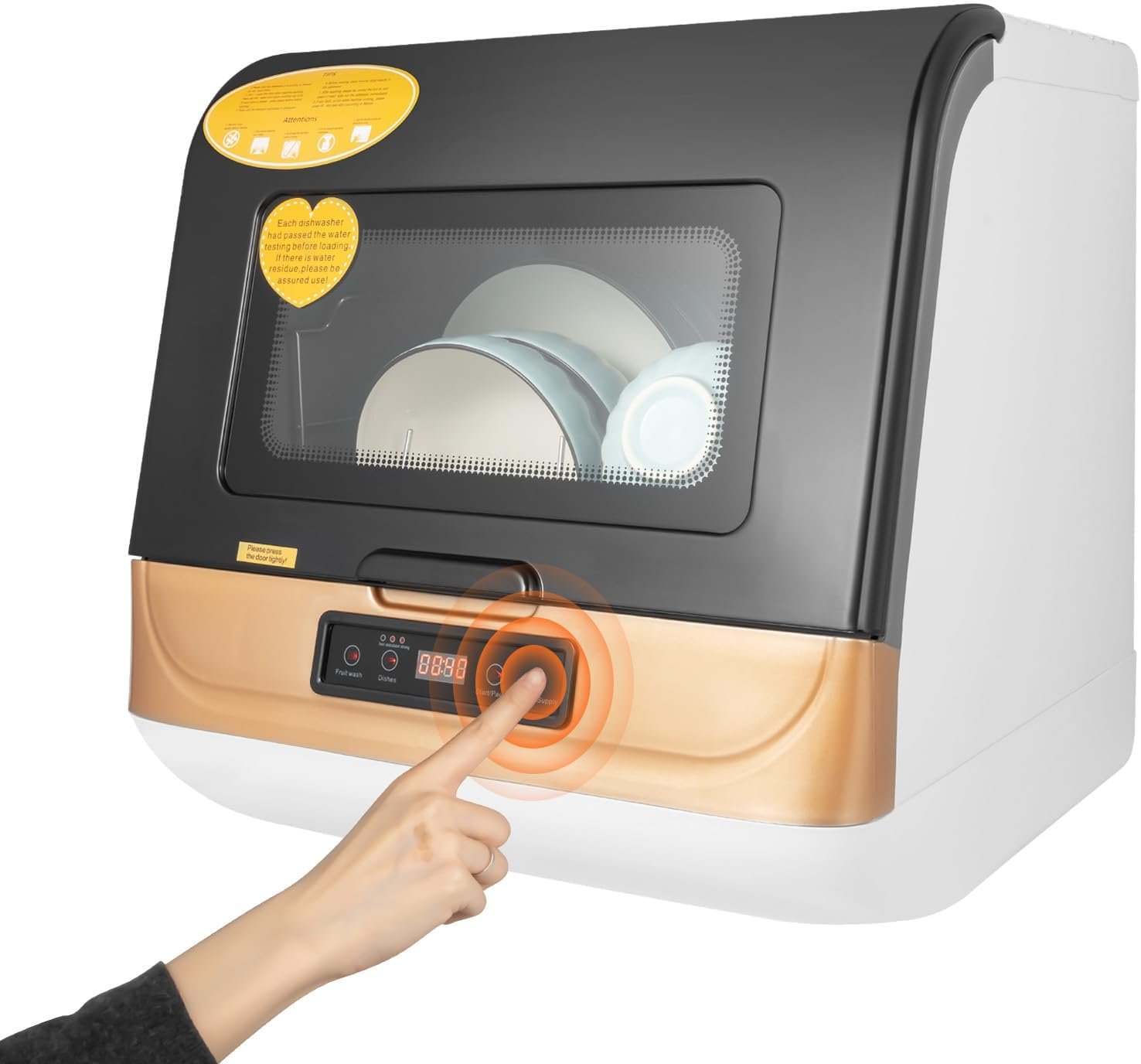
Compact countertop units must balance physical footprint, usable volume, and load versatility. This model lists a capacity of 4–6 place settings (12–20 pieces) within a 7.8 L tub, which is typical for small dishwashers where vertical clearance and internal width constrain arrangement. Rack geometry and cutlery holders determine the number of plates, bowls, cups, and utensils that can be securely positioned for spray access. The transparent lid and upward flip design allow visual confirmation of placement without interrupting cycles. Users should plan loads to avoid overlapping items, limiting tall stemware or oversized pots. The supplied internal layout is optimized for everyday tableware but will require strategic stacking for mixed loads to ensure spray reach and avoid shadowing.

Plate spacing, cup placement, and cutlery handling
Effective spray coverage requires consistent spacing between plates and cups so jets can reach exposed surfaces. Racks sized for compact machines often include fixed prongs or molded slots that support upright plates and inverted cups. Cutlery placement benefits from separate baskets or slots that present flat surfaces to spray rather than dense clusters; separating forks, spoons, and knives reduces nesting and improves both cleaning and drying. For small items such as chopsticks and small spoons, securing them horizontally or in a designated tray reduces the risk of obstruction. Heavier or oddly shaped items should be placed on the bottom with consideration for spray arm clearance.
Using a compact dishwasher for mixed items and produce
Manufacturer notes indicate suitability for tableware, utensils, and light produce cleaning. Mechanical spray and moderate temperatures can remove light soils and residues from fruits and vegetables, but sanitary considerations suggest using a dedicated wash or a rinse cycle for delicate produce. Glassware and stemware require careful placement to prevent tipping and thermal shock from high-temperature cycles. Cookware with heavy baked-on residues may not reach desired cleanliness in a single compact cycle; pre-soaking or pre-scraping is advisable. The compact tub favors standard dish sets and everyday use rather than large pans and casserole dishes.
Loading strategies for frequent small loads
Countertop dishwasher users often run multiple small loads rather than a single large one. Load strategies that prioritize airflow and expose soiled surfaces to the spray arm—placing plates along the circumference, nesting cups at angles, and separating cutlery—improve per-cycle effectiveness. Given the modest 7.8 L capacity, consolidating similar items (e.g., all glasses or all plates) maintains consistent spray dynamics and temperature retention. Routine inspection of the filter and spray arm before consecutive cycles ensures debris buildup does not reduce wash pressure or performance.
Noise, drying systems, and moisture control
Noise level and drying approach are decisive factors for countertop installations in open-plan living spaces. This model specifies a noise rating of 65 dB, which is audible in adjacent living areas but less intrusive than older pump designs; perceived loudness depends on room acoustics and placement height. Drying is handled through residual-temperature drying augmented by air-cooled drying, where retained heat and internal airflow reduce surface moisture. Residual-temperature drying leverages the heat from the wash and heating plate to evaporate water, while air-cooled drying uses ambient airflow to carry moisture away. For efficient moisture control, door seals, internal stainless steel framing, and venting paths reduce condensation, but complete dryness for plastics can remain challenging without heated or active drying elements.

Interpreting the 65 dB rating for apartment and open kitchens
A 65 dB rating places the unit in a mid-range audible category—louder than quiet built-in models marketed below 50 dB but comparable to many portable units. In a small studio or open-concept kitchen, 65 dB will be noticeable during operation and may overlap with conversation levels. Placement on a solid countertop and isolation from thin cabinetry can reduce vibration transmission. For noise-sensitive households or those requiring overnight operation, lower-decibel models or delayed start during daytime hours may be preferable. Acoustic impact also depends on measure standards and the distance between the dishwasher and living spaces.
Residual-temperature drying and air-cooled drying behavior
Residual-temperature drying uses retained heat after the final rinse to promote evaporation; this passive method conserves energy compared to active heated drying but is less aggressive on plastic items. Air-cooled drying introduces ambient air circulation to carry evaporated moisture out of the tub, improving finish on glass and ceramic surfaces. Combined, these methods reduce energy consumption while delivering acceptable dryness for most tableware. Expect some residual droplets on matte plastics or deep cutlery recesses; manual towel drying or brief open-lid airing may be necessary for complete dryness.
Moisture management and prevention of odors
Moisture control is closely tied to filter cleanliness, tub material, and drying strategy. Stainless steel framing inside the tub resists staining and retains less odor-prone residues than some coated plastics. Regular filter removal, emptying the sump of collected solids, and leaving the lid ajar after cycles help reduce residual humidity and microbial growth. Because the filter is removable and washable, routine maintenance mitigates odors associated with trapped food particles and standing water. Venting via the air-cooled cycle also limits condensate accumulation when the unit is used frequently.
Efficiency expectations, maintenance, and durability
Water consumption near 7.8 liters per cycle positions this portable model as materially efficient versus hand-washing and many older units; however, energy efficiency certification is not provided, so power draw and annual usage depend on cycle selection and frequency. Rated power is 800W with heating plate operation across cycles—higher-temperature cycles will increase energy use proportionally. Maintenance centers on the removable internal filter and periodic inspection of spray arm orifices for clogs. Construction materials including ABS, PP, and stainless steel framing suggest a balance of lightweight external housing and durable internal structure. Long-term reliability will correlate with user maintenance habits, water quality, and adherence to manufacturer recommendations for inlet connections and pressure range.

Water and energy profile expectations
The 7.8 L per-cycle water consumption suits small households and short cycles; combining that with 30–50 minute cycle times provides flexibility for light or more intensive cleaning. Energy use concentrates on the heating plate—shorter fast cycles at 55°C consume less energy than the strong 65°C program. Without third-party energy labeling, expected annual energy depends on run frequency; buyers should consider cycle selection and ambient inlet temperature. For areas with hard water, mineral buildup can reduce thermal transfer and spray efficiency over time, emphasizing the need for descaling procedures where recommended.
Filter care, hose connections, and routine maintenance
A washable internal filter simplifies routine upkeep; manufacturers commonly advise inspection after dirty loads and full cleaning on a weekly or biweekly schedule depending on usage. The unit ships with a 1.47 m water hose; one end uses a G1/2 connection to the home supply and the other a G3/4 connection to the machine, requiring an adapter for varying plumbing setups. Maintaining clear spray-arm orifices, ensuring inlet strainers are free of sediment, and avoiding large food scraps reduce clogging and pump strain. Proper storage in winterized climates and avoiding unprotected outdoor hookups preserve seals and electronics.
Construction materials and indicators of durability
Internal stainless steel framing offers wear and heat resistance inside the wash compartment, while external ABS and PP panels keep weight low at about 10.2 kg net. Mechanical components such as the pump, motor, spray arm bearings, and sealing gaskets drive durability outcomes; these parts’ longevity depends on load balance, water quality, and frequency of heavy soils. The inclusion of a transparent lid and upward flip mechanism provides convenient access but introduces a hinge component that should be inspected regularly for wear. Absence of a specified warranty in manufacturer disclosures places a premium on adherence to recommended maintenance practices to extend service life.

Pros & Cons
Pros
- Compact footprint and included hose make countertop installation straightforward for small kitchens and rentals. The 17.72 x 15.75 x 17.3-inch dimensions and 7.8 L tub are designed to fit limited counter spaces while handling daily dishware.
- Three selectable wash modes with temperature control (55°C–65°C) provide flexibility for light to moderately soiled loads. Higher temperature and longer duration in strong mode improve detergent activation and stain removal performance.
- 360° rotating lower spray arm increases mechanical cleaning coverage compared with static jets. This design helps distribute hydraulic energy to multiple dish surfaces within a condensed tub.
- Residual-temperature plus air-cooled drying reduces energy consumption versus active heated drying while providing acceptable dryness for glass and ceramic items. The combined method conserves power and limits overheating of plastics.
- Removable and washable internal filter simplifies routine maintenance and reduces redeposition risks. Easy access to the filter helps maintain pump efficiency and spray pressure.
- Stainless steel internal framing improves heat resistance and reduces staining inside the tub. Metal internal components typically tolerate repeated thermal cycles better than coated plastics.
- Lightweight build and transparent flip-up lid enable visual monitoring of cycle progress without opening the machine. This can help confirm spray action and loading position.
Cons
- Noise rating of 65 dB is higher than quieter built-in models, which may be disruptive in open-plan living areas. Users sensitive to ambient noise should consider placement or timing of cycles to reduce impact.
- Capacity is limited to 4–6 place settings, which is not suitable for larger families or those who prefer one-load-per-day usage. Multiple small runs are likely for households generating more daily dishware.
- No energy efficiency certification or warranty information is provided in manufacturer disclosures. Lack of third-party labeling means energy and annual consumption must be inferred from rated power and run frequency.
- Heated drying is passive rather than active, which may leave plastics and deeply recessed cutlery partially wet. Manual towel drying or airing may be necessary for complete moisture removal.
- Hose connections use G1/2 and G3/4 fittings; additional adapters may be required for some household inlet configurations. Installation convenience depends on plumbing match and adapter availability.
Final Verdict: Who This Dishwasher Is Best For (and Who Should Skip It)
This portable 800W countertop dishwasher suits small households, studio apartments, and secondary kitchens where space is constrained and convenience matters more than maximum capacity. The unit’s 360° rotating spray arm, three temperature-graded wash cycles, and removable filter align with common domestic cleaning needs for everyday plates, cups, and utensils. Residual-temperature plus air-cooled drying conserves energy and achieves acceptable dryness for ceramics and glass, while the stainless steel interior elements enhance durability for recurring thermal cycles. The compact footprint and included hose make countertop placement practical without cabinet modification, making it an appealing option for renters and users seeking a self-contained solution.
Conversely, this model is less suitable for larger families, households that frequently clean bulky cookware, or noise-sensitive environments where sub-50 dB operation is desired. Absence of a specified energy certification and warranty requires buyers who prioritize certified efficiency or extended manufacturer support to consider alternative models. For those in areas with hard water or heavy daily loads, attention to filter maintenance and periodic descaling will be essential to preserve performance over time. Overall, the dishwasher provides a balanced, space-efficient option for small-scale daily dishwashing needs in 2026, with clear limitations tied to capacity and acoustic profile.
Frequently Asked Questions (FAQs)
How many place settings fit in a compact countertop dishwasher?
Compact countertop dishwashers typically accommodate 4–6 place settings depending on rack design and item sizes. This model specifies a capacity of 12–20 pieces, which suits daily loads of plates, bowls, cups, and utensils when arranged to avoid overlap and obstruction of the spray arm. Larger pots and oversized items may require separate cleaning or pre-rinsing.
Is a 65 dB noise rating acceptable for open-plan kitchens?
A 65 dB rating is audible and may be noticeable in open-plan layouts; it is louder than quiet built-in models that advertise sub-50 dB operation. Placement on a solid countertop and distance from living areas can reduce perceived noise. For noise-sensitive households, scheduling cycles during daytime or choosing a lower-decibel model may be preferable.
Will the dishwasher dry plastic items completely?
Drying is provided by residual-temperature drying plus air-cooled drying, which conserves energy but is less aggressive than active heated drying. Glass and ceramic items often reach acceptable dryness, while plastics and recessed cutlery may retain some moisture, requiring brief towel drying or additional airing for full dryness.
How often should the internal filter be cleaned?
Manufacturer guidance and appliance best practices recommend checking the removable internal filter after heavily soiled cycles and performing a thorough rinse weekly to biweekly depending on usage. Regular cleaning prevents redeposition of food particles, maintains spray pressure, and reduces odors.
Can this unit clean fruits and vegetables safely?
The spray system can rinse light soils from produce, and the machine is suitable for washing fruits and vegetables in a pinch. For delicate produce or where food-safety precision is required, a dedicated rinse under running water is often recommended. Avoid washing produce with greasy or heavily soiled items in the same cycle.
What are the water and energy expectations for a countertop dishwasher?
This model lists approximately 7.8 liters per cycle and a rated power of 800W. Water use is efficient compared to hand-washing in many scenarios, but energy consumption depends on selected cycle temperature and run frequency. Higher-temperature or longer cycles consume more power due to heating plate operation.
Does the dishwasher require special plumbing connections?
The included water hose uses a G1/2 connection for household supply and a G3/4 connection to the machine. If home plumbing does not match these fittings, an adapter will be required. Checking local faucet and hose thread types before installation simplifies setup.
Who should avoid buying a compact countertop dishwasher?
Households that need to clean large cookware regularly, families requiring single-load capacity for many place settings, or occupants highly sensitive to appliance noise should consider larger built-in models or quieter alternatives. Also, those seeking third-party energy certifications or extended warranties may prefer models with documented labeling and support.