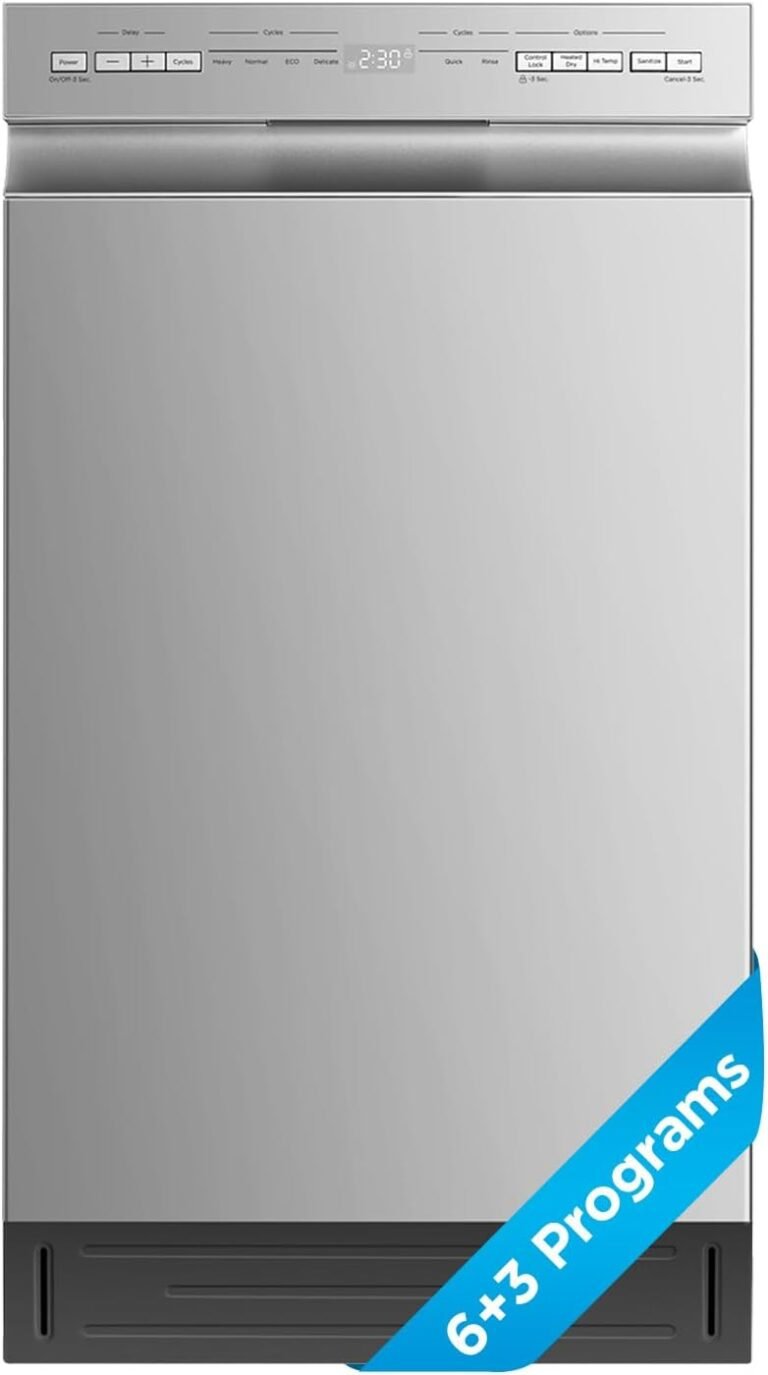
Quiet, Efficient Countertop Dishwasher for Small Kitchens
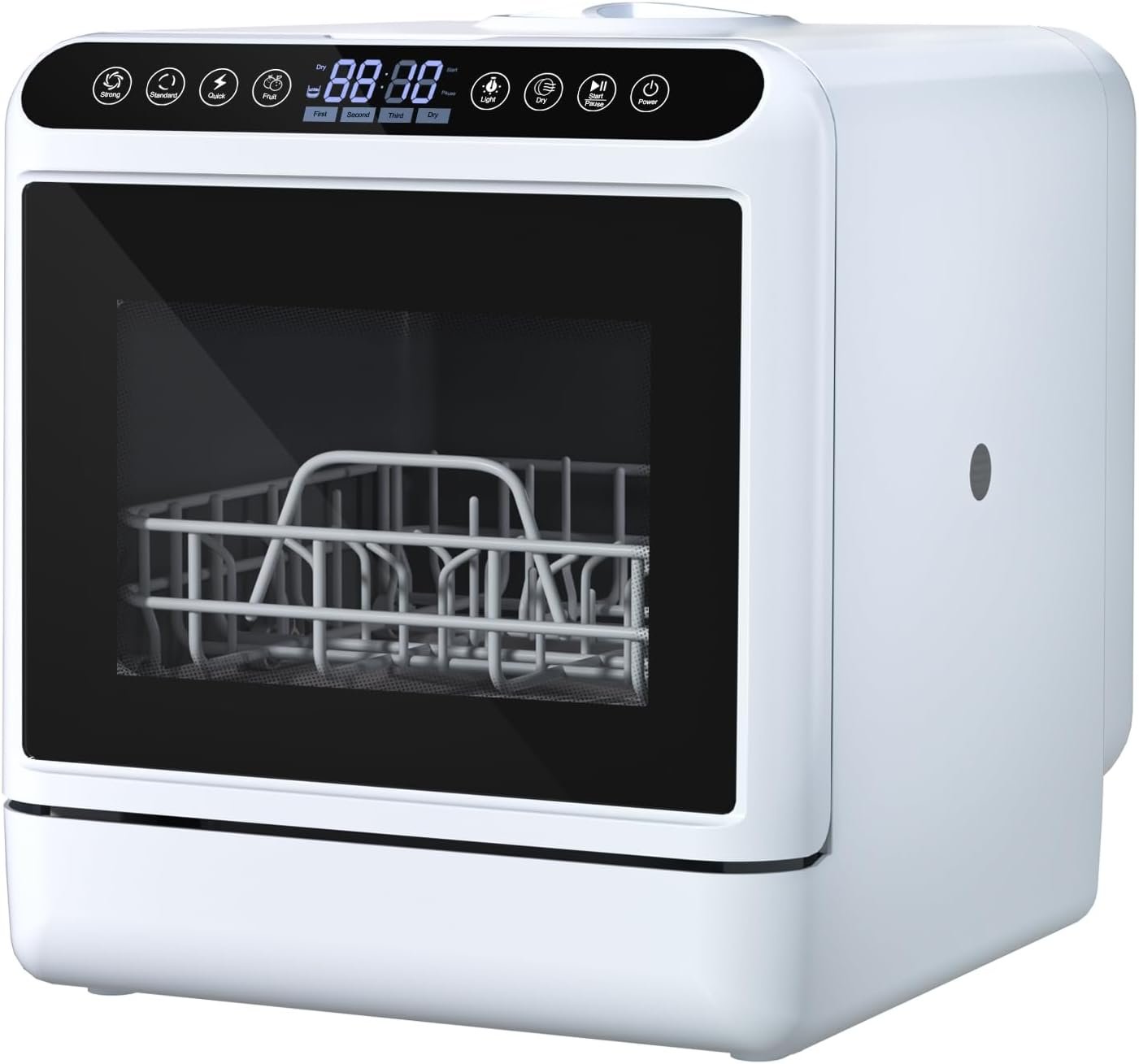
Choosing a Countertop Dishwasher: Why Selection Matters
Selecting a countertop dishwasher requires balancing cleaning performance, kitchen layout constraints, and household routines. For small kitchens and apartments, a compact unit must deliver reliable wash coverage while fitting on limited counter space and avoiding excessive noise that can interfere with open-plan living. Buyers should prioritize how well the machine removes common soils, the flexibility of rack layouts for varied dishware and cookware, and drying performance to minimize moisture after cycles. Energy and water efficiency become more relevant in frequent-use scenarios because portable units often rely on integrated water tanks and internal heating. Noise sensitivity and the intended placement—near living spaces or a bedroom—will influence suitability. Maintenance expectations, filter accessibility, and the longevity of plastic components are fundamental to long-term value. Understanding these factors helps match a compact countertop model to a household’s plate counts, typical soil levels, and tolerance for ambient machine noise.
Quick Overview
| Feature | Details |
|---|---|
| Dishwasher type | Countertop / Portable |
| Capacity | 5 place settings; claims to hold over 40 pieces of cutlery |
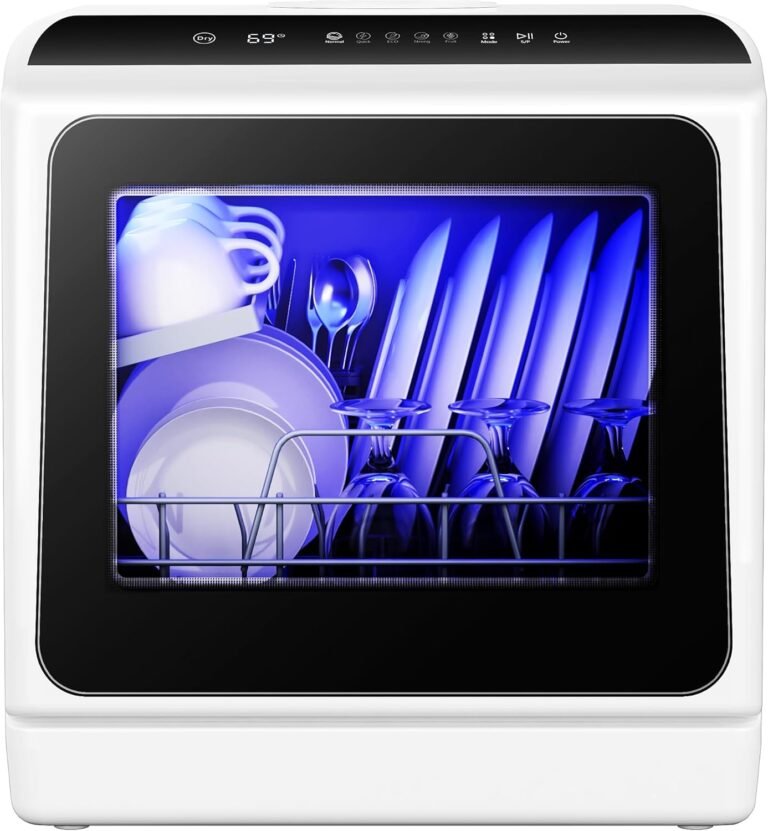
| Wash cycles and cleaning technology | Heavy, Normal, Delicate, Quick (≈28–29 min), Fruity; 3 high-pressure spray arms; steam-capable; sterilizing function |
| Drying method | Air-dry function with optional heated drying; dual heating system listed |
| Noise level | Not specified by manufacturer |
| Energy/water efficiency | Built-in 5L water tank; water consumption listed as 5 liters per cycle; no formal certification listed |
| Dimensions & installation | 46 x 46 x 41 cm (approx.); countertop installation; option to connect to faucet via inlet hose |
| Materials & controls | Plastic exterior and interior components; touch LED control panel |
| Warranty | Not specified |
This specification table highlights core trade-offs: a compact footprint with a two-tier rack and 5-place capacity favors small households and spaces without a permanent plumbing connection. The 5L water usage and built-in tank support flexible placement away from a sink, but the absence of listed noise and certification data requires buyers to evaluate tolerance for potential operational sound and to consider product reviews and return policies.

Cleaning Performance and Spray Coverage
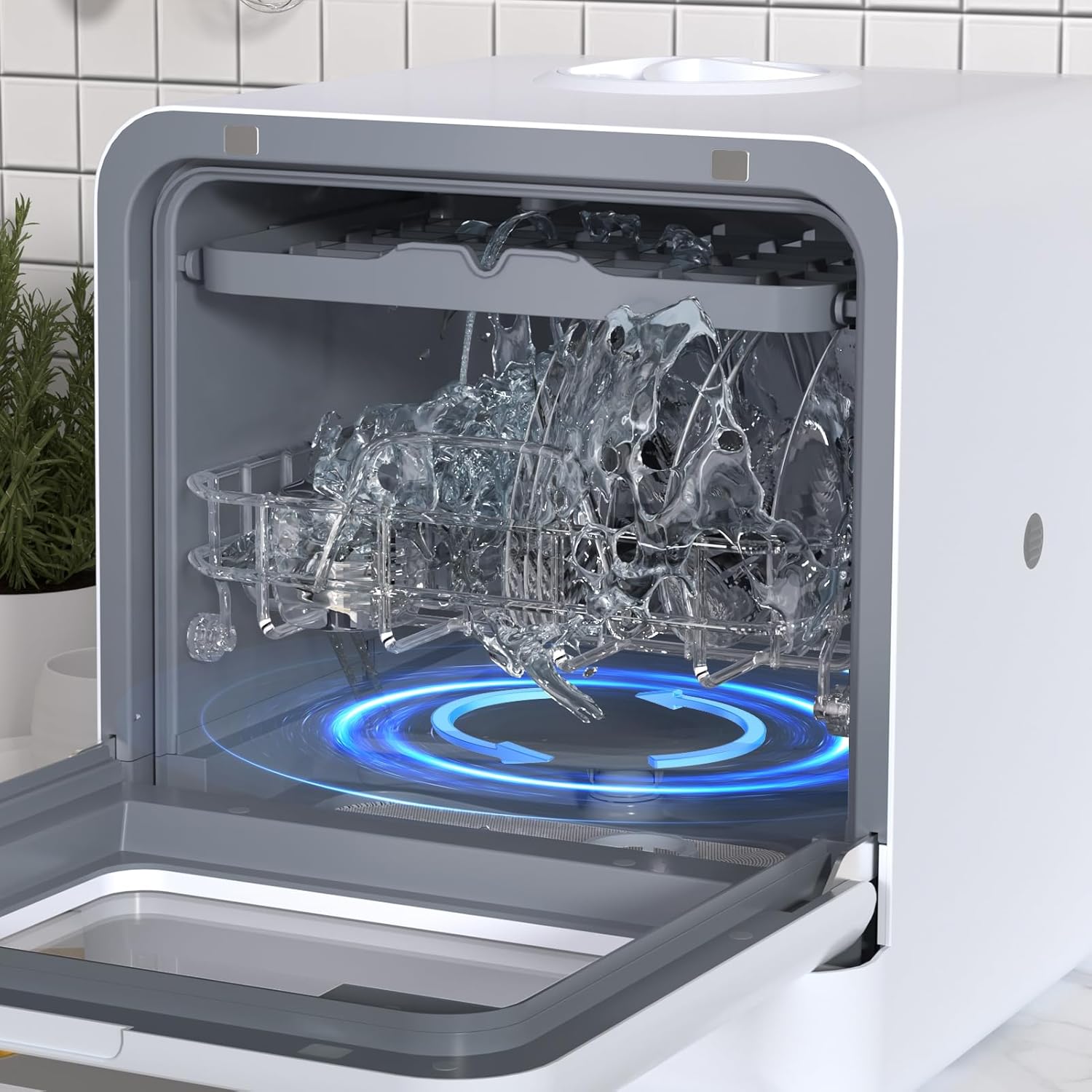
The cleaning performance profile hinges on three primary elements: spray geometry and pressure, heating capability, and filtration. The unit’s three high-pressure spray arms suggest multi-plane coverage designed to create overlapping jets for more consistent soil removal across stacked racks. The manufacturer-stated maximum wash temperature of 75°C allows for elevated thermal cleaning and sanitizing performance within wash programs that claim sterilizing capability; however, actual sanitization depends on cycle duration and maintained water temperature. The built-in 5L tank and dual heating system indicate water is preheated in the tank and again during circulation, which can shorten heat-up time and support higher in-cycle temperatures. Filtration and particle capture are essential for preventing redeposition; specifications do not detail filter mesh size but standard portable designs use removable coarse and fine filters that require routine cleaning to preserve spray efficiency and prevent odors.
Spray system design and coverage
Three spray arms generally aim to create 360° coverage by directing water upward, downward, and laterally across a two-tier layout. In compact countertop geometry, spray arm placement is critical to reach vertical stacking zones where taller items can shadow lower racks. High-pressure nozzles can improve soil removal on rinsed or moderately soiled dishes, but they depend on a clear filter and unobstructed arm rotation. The presence of steam cleaning and high-temperature cycles enhances the loosening of baked-on residues, while rapid spray action addresses soft food soils. Users should expect the best results on typical dinnerware and glassware; heavily soiled pans or encrusted baking dishes may still require pre-soaking or a scrub before loading.
Temperature, sanitizing and filtration considerations
A maximum water temperature up to 75°C enables effective thermal cleaning and supports sterilization claims when paired with sufficient contact time. The dual heating approach—heating water in the built-in tank and during circulation—reduces cold-start penalties and helps maintain consistent wash temperatures throughout the cycle. Effective filtration prevents solid particles from recirculating; typical units combine a coarse trap for large debris and a fine mesh for smaller particles. The manufacturer does not provide filter micron ratings, so buyers should anticipate manual filter checks after high-soil loads and consider frequency of cleaning to avoid performance loss and odors. Access to a removable filter assembly simplifies maintenance and supports consistent spray pressure.
Cycle options and stain removal expectations
Program diversity affects removal of grease, starches, and protein-based soils. Heavy and Normal cycles generally combine extended soak, elevated temperature, and stronger pump duty to break down stubborn residues. Quick cycles are valuable for lightly soiled loads and short turnaround, but they offer reduced time and may not reach peak sanitizing temperatures. Delicate cycles lower temperatures and reduce water pressure to protect glassware. A fruit/vegetable wash program indicates a gentle option aimed at produce rinsing; its efficacy on stains is limited compared with heavy cycles. Overall stain removal will align with cycle selection, loading practices, pre-rinsing habits, and filter cleanliness.
Capacity, Rack Design, and Place Settings
Capacity and internal layout determine how well the machine adapts to varied households. The stated 5-place settings and two-tier rack with removable upper basket are typical for compact countertop dishwashers and favor plates, bowls, glasses, and cutlery for small households or couples. The ability to remove the upper basket to accept an 11.8-inch plate increases flexibility for occasional larger items, but it reduces overall simultaneous capacity. The claim to hold over 40 pieces of cutlery suggests a dedicated cutlery tray or basket design that maximizes vertical stacking without obstructing spray arms. Material choices, primarily plastic racks and internal fittings, influence long-term durability and protection for fragile items. Users should evaluate how commonly used cookware fits within the available height and how often basket removal is required for larger plates or serving pieces.

Two-tier rack layout and removable upper basket
The two-tier design provides a defined separation for plates and smaller items, and a removable upper basket increases adaptability for plates up to 11.8 inches. This flexibility is useful in households that alternate between day-to-day dinnerware and occasional larger plates or platters. However, removing the upper basket reduces the number of available positions, so concurrent cleaning capacity drops when accommodating large items. Rack coatings and pin spacing impact the ability to secure plates without tipping; plastic-coated tines are common in compact units and reduce chipping risks. Load planning benefits from thoughtful placement to ensure spray arms are not blocked and that cutlery is positioned to avoid nesting.
Cutlery organization and utensil handling
A claim of over 40 pieces of cutlery suggests a compact but efficient cutlery tray or basket footprint. Effective cutlery organization prevents nesting and improves exposure to spray jets, which enhances drying and cleanliness. Forks and spoons oriented handle-down typically receive better exposure to upper spray arms, while tall utensils may interfere with the top basket or spray rotation. Some compact dishwashers use removable baskets to accommodate tall items or small pots; those features increase utility for mixed loads. Users should expect bend-prone utensils and lightweight plasticware to require careful placement to avoid displacement by high-pressure sprays.
Limitations with larger cookware and serving pieces
Countertop dishwasher dimensions and internal heights impose practical limits on cooking vessels. The unit’s compact internal volume makes it better suited for plates, cups, and small pans rather than large stockpots, oversized baking sheets, or full-size casserole dishes. Even when the upper basket is removed, depth and spray arm reach can prevent effective cleaning of deep or heavily soiled pans. Frequent owners of large cookware should plan for manual washing or alternative arrangements. The plastic interior may also be less tolerant of heavy impacts from large items, so cautious loading is advised to preserve racking and tub components.
Noise Levels and Suitability for Open Kitchens
Noise performance is a crucial factor for open-plan layouts, but the manufacturer does not provide a decibel rating. Portable countertop dishwashers typically range in noise from moderately quiet to fairly intrusive, depending on motor design, pump speed, insulation, and mounting. The lack of quantified noise data means expectations should be set toward moderate operational sound characteristic of compact units that house pumps and motors in a small enclosure. Vibration isolation, soft-mount feet, and a stable countertop surface can reduce perceived noise; conversely, placement on resonant or lightweight counters may amplify sound. Buyers sensitive to ambient noise should consider using delayed-start scheduling during daytime or selecting a dedicated space that buffers sound from living areas.

Interpreting unspecified noise claims and expected dB ranges
When a manufacturer omits a decibel specification, industry practice suggests comparing similar countertop models where typical noise levels for this class often fall between the mid-40s and mid-50s dB during active wash cycles. Peak pump and drain events can generate transient increases. Without an explicit dB rating, rely on user reviews and retailer Q&A to gauge real-world impact in comparable kitchens. Noise perception also depends on distance and room acoustics—an open-plan kitchen adjacent to a living area will experience higher perceived intrusion than a separated utility nook. For sensitive households, prioritize units with proven low-noise engineering or place the dishwasher in a buffer location.
Vibration, placement, and countertop considerations
Compact dishwashers transmit vibration to countertops through contact points. Stable, non-resonant surfaces like solid stone or thick butcher-block mitigate vibration better than thin laminate or lightweight particleboard. Anti-vibration feet and secure placement are important because movement can amplify mechanical noise and risk shifting during pump cycles. The appliance’s weight (≈33.1 pounds) when empty and higher when filled requires a load-bearing countertop and consideration of water spills during tank fills and drain events. Keep the unit away from cabinet overhangs and edge locations to reduce potential tipping hazards and to allow unobstructed airflow around exhaust vents for drying cycles.
Night-time use, delayed start, and routine scheduling
Delayed start capability (2–12 hours) helps schedule wash cycles during off-peak household activity or utility rate windows. For households seeking to run cycles while asleep or during quiet evening hours, delayed start can minimize daytime disruption but does not eliminate operational noise once active. If nocturnal operation is important, test placement and account for pump and drain events that may occur toward cycle ends. Scheduling flexibility also enables load accumulation for full cycles, improving water and energy utilization compared with frequent partial loads.
Drying Systems, Energy & Water Efficiency, Maintenance and Durability
Drying performance, water consumption, energy use, and ease of maintenance collectively affect long-term satisfaction. The listed air-dry function, combined with dual heating, suggests a hybrid approach where thermal energy assists moisture removal while a passive air exchange completes drying. Water consumption is specified as 5 liters per cycle, consistent with compact tank-based designs, and the dual-heating system aims to improve in-cycle temperature management to reduce overall energy usage for reheating. No formal energy certification is provided, so buyers should expect efficiency comparable to similar countertop units rather than certified performance. Maintenance tasks—filter cleaning, spray-arm clearing, and periodic descaling—are central to sustained results. Durability depends on plastic material quality, seam construction, and component access for repair or part replacement.
Air-dry function, moisture control and residual humidity
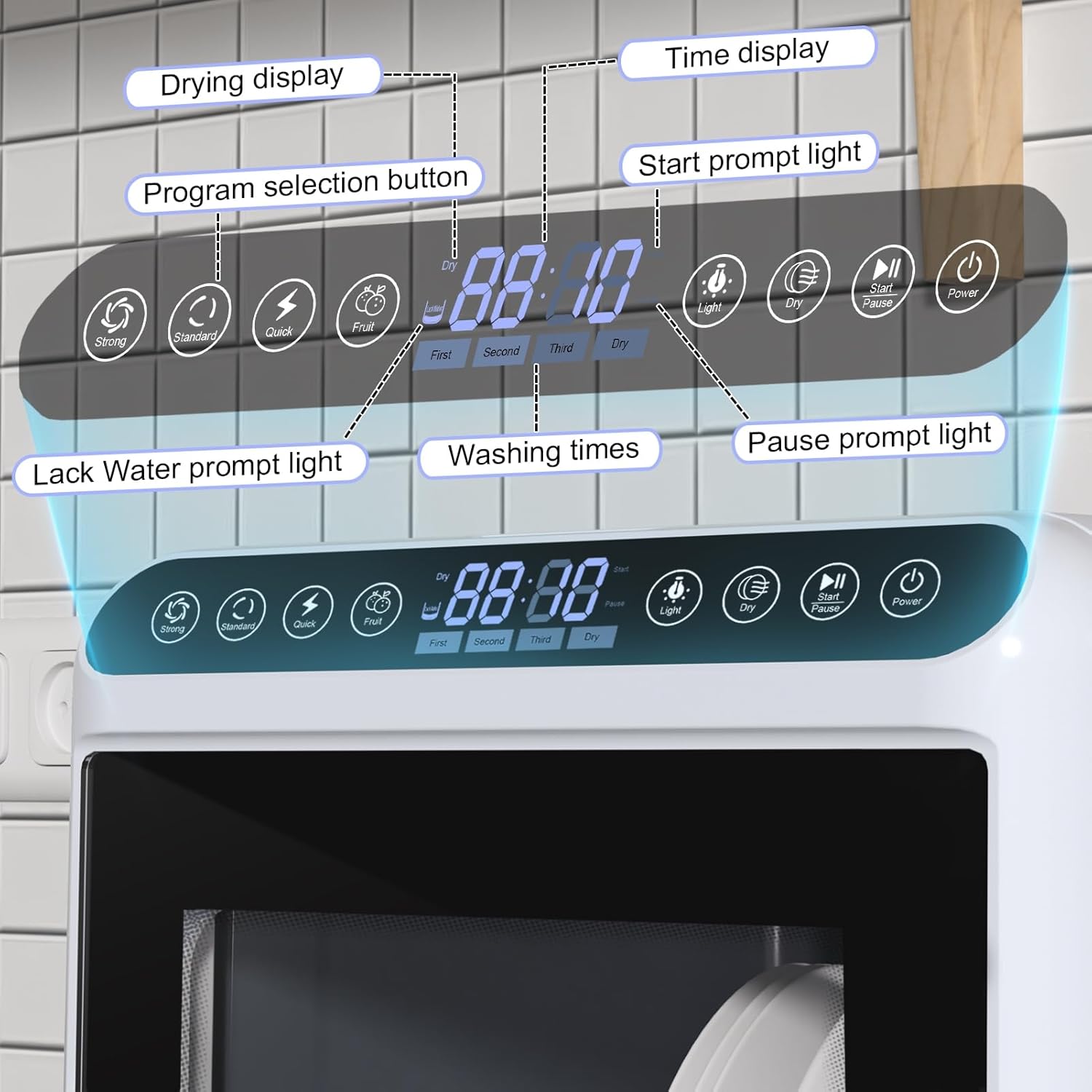
Air-dry systems rely on airflow and passive evaporation; when paired with heated rinse or a short heated dry phase, they lower residual moisture. Compact designs can trap humidity inside a small cavity, increasing drying times for dense loads or tall glassware. Steam or heated rinse cycles loosen water films, but without an active condensation or fan-assisted drying stage, some plastic items and deep-set hollows can retain droplets. The unit’s LED display and cycle selection likely permit selecting longer drying phases, which improves moisture control but consumes more energy. Users should remove and slightly ajar the door after completion, where feasible, to accelerate drying and reduce odor risk.
Energy and water consumption expectations with dual heating
A 5L per cycle water use aligns with countertop models designed for short, concentrated washes. The integrated tank and dual-heating strategy—preheating tank water and applying in-cycle heating—reduces cold-start penalties and can improve wash temperature stability. Energy consumption depends on heater wattage (manufacturer lists 1000W) and cycle duration; shorter quick cycles use less energy but may not reach sanitizing temperatures. The absence of ENERGY STAR or similar certification indicates that energy performance should be evaluated against competing models rather than relying on a standardized label. For frequent users, efficient load planning and full loads per cycle maximize per-item energy and water efficiency.
Filter maintenance, component access and expected durability
Removable filters and accessible spray arms are standard maintenance points that preserve performance and prevent redeposition. Although filter micron ratings are not provided, routine cleaning of coarse traps and fine meshes is necessary after high-soil loads to maintain spray pressure and prevent smells. The predominance of plastic in materials and racks can reduce corrosion risk but introduces concerns about long-term rigidity and heat tolerance. Plastic parts exposed to repeated thermal cycling at elevated temperatures can experience stress over time. Component accessibility, such as easily detached spray arms and a user-serviceable filter basket, will extend useful life by simplifying home maintenance and reducing service calls.

Pros & Cons
Pros
- Compact footprint with flexible placement options: The countertop form factor and built-in 5L water tank enable installation away from a fixed plumbing point, making it suitable for apartments, dorms, and RV-adjacent uses. This flexibility supports users who lack under-sink connections.
- Multiple wash programs including high-temperature cycles: A mix of Heavy, Normal, Delicate, Quick, and Fruity cycles plus a sterilizing option offers adaptability for common household soils and fragile items, improving cleaning outcomes when cycles are correctly matched to soils.
- Dual heating for faster temperature ramp-up: Heating both the built-in tank and circulating water reduces cold-start delays, helping reach higher wash temperatures for improved cleaning and sanitization potential within cycle times.
- Three high-pressure spray arms for multi-directional coverage: The spray arm count and placement aim to provide overlapping jets to reduce blind spots and enhance soil removal across two rack levels.
- Removable upper basket and 2-tier rack for load flexibility: The ability to remove the top basket to fit an 11.8-inch plate increases utility for mixed loads without permanently sacrificing smaller-ware capacity.
- Low water per cycle relative to full-size dishwashers: A 5L per-cycle consumption supports compact-unit efficiency goals when compared to manual rinsing or frequent small loads in larger machines.
Cons
- Noise level not specified: The absence of a decibel rating requires buyers to rely on third-party reviews and personal tolerance assessments; countertop units can be louder than built-in equivalents.
- Predominantly plastic construction: While corrosion-resistant, plastic interiors and racks may show accelerated wear under frequent high-temperature cycles and are generally less robust than stainless steel tubs.
- Limited capacity for large cookware: Internal dimensions and rack layout constrain the cleaning of large pots, baking sheets, and oversized serving pieces, necessitating manual washing for such items.
- No listed energy or safety certifications: The lack of ENERGY STAR or UL certification details in the specifications means efficiency and electrical safety compliance should be confirmed with retailers or manufacturer documentation.
- Filter and maintenance details sparse: Missing explicit filter ratings and maintenance intervals may make it harder to predict upkeep frequency and long-term performance without additional documentation.
Final Verdict: Who This Dishwasher Is Best For (and Who Should Skip It)
This countertop dishwasher is best suited for small households, couples, and individuals in apartments or small kitchens who prioritize counter-level convenience, flexible placement, and modest wash capacity. The two-tier rack with a removable upper basket and cutlery accommodation makes it a practical choice for day-to-day dinnerware, glassware, and light cookware typical of 1–3 person households. The integrated 5L water tank and dual-heating system favor users needing off-sink installation or limited plumbing access, and the range of wash programs supports varied load types from delicate glassware to heavier soiled plates.
Conversely, this model is not recommended for households that frequently use large cookware, require certified low-noise operation in open-plan living areas, or prioritize stainless-steel durability and formal energy certifications. Buyers depending on high-capacity loads or full-size pans should choose a built-in or full-size dishwasher instead. Prospective purchasers should verify warranty details, noise data, and filter specifications with the manufacturer or retailer before buying to ensure alignment with long-term reliability and maintenance expectations.
Frequently Asked Questions (FAQs)
How many place settings does a countertop dishwasher typically hold?
Countertop dishwashers in this size class commonly list a capacity of about five place settings, which usually accommodates plates, bowls, glasses, and cutlery for 1–3 people. Removable upper baskets can increase flexibility for larger plates at the expense of simultaneous load capacity.
Can a countertop dishwasher be used without connecting to a faucet?
Many portable countertop models include a built-in water tank that allows operation without a direct faucet connection. The integrated tank must be filled manually and typically supports a single cycle, making placement away from a sink feasible but requiring manual refilling between loads.
Does a 5-liter water consumption per cycle provide effective cleaning?
A 5-liter per-cycle water use is typical for compact tank-based units and can provide effective cleaning when combined with targeted spray coverage, elevated wash temperatures, and appropriate cycle selection. Performance depends on soil levels, loading practices, and filter cleanliness rather than water volume alone.
Are countertop dishwashers noisy compared with built-in models?
Countertop dishwashers often have higher perceived noise levels than built-in units because pumps and motors are located in a smaller, less insulated enclosure. When manufacturers do not publish decibel ratings, noise should be assessed via reviews or by considering placement on non-resonant counters to reduce transmission.
How important is filter maintenance for compact dishwashers?
Filter maintenance is critical: removing trapped food and debris from coarse traps and fine meshes preserves spray pressure, prevents redeposition, and reduces odor risk. Frequent cleaning after heavy-soil loads is recommended, and easy access to the filter assembly simplifies routine upkeep.
Will the air-dry function prevent moisture and odors after cycles?
Air-dry functions assist moisture reduction by allowing passive evaporation and may be supplemented by an initial heated rinse. Without active fan-assisted condensation removal, some residual humidity can remain, especially in dense loads or hollowware. Slightly propping the door after a cycle supports faster drying and reduces odor development.
Is dual heating more energy efficient for a countertop dishwasher?
Dual heating—preheating water in the tank and applying in-cycle heating—reduces cold-start energy losses and can help maintain consistent wash temperatures, improving cleaning efficiency. Overall energy efficiency depends on cycle durations and heater wattage; absence of formal certifications means efficiency should be compared against similar models.
Who should avoid a compact countertop dishwasher?
Households that frequently use large pots, baking sheets, or require low-noise operation in open-plan living areas may find compact countertop models unsuitable. Those seeking stainless-steel tubs or certified energy performance should consider full-size built-in alternatives.