Quiet, Efficient Countertop Dishwasher for Small Kitchens
Why dishwasher selection matters for small kitchens and busy households
Choosing a dishwasher for a small kitchen involves more than matching colors or countertop space. The right unit balances cleaning performance, cycle variety, and noise levels while fitting specific household routines—daily meal clean-up, baby bottles, or occasional cookware. For compact countertop models, considerations include water supply flexibility, internal layout that maximizes place settings, and drying or ventilation strategies that prevent lingering moisture in confined spaces. Efficiency expectations matter when circuit capacity and water access are limited, and buyers should prioritize a machine whose specifications align with kitchen layout, frequency of use, and sensitivity to operational noise. For households of two to four people, a portable countertop dishwasher with multiple wash modes and integrated drying can replace handwashing for most daily loads, provided the design supports effective spray coverage, reliable filtration, and straightforward maintenance.
Quick Overview
| Feature | Details |
|---|---|
| Dishwasher type | Countertop portable dishwasher with built-in water tank and faucet inlet |
| Capacity / place settings | Holds up to 4 full place settings; accepts dishes up to 12″ when loaded at an angle; double-layer rack layout |
| Wash cycles and cleaning technology | Five programs: Normal, Speed, Soft, Baby Care/Heavy, Fruit; dual spray arms for coverage |
| Drying method | PTC hot air drying (60-minute automatic dry after wash on most modes) plus timed ventilation/storage mode |
| Noise level rating | 50 dB reported |
| Energy and water metrics | Rated at 950 watts; water consumption listed as ~5 liters per cycle; no specific certification listed |
| Dimensions and installation | 16.8 x 16.9 x 18.1 inches; countertop placement, no permanent plumbing required |
| Warranty | Not specified by manufacturer in provided materials |
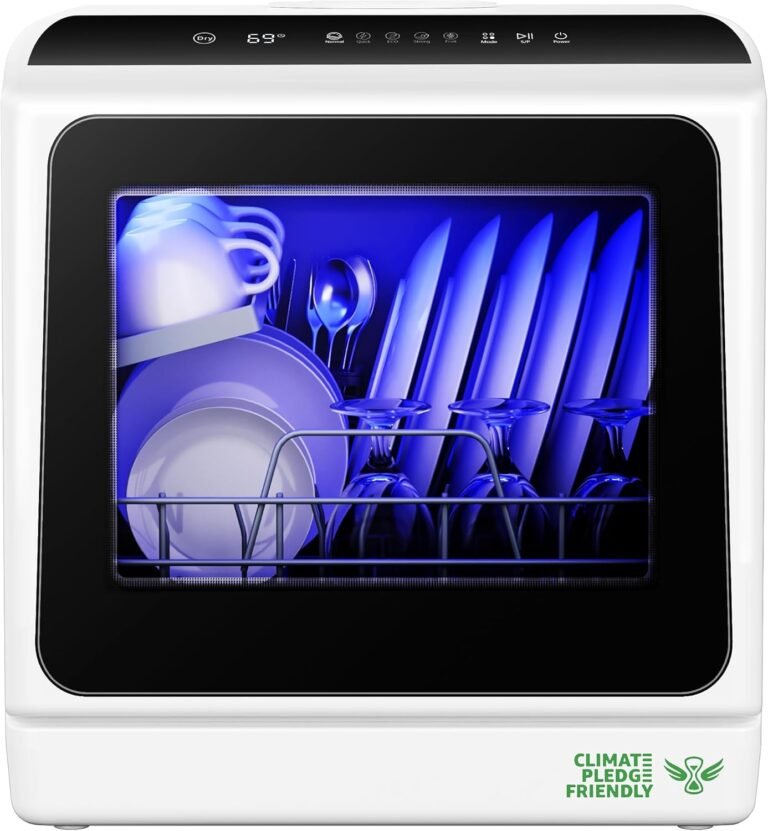
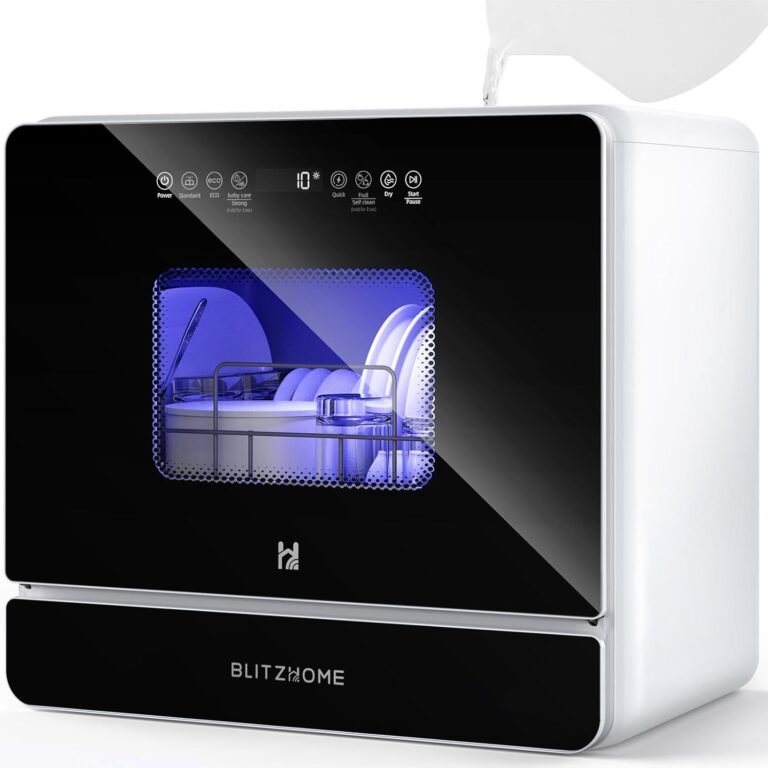
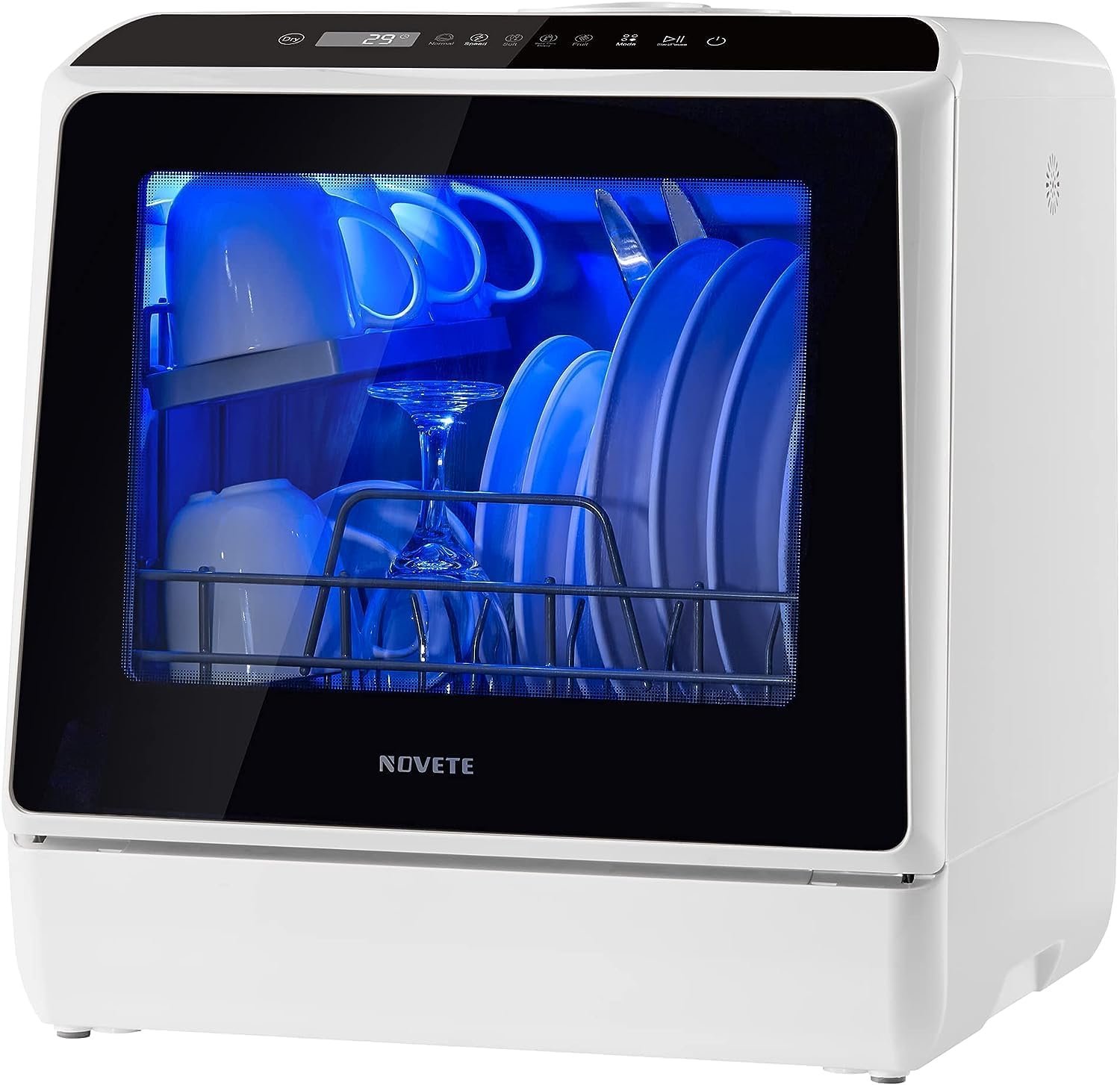
This compact countertop model converts countertop space into a multi-function cleaning, drying, and storage appliance suited for small apartments, dorms, and RV use. Built-in water tank capability and a faucet inlet enable installation without dedicated plumbing, and dual spray arms plus five cycle choices make the unit usable for daily tableware and occasional higher-temperature baby care loads. The modest footprint prioritizes convenience over large-scale capacity.

Cleaning performance and wash coverage
Cleaning effectiveness for compact countertop dishwashers depends on spray arm design, water pressure management, cycle temperatures, and internal circulation. A unit with two spray arms can provide layered coverage across upper and lower rack zones, improving rinse distribution on stacked items. The specified Baby Care/Heavy mode reaching a higher wash temperature supports more effective grease emulsification and sanitizer action for heavily soiled items within the limits of detergent chemistry. Cycle duration and speed options affect soil suspension and re-deposition risks; shorter cycles rely on higher flow and targeted agitation while longer normals provide time for detergents to act. Overall, cleaning performance expectations should be framed by typical load types—dishes and cups versus heavily soiled pots—and by adherence to recommended loading patterns and detergent dosing.

Spray system layout and expected coverage
Two spray arms in a compact cabinet typically create overlapping spray envelopes that target different vertical zones. The lower arm addresses plates and larger items, while the upper arm focuses on bowls, cups, and smaller flatware. In a small dishwasher, angled loading of 12″ dishes helps maintain exposure to both arms; however, close packing or oversized items can create spray shadows that reduce soil removal. Effective detergent distribution, sufficient cycle temperature (up to the listed 167 °F wash point for baby-care/heavy mode), and periodic cleaning of spray arm nozzles are necessary to maintain consistent coverage. Customers should expect the best results with arranged loads that avoid blocking spray pathways.
Filtration, water handling, and detergent considerations
Filtration and water handling affect how soils are captured and whether particles recirculate onto dishes. Compact models usually employ a coarse filter and pump intake arrangement that handles food particles while relying on wash cycles to flush them to the drain. The presence of a removable mesh filter or trap simplifies debris removal and reduces redeposit risk. Detergent selection matters: low-sudsing, appliance-formulated detergents improve rinse clarity and work with the machine’s water volume and temperature profile. Using rinse aids can further reduce spotting on glassware, especially when the drying cycle is air-based rather than condensation-assisted. Regular filter checks and following manufacturer dosing guidance support consistent cleaning outcomes.
Capacity, rack design, and place settings
Capacity assessment focuses on usable volume rather than external dimensions alone. A compact dishwasher claiming four place settings indicates a layout optimized with a double-layer rack and specific cutlery tray space that accommodates basic service of plates, bowls, cups, and utensils. The reported ability to fit 12″ dishes when angled reflects rack spacing and tines that allow tilting; however, bulky pans and large cookware are generally not supported. Load stability, secure placement of glassware to avoid tipping, and a dedicated cutlery basket or tray influence practical capacity. Buyers should match typical household load types and sizes to the internal geometry to avoid inefficient partial loads or obstruction of spray arm motion.

Load patterns and maximizing usable space
Maximizing capacity in a compact machine relies on systematic load patterns: plates along the lower rack tines angled toward spray arms, bowls and cups on the upper tier with openings facing down, and cutlery grouped handle-down in the basket to reduce nesting. The double-layer configuration allows separation of glassware from heavier items, but tight packing can reduce spray access and compromise cleaning. Removing excess food and pre-rinsing large particles helps maintain flow and avoids clogging the filter. For households of three to four people, running frequent half-to-full loads with optimized placement yields the best balance between readiness and energy/water use.
Cutlery, baby items, and fragile ware considerations
A cutlery basket and optional small parts basket enable separation of forks, spoons, and small baby accessories, reducing flattening and nesting that impedes cleaning. Baby-care cycles with higher temperatures and extended rinses suit bottles and certain plastic items that are dishwasher-safe; however, delicate glassware, hand-finished crystal, and some plastics require manufacturer guidance. Heat-sensitive items should be placed away from the heating element and drying air path. When washing mixed materials, arranging similar items together improves both cleaning and drying outcomes while reducing risk of damage.
Noise levels and suitability for open kitchens
Operating sound matters in open-concept homes and small living spaces where kitchen noise permeates living areas. A 50 dB rating positions the unit in a moderate-low noise band—comparable to a quiet conversation—making it less intrusive during cycles than louder countertop alternatives. Noise perception also depends on placement (solid countertop versus rubber feet isolation), nearby reflective surfaces, and background ambient noise. For light sleepers or for households using the kitchen as living space, a stable, level installation and avoidance of load imbalance reduce rattles. Buyers who require near-silent operation for overnight cycles should still consider that compact pump motors and fans can produce higher-frequency sounds that carry differently than low-frequency hums.

Interpreting the 50 dB rating in real settings
A manufacturer-listed 50 dB figure typically reflects peak or nominal sound under standard test conditions; actual perceived volume varies with kitchen acoustics. On solid countertops with cabinetry and non-reflective finishes, sound may be damped and seem quieter. Conversely, tile, metal surfaces, and poorly isolated countertops can reflect and amplify higher-frequency noise. When evaluating suitability for open kitchens, prioritize level placement to prevent vibration, arrange dishes to avoid contact points that cause clanking, and consider running cycles during daytime if sensitivity to night-time noise remains a concern. The 50 dB rating indicates reasonable quiet operation for most small households.
Placement and countertop considerations for vibration control
Countertop stability affects both noise and longevity. Rubberized feet, a stable work surface, and ensuring the dishwasher is not shifted during cycles reduces mechanical noise and potential wear. Compact portable units can transmit pump and fan vibrations through lightweight countertops more readily than built-in models; using a non-slip mat or small isolation pads beneath the unit can reduce transmission. Additionally, routing the drain hose and inlet hoses without kinks ensures pumps operate without additional strain. For long-term reliability in compact kitchens, buyers should confirm available countertop weight tolerances and electrical outlet placement before regular use.
Drying systems and moisture control
Drying in compact dishwashers commonly relies on forced hot air or residual heat methods rather than condensation-only systems used in larger built-ins. PTC hot air dryers provide consistent air temperatures for an active drying phase; a 60-minute hot air cycle removes surface moisture and reduces spotting on glassware, though results vary with load density and material types. Post-cycle ventilation that periodically circulates air over stored dishes helps prevent trapped moisture from developing odors in confined spaces. These features are particularly relevant for kitchens without good natural ventilation. Drying effectiveness is also influenced by rinse aid use and cycle selection, with the Fruit mode often excluded from automatic drying to protect heat-sensitive produce or items.

How PTC hot air drying performs on mixed loads
PTC (Positive Temperature Coefficient) ceramic heating elements provide steady, controllable hot air with lower risk of extreme surface temperatures. In mixed loads, plastic items tend to retain moisture due to lower thermal mass, while glass and ceramics dry faster. The 60-minute hot air duration is sufficient for most glassware and ceramics when not overly crowded; for dense loads or large plastic containers, residual moisture may remain. Air circulation design and venting paths determine whether generated heat reaches interior crevices. Users sensitive to moisture should consider the unit’s storage ventilation feature that periodically exchanges air for up to 72 hours to minimize stale odors.
Storage ventilation and odor prevention in small spaces
A timed ventilation or storage mode that runs periodic air exchanges reduces the risk of trapped moisture and subsequent odor growth when dishes are not immediately removed. The described automatic ventilation every 75 minutes for up to 72 hours creates intermittent airflow that helps dry residual dampness. In small apartments or RVs with limited airflow, this feature aids sanitary storage between uses, but it does not replace manual drying or unloading for long-term storage of sensitive items. Proper pre-cleaning, filter maintenance, and occasional machine interior wiping remain necessary to avoid biofilm or residue buildup over time.
Energy, water efficiency, maintenance, and durability expectations
Energy and water performance for compact dishwashers should be interpreted in context: a listed 950-watt power draw reflects peak heating and motor usage, while a per-cycle water consumption of approximately 5 liters positions the unit well below many full-size dishwashers in water use. Absence of formal energy certifications means efficiency comparisons rely on the stated metrics rather than third-party ratings. Maintenance expectations include regular filter cleaning, spray arm nozzle checks, and ensuring the water tank and hoses are flushed to prevent stagnation. Durability depends on build materials (primarily plastic interior and plastic racks with a metal basket), component quality, and user maintenance; heavier daily use and hard water conditions increase service needs over time.

Interpreting wattage and water use for operational expectations
A 950-watt heater/pump rating represents instantaneous power demand during heating and drying phases; cumulative energy per cycle depends on cycle length and frequency of high-temperature modes. Lower water use per cycle reduces total household water consumption compared with larger machines, but more frequent runs to match household needs can offset that advantage. For installations on standard 120V circuits, confirming circuit capacity is advised to avoid nuisance tripping when other high-load appliances are active. Buyers should align cycle selection—speed versus baby-care—based on cleanliness needs and energy trade-offs.
Maintenance items, filters, and longevity indicators
Removable coarse filters and accessible spray arms simplify routine maintenance and minimize redeposit risks. Regularly emptying and rinsing the built-in water tank, inspecting inlet and drain hoses for residues, and descaling in hard-water areas improve performance longevity. Plastic interiors are lightweight and corrosion-resistant but can show wear from detergents and high heat over many years; metal baskets provide structural support but may be susceptible to coating wear if damaged. Longevity expectations are influenced by use patterns, maintenance diligence, and adherence to manufacturer guidelines for water hardness and detergent types.

Pros & Cons
Pros
- Compact footprint with multi-mode operation: The small external dimensions paired with a double-layer rack and a five-cycle program suite make the unit adaptable for apartments, dorms, and RVs. It offers both a built-in water tank and faucet inlet for versatile setup without permanent plumbing.
- Effective cleaning options including high-temperature baby mode: A dedicated Baby Care/Heavy mode capable of higher wash temperatures supports grease removal and more thorough rinsing for baby items and oily tableware, improving soil breakdown compared to cooler cycles.
- Active drying and storage ventilation: PTC hot air drying and a timed ventilation/storage mode help reduce residual moisture and mitigate odors when dishes are not immediately unloaded, useful in compact living spaces.
- Low reported noise level: A 50 dB rating places the unit in a moderate-low noise range suitable for many open-plan living situations, reducing disruption compared with louder countertop models.
- Low per-cycle water use: Water consumption around 5 liters per cycle is economical relative to full-size dishwashers, benefiting households prioritizing water conservation or operating off limited water supplies.
- Straightforward controls and included accessories: Touch controls, LED display, cutlery basket, storage rack, and fruit basket simplify operation and organization of small loads.
- Portable installation options: The dual water supply modes (water tank and faucet) allow immediate use in setups without hard plumbing, increasing placement flexibility.
Cons
- Limited capacity for larger cookware: The four-place-setting capacity and compact interior are not suitable for large pots, wide serving platters, or frequent full-family cooking sessions, necessitating handwashing for oversized items.
- Plastic interior materials may affect long-term durability: A predominantly plastic interior and components can be less durable under heavy daily use and may show wear from detergents and heat over extended periods compared with stainless interiors.
- No third-party energy or water certification listed: Absence of formal efficiency certifications means comparisons must rely on stated wattage and per-cycle water figures rather than verified labels.
- Potential for spray-shadowing with dense loads: Close packing or improper angling of dishes can obstruct spray arms in a small cabinet, reducing cleaning effectiveness unless loading is optimized.
Final Verdict: Who This Dishwasher Is Best For (and Who Should Skip It)
This countertop dishwasher suits small households, apartment dwellers, and mobile living scenarios that require a compact cleaning solution without permanent plumbing. Its combination of a built-in 5 L water tank, faucet inlet option, five wash programs including a high-temperature baby-care mode, and active PTC hot air drying make it a practical choice for two-to-four-person households that prioritize convenience, quiet operation, and water efficiency. The 50 dB sound rating and portable installation support placement in open kitchens and temporary setups where a full-size built-in unit is impractical.
This model is not recommended for households that regularly need to clean large cookware, full dinnerware sets for frequent entertaining, or users seeking the highest-rated certified efficiency. Buyers prioritizing stainless steel interiors for maximum durability or formal energy/water certifications should consider alternative options. For those in need of a space-saving, adaptable countertop dishwasher for daily dish cycles and occasional baby or delicate item washes, this unit represents a capable, specification-driven solution in 2026, provided attention is paid to proper loading and routine maintenance for sustained performance.

Frequently Asked Questions (FAQs)
How many place settings will this compact countertop dishwasher hold?
The unit is specified to hold four full place settings, with a double-layer rack design that accepts dishes up to 12 inches when arranged at an angle. Practical capacity depends on load composition—plates, bowls, cups, and cutlery—and efficient placement is necessary to avoid spray obstruction and maximize usable space.
Can the dishwasher sanitize baby bottles and accessories safely?
A Baby Care/Heavy mode with a higher wash temperature (manufacturer-listed up to 167 °F) provides elevated rinse conditions that enhance grease breakdown and rinsing effectiveness for baby items that are labeled dishwasher-safe. Users should follow bottle and accessory manufacturer guidance regarding dishwasher suitability and use recommended detergents for sanitized results.
Is the built-in 5 L water tank adequate for regular use without faucet connection?
A 5-liter internal tank supports immediate use without faucet hookup and aligns with the unit’s low per-cycle water consumption (~5 liters). For regular daily usage in small households, the tank enables convenient intermittent loading, though households with high daily volumes may prefer faucet mode for continuous refills.
How quiet is a 50 dB dishwasher in an open kitchen layout?
A 50 dB rating typically corresponds to a moderate-low sound level similar to a quiet conversation. In most open kitchens this is reasonably unobtrusive, but perceived noise varies with countertop stability, room acoustics, and reflective surfaces. Proper placement and leveling further reduce vibration and noise transmission.
What maintenance is required to keep cleaning performance consistent?
Routine tasks include emptying and rinsing the coarse filter, inspecting and unclogging spray arm nozzles, flushing the built-in water tank periodically, and checking hoses for blockages. Using low-sudsing dishwasher detergents and following manufacturer guidance for water hardness and descaling extend consistent performance.
Does the dishwasher require a dedicated circuit or special electrical considerations?
The machine operates on standard 120V AC and lists a 950-watt power draw. While it does not typically require a dedicated 240V circuit, buyers should confirm circuit capacity if other major appliances operate on the same line to avoid overloads or nuisance tripping during heating-intensive cycles.
Which types of households should avoid this compact countertop dishwasher?
Households that routinely wash large pots, wide serving platters, or entertain large groups frequently should avoid this model due to limited interior dimensions and four-place-setting capacity. Likewise, buyers seeking stainless steel interiors or formal energy/water efficiency certifications may prefer larger built-in alternatives.