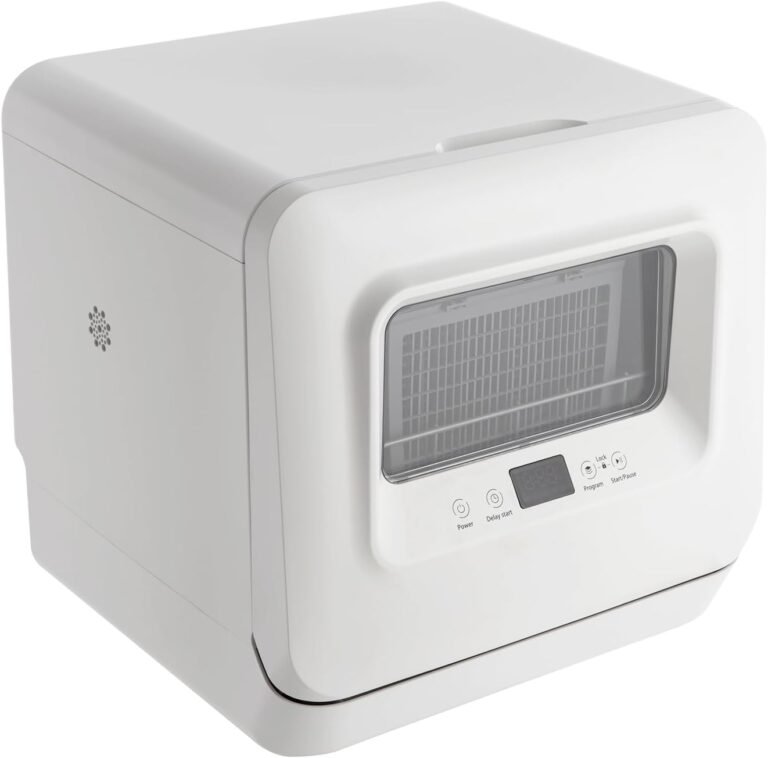
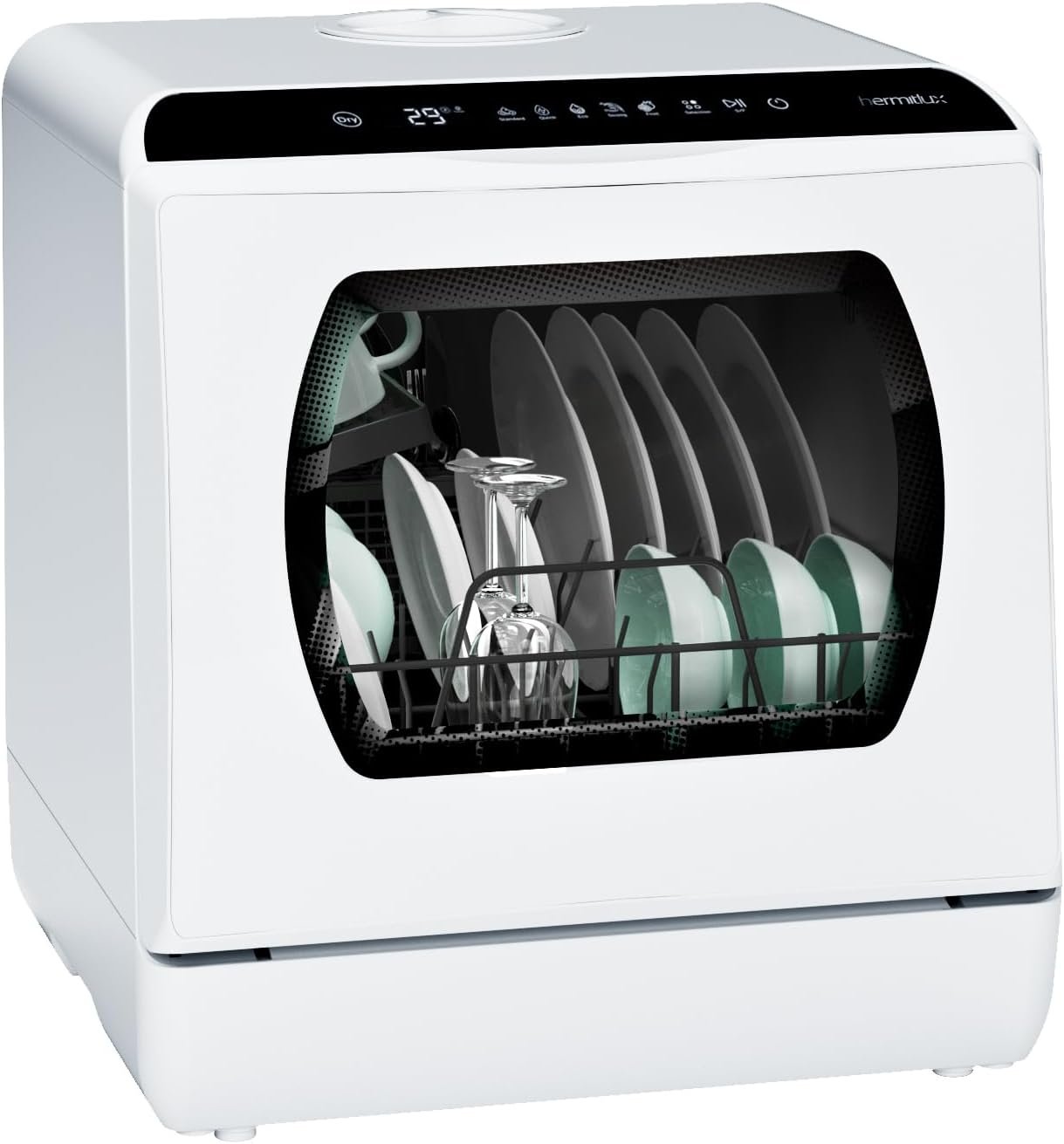
Hermitlux Countertop Dishwasher: Cleaning & Noise Guide
Choosing a Countertop Dishwasher: What Matters
Selecting a countertop dishwasher requires balancing cleaning performance, space constraints, and household routines. For small households, apartments, RVs, and dorms, capacity and physical footprint determine whether a portable unit can handle daily loads or only occasional use. Kitchen layout and proximity to seating areas matter when evaluating noise levels; units without published decibel ratings require conservative placement to reduce disturbance. Cleaning needs vary by diet and cookware: frequent heavy-soil loads demand effective spray coverage and higher-temperature cycles, while delicate glassware benefits from low-energy, sensor-controlled programs. Efficiency expectations include water per cycle and annual energy consumption; compact machines trade larger-capacity economies for lower absolute energy use but may have higher per-item energy. Finally, maintenance and durability considerations—filter design, hose length and connections, materials, and certifications—impact long-term reliability and owner effort. This review synthesizes manufacturer specifications, component materials, and appliance engineering principles to outline how those characteristics translate into real-world suitability without implying hands-on testing or personal use.
Quick Overview
| Feature | Details |
|---|---|
| Dishwasher type | Countertop / Portable (no permanent hookup required) |
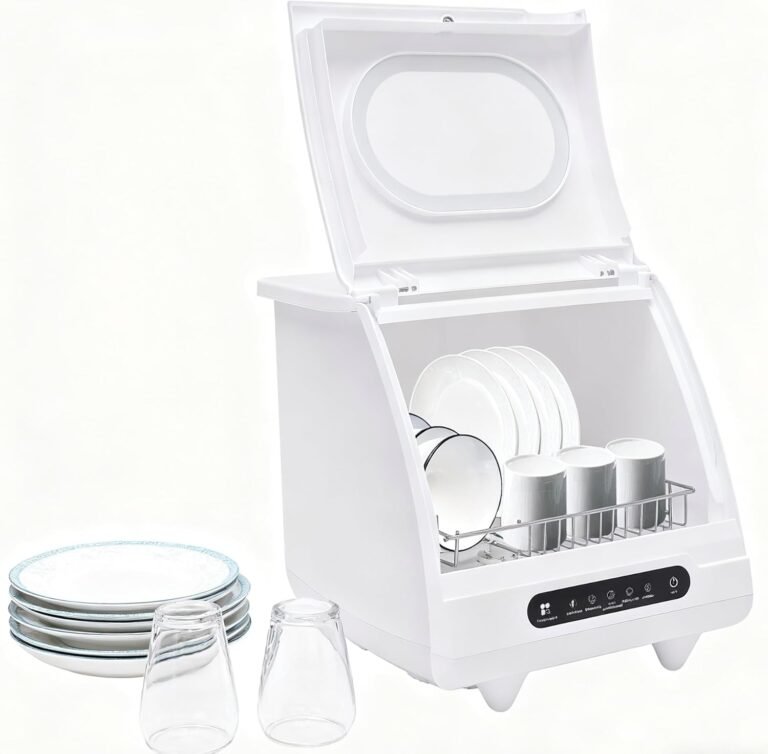
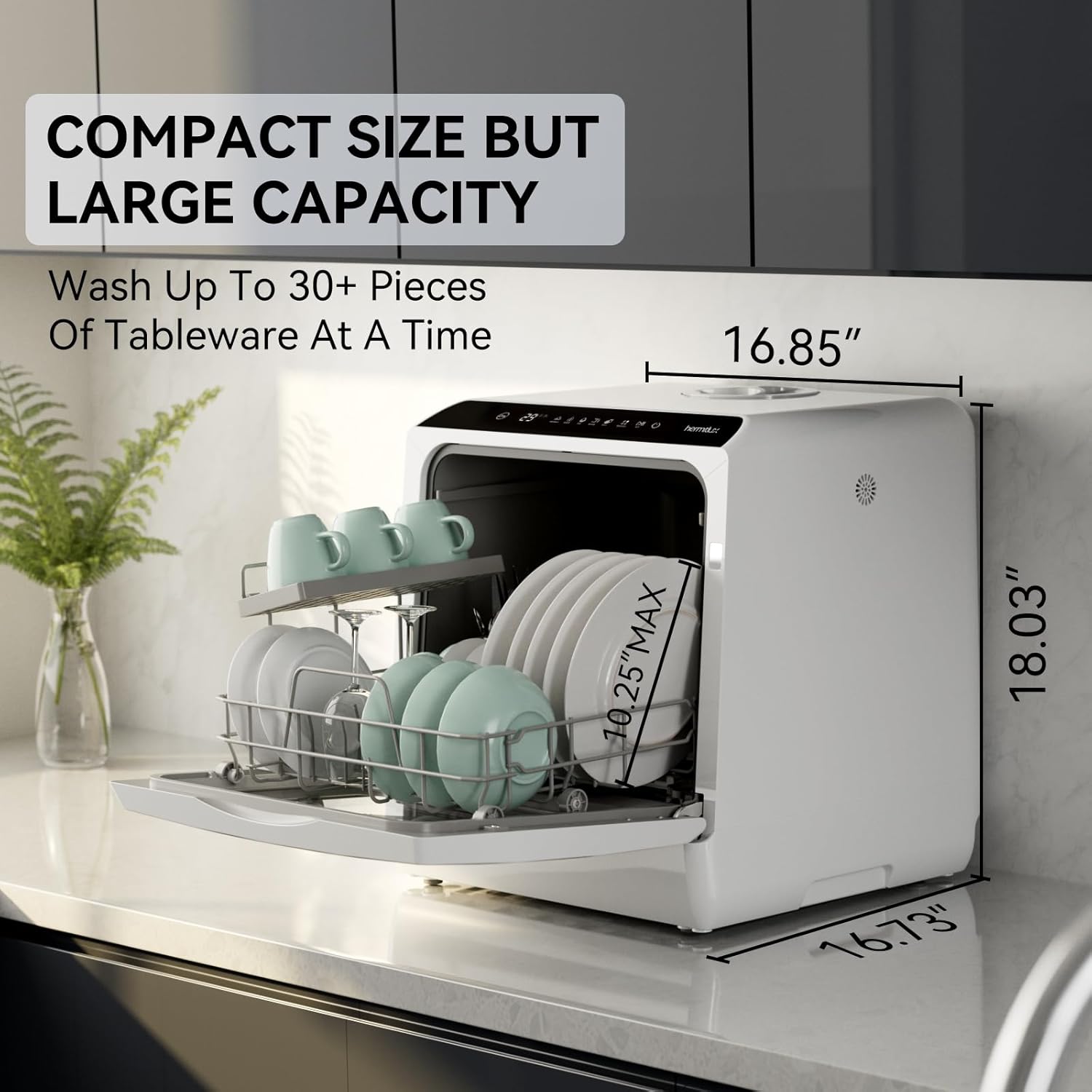
| Capacity | 4 place settings; internal 5 L built-in tank; fits 10.25″ dishes angled |
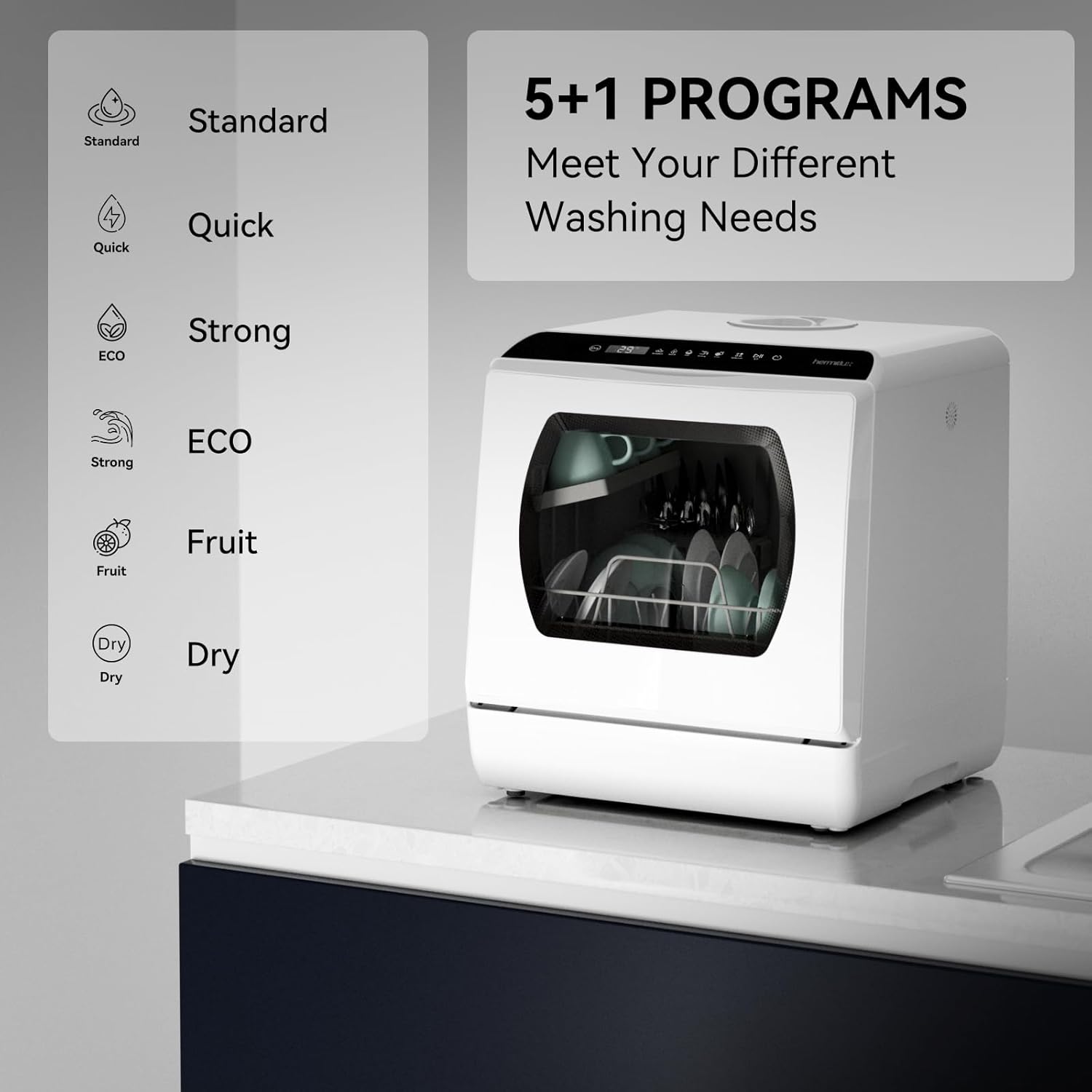
| Wash cycles | 5 washing programs (Standard, Quick, Strong, ECO, Fruit) + Dry function |
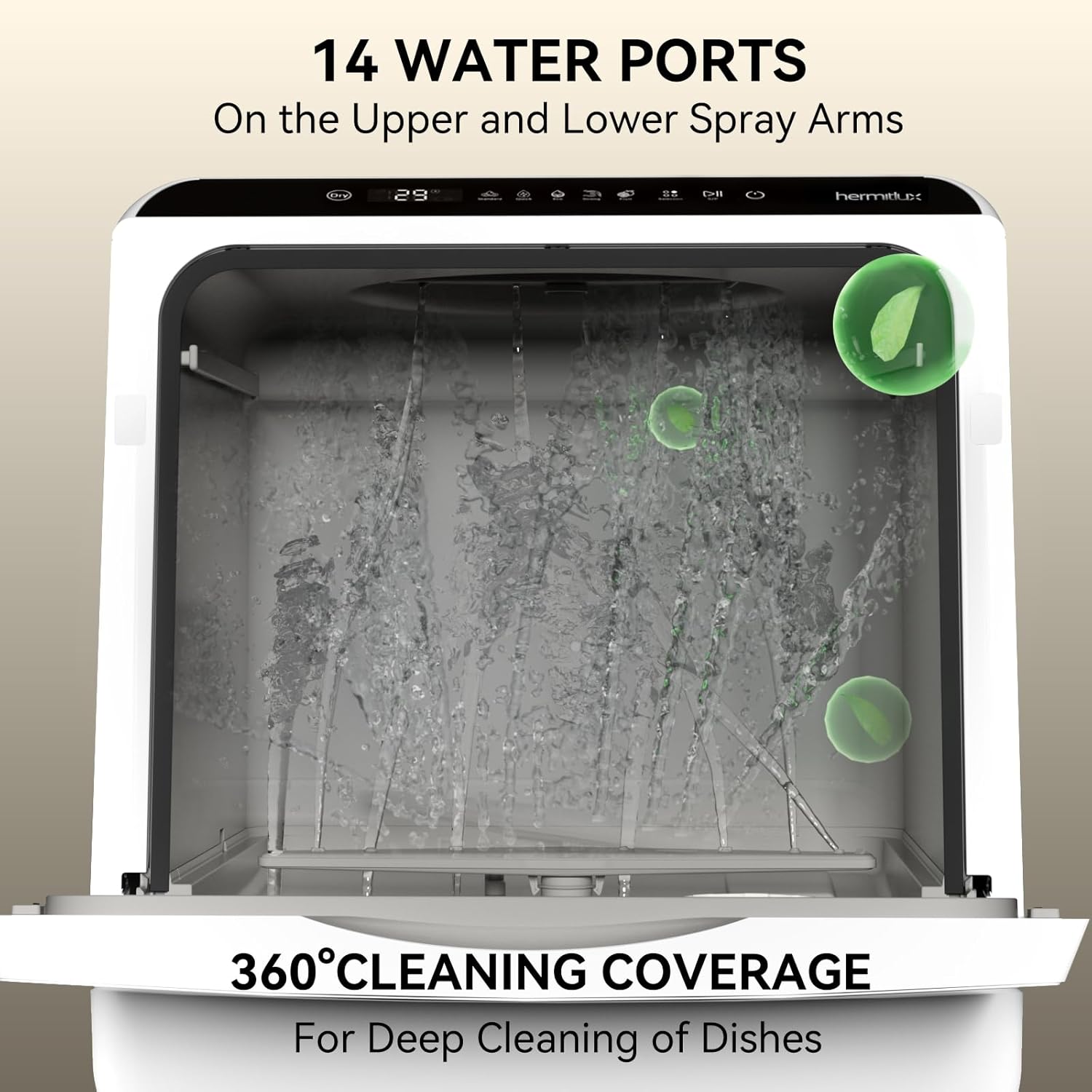
| Cleaning technology | Dual spray arms with 14 water jets; sensor wash available |
| Drying method | 60-minute hot air drying; 72-hour automatic ventilation |
| Noise level | Not specified by manufacturer |
| Energy & certifications | 83 kWh/year annual energy consumption; ETL certification |
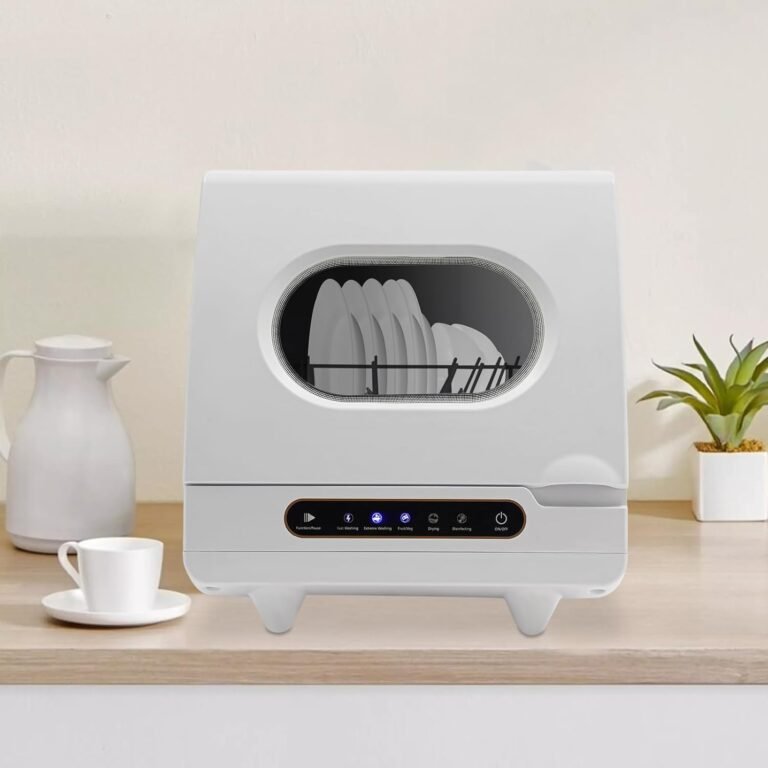
| Dimensions & installation | 16.85″ W × 16.73″ D × 18.03″ H; countertop form factor; inlet/outlet hoses 59″ |
| Materials & components | ABS plastic, glass door, PP internals, PA powder-coated metal racks |
| Warranty | Manufacturer warranty information not specified |
The table above condenses the Hermitlux portable countertop dishwasher into core attributes that influence fit. The compact footprint and built-in 5 L tank enable use where plumbing access is limited, while the array of cycles and hot-air drying support varied cleaning needs. Lack of a manufacturer-listed noise rating requires buyers to assume conservative placement in open-plan kitchens. Energy consumption and ETL certification provide baseline expectations for safety and annual use, while rack and material choices indicate typical compact-dishwasher durability and load handling.

Cleaning performance and spray coverage
The Hermitlux countertop dishwasher centers cleaning on a dual-arm spray architecture with 14 jets delivering water from top and bottom, combined with sensor washing to adjust cycle behavior. Spray arm geometry and nozzle count influence impingement angles and turbulence; multiple jets increase the likelihood of direct impact on soiled surfaces, especially for standard and strong cycles. Sensor wash modes typically modulate time and temperature in response to load soil sensors, helping conserve water and energy on lighter loads. Filtration and pump flow determine the machine’s ability to recirculate water and prevent redeposition of soils: a fine-strainer filter combined with a robust circulation pump yields better particulate separation. Given the compact chamber, spray overlap and rack positioning are critical to avoid blind spots and ensure even rinsing across plates, bowls, and glassware.
Spray system, filtration, and program interaction
Spray arms with multi-directional jets create overlapping patterns that reduce shadow zones; in a small chamber these patterns can provide near-360° coverage when racks are loaded as intended. Effective filtration relies on a multi-stage approach: a coarse mesh to capture large debris and a finer strainer to prevent pump clogging. Recirculation flow rate and pump power dictate the kinetic energy available for soil removal—higher flow increases mechanical action but can be limited by water tank capacity in portable units. Program interaction matters: strong cycles typically extend wash time and raise temperature, while ECO and quick cycles reduce flow or time to conserve resources. Sensor wash capability helps tailor cycle intensity to visible soil levels, optimizing cleaning without unnecessary resource use.
Expected cleaning on common soils and delicate items
General appliance principles indicate a compact dishwasher with dual spray arms and heated cycles can handle typical food residues—light to moderate starches, sauces, and beverage stains—provided proper loading minimizes overlapping items. Grease and baked-on soils respond best to higher-temperature and longer-duration cycles; the strong cycle should improve removal versus quick or ECO settings. Delicate glassware benefits from lower-energy or sensor-guided cycles that reduce thermal and mechanical stress; angled rack placement and the manufacturer’s guidance for dish orientation help reduce vibration and contact. For fragile items and thermal-sensitive plastics, the fruit or ECO programs and the option to exclude drying (to avoid high heat) offer gentler alternatives.
Capacity, rack design, and place settings
Capacity decisions hinge on the stated four place-setting arrangement and the interior geometry that accommodates 10.25″ dishes at an angle. Compact countertop models optimize internal volume through angled racks and a targeted cutlery basket, enabling more items per cycle than size alone suggests; however, overall throughput remains best suited to one- to two-person households or occasional use in larger residences. Rack metallurgy—PA powder-coated metal—provides corrosion resistance and a balance between rigidity and weight; ABS and PP components inside reduce thermal stress but are less impact-resistant than stainless steel. The included cutlery holder and dedicated glass door visibility support organized loading, while the listed dimensions and required clearance beneath wall cabinets set installation constraints for fitting under overhangs or within limited spaces.

Practical load planning and place-setting definition
A four place-setting capacity typically includes plates, bowls, a set of flatware, and a few cups; actual item counts depend on load mix and orientation. Angling dishes maximizes clearance for taller items while maintaining spray exposure; space-saving tactics such as nesting small bowls on plate edges should be avoided since they obstruct jets and reduce cleaning effectiveness. Taller items like cutting boards and pots may not fit; the listed 10.25″ dish fit provides a clear limit. Cycle selection influences throughput: shorter quick cycles enable higher daily turnover at reduced cleaning intensity, whereas standard or strong cycles provide deeper cleaning for fewer loads.
Rack materials, cutlery holder, and loading flexibility
PA powder-coated metal racks balance corrosion resistance with affordability, and the powder coating provides a protective barrier against chipping and rust. The included cutlery basket centralizes small items to prevent them from blocking spray paths and to limit contact with dish surfaces. Fixed rack layouts in compact units reduce adjustable flexibility compared to full-size dishwashers, so buyers should evaluate whether the fixed prong spacing and basket size align with typical cookware. The glass door improves visibility for confirming load placement without opening the unit, which helps maintain internal temperatures and prevents condensation during drying cycles.
Noise levels and suitability for open kitchens
Noise disclosure is a key selection factor; the Hermitlux specification does not list a decibel rating, which leaves interpreters to rely on product class and build materials for expectations. Countertop portable dishwashers commonly emit higher perceived noise than built-in, heavily insulated models due to thinner cabinet walls and smaller physical mass. Sound sources include pump motors, circulation flow through spray arms, and fan-driven drying; metal-coated racks and a glass door can transmit vibration. For open-plan kitchens or overnight operation in shared spaces, conservative placement—away from seating and sleeping areas—or use during unoccupied intervals reduces perceived disturbance. Acoustic performance can be influenced by installation surface, anti-vibration padding, and hose routing.
Manufacturer noise disclosure and practical implications
Absence of a published decibel value prevents precise comparison to quiet built-in models, but ETL certification confirms electrical safety and basic performance thresholds rather than acoustic standards. Engineering principles indicate that compact pumps and axial fans used for hot-air drying contribute most of the audible sound; mounting points and chassis stiffness affect vibration transmission. Buyers in noise-sensitive environments should expect audible operation during wash and dry cycles and plan placement accordingly. Practical mitigations include rubber feet, soft countertop pads, and avoiding direct contact with cabinetry or lightweight shelving that can amplify sound.
Placement, ventilation, and proximity considerations
Placement impacts both noise perception and ventilation efficiency: a stable, solid countertop reduces resonance and provides a secure mounting surface for the 34-pound unit. Ventilation requirements for hot-air drying and the 72-hour automatic ventilation function necessitate unobstructed air exchange around the rear and top of the machine; obstructed airflow can prolong drying times and increase internal humidity. Proximity to faucets determines whether the inlet hose connection is feasible without adapter plumbing; the 59-inch inlet/outlet hoses support flexible placement but require careful routing to avoid kinks that impede flow. In small kitchens, positioning near sinks or above dishwasher-safe surfaces simplifies water handling and reduces trip hazards from hoses.
Drying systems and moisture control
Drying performance centers on the 60-minute hot-air drying system and a 72-hour automatic ventilation feature intended to keep interiors fresh. Hot-air drying uses an integrated heating element and fan to evaporate residual moisture; effective airflow pathways and thermal insulation determine how uniformly heat is distributed. In compact units, heated drying accelerates moisture removal but increases energy use compared to passive condensation methods. Automatic ventilation cycles that periodically circulate air for up to 72 hours reduce stagnation and odors but rely on room ambient conditions for effective moisture removal. Condensation management is influenced by door seals, internal geometry, and materials: glass doors can accumulate condensation on cooler surfaces if ambient temperature differentials are high.
Hot-air drying mechanics and implications for materials
Hot-air drying combines elevated temperature and forced convection to lower surface tension of residual water and promote evaporation. Plastics and some lightweight materials can deform under sustained high temperatures; the manufacturer’s guidance to avoid using drying for certain cycles (such as the fruit program) minimizes risk. The heated element’s wattage, fan speed, and airflow distribution affect how fast and evenly items dry, with taller or tightly nested items retaining moisture in shaded pockets. For hygiene-focused buyers, heated drying reduces the duration water contacts surfaces but should be balanced against material sensitivity and energy considerations.
Residual moisture, cycle choices, and air exchange
Residual moisture after a cycle is common in compact dishwashers due to smaller drainage gradients and limited internal volume for air circulation. Choosing longer or heated cycles reduces leftover droplets, while the 72-hour ventilation function can mitigate musty odors by slowly exchanging internal air with room air. Proper loading—angling items and avoiding overlap—assists drainage and drying by exposing surfaces to airflow. Where complete dryness is critical for items like stainless steel or certain plastics, an additional short hot-air-only program or manual towel finishing may be necessary to achieve immediate ready-to-use dryness.
Energy and water efficiency, maintenance, and durability
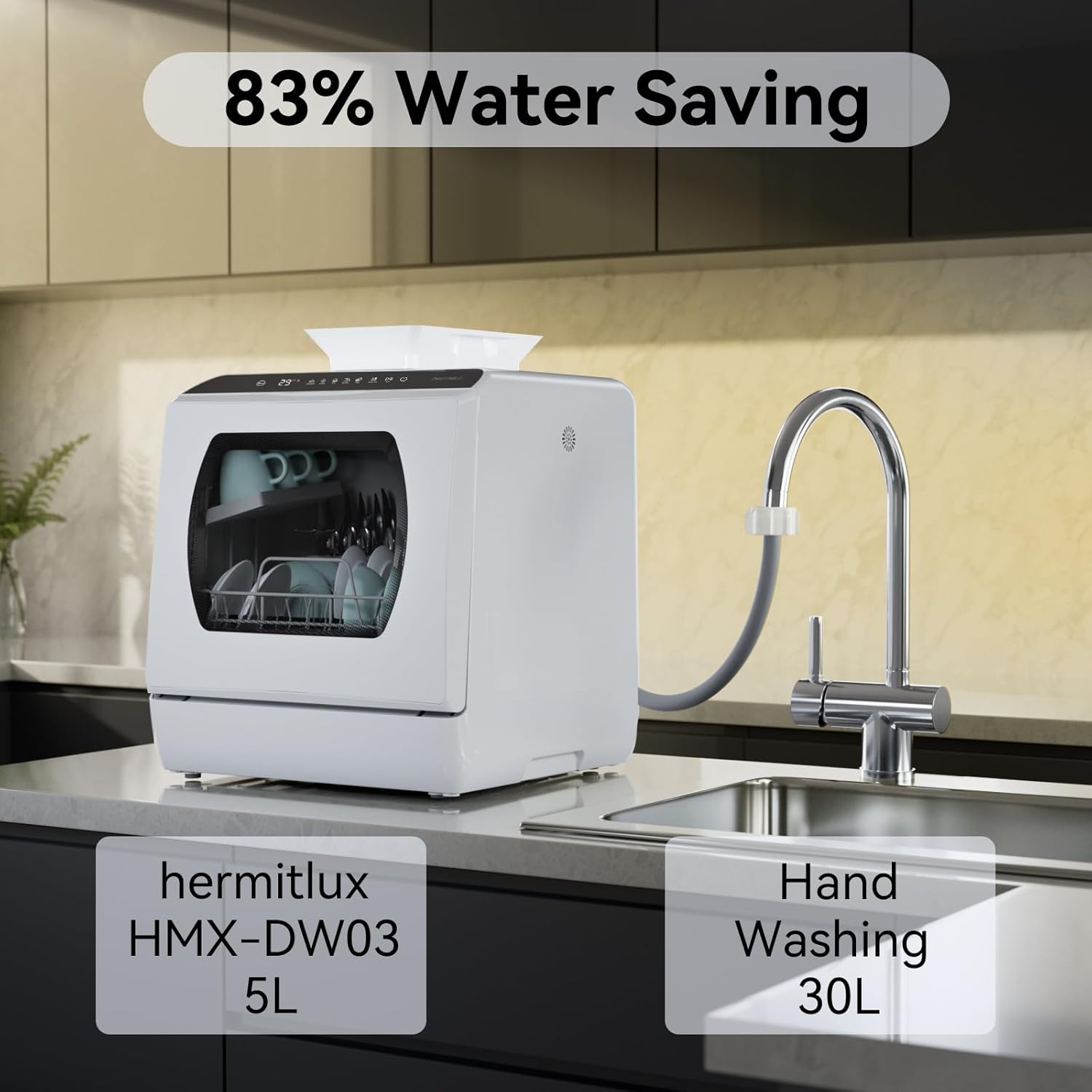
Energy and water efficiency influence operating expectations: the Hermitlux unit lists an annual energy consumption of 83 kWh/year and claims 5 L per cycle when using the built-in tank, suggesting low absolute water use compared to full-size units. Compact dishwasher energy metrics often reflect fewer cycles and lower heated water volumes, but per-item energy can be higher if loads are small. Maintenance factors—filter cleaning, drain hose routing, and periodic descaling—determine long-term performance; accessible filter access and a detachable cutlery basket simplify routine cleaning. Durability is informed by materials and certification: ABS and PP internals resist corrosion but are susceptible to long-term heat cycling, while powder-coated metal racks offer reasonable protection against rust. ETL certification provides a baseline for electrical safety and design compliance.
Interpreting the energy and water specifications
An 83 kWh/year rating situates the unit among other compact electric appliances in terms of annual consumption, but actual energy use is sensitive to cycle choice—heated drying and strong cycles increase consumption relative to ECO or quick modes. The 5 L per cycle water claim from the built-in tank underscores low absolute water demand and potential water savings versus handwashing for small loads; however, loading efficiency determines per-item water use. The faucet connection mode provides flexibility for continuous water supply and may alter total water drawn per cycle depending on inlet flow and program configuration. Buyers should match expected cycle frequency to household habits to estimate real-world resource use.
Maintenance routines, filter requirements, and indicators of longevity
Routine maintenance includes emptying and rinsing the fine strainer or multi-stage filter to prevent clogs, checking inlet and outlet hoses for kinks or wear, and wiping door seals to prevent residue buildup. The included drain hose and 59-inch inlet/outlet hoses facilitate flexible installation but should be inspected periodically for splits or mineral buildup, particularly in hard-water areas. Internal materials like ABS and PP reduce corrosion risk, but repeated high-temperature cycles and detergent exposure will gradually stress plastics; PA powder-coated racks offer good resistance to rust but can chip if loaded improperly. Adherence to manufacturer cleaning intervals and using recommended detergents helps preserve seals and heating elements over time.
Pros & Cons
Pros
- Compact, portable design with built-in 5 L water tank provides instant operation without a permanent hookup. This supports use in apartments, RVs, and temporary living spaces where plumbing access is limited. The included inlet and outlet hoses extend placement flexibility.
- Multiple wash programs plus a dedicated dry function allow users to select appropriate cycle intensity and drying, covering delicate glassware to heavier soiling scenarios. Sensor wash helps tailor cycle duration and energy use to load soil.
- Dual spray arms with 14 jets aim to deliver multi-angle coverage in a small chamber, reducing shadow zones and improving contact with dish surfaces when loaded correctly. The glass door aids visibility for loading adjustments.
- Low per-cycle water usage when using the built-in tank and a modest annual energy figure give a baseline for efficient operation for small households. ETL certification provides safety assurance for electrical components.
- Metal racks with PA powder coating offer corrosion resistance suitable for compact dishwasher environments, and included accessories such as a cutlery basket aid organized loading.
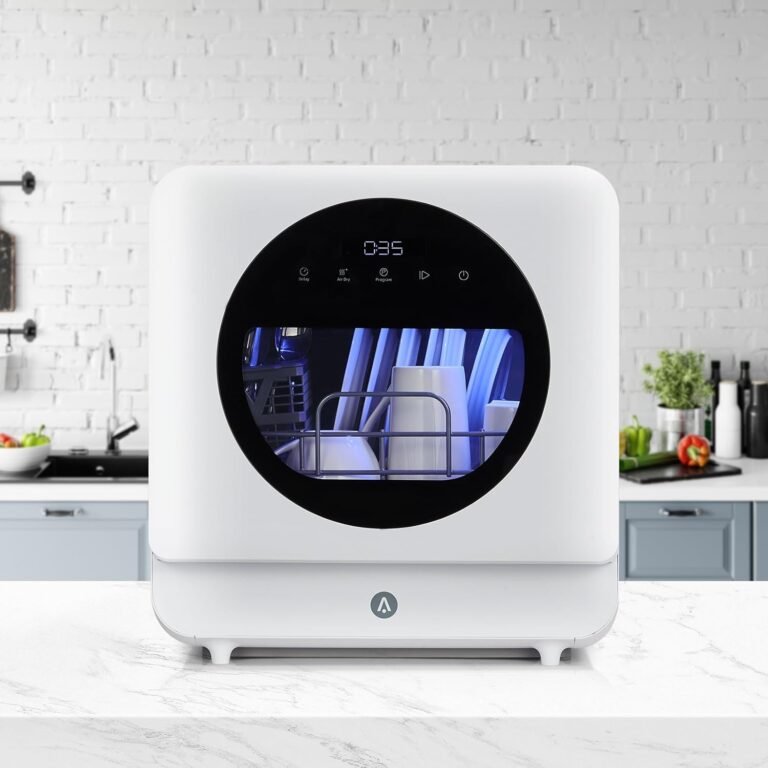
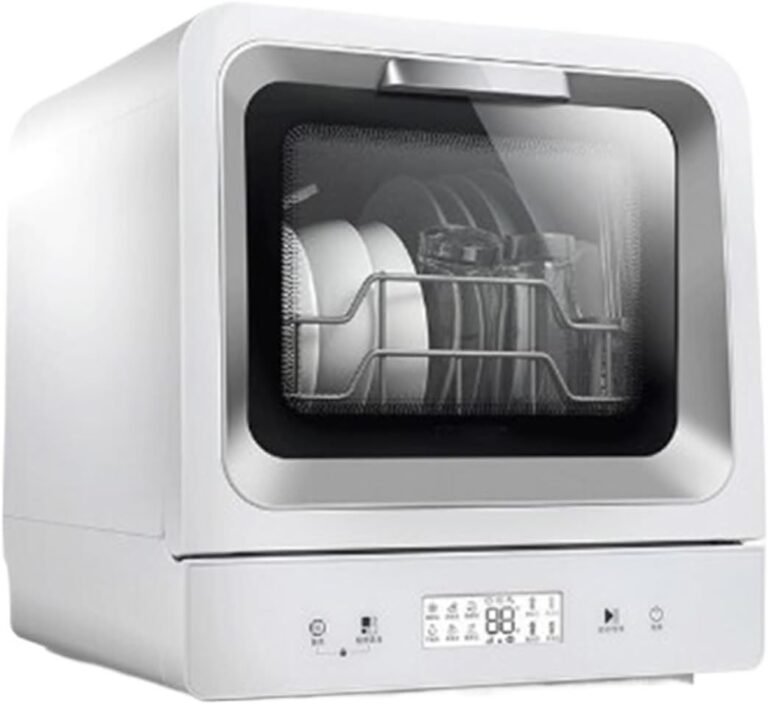
- Touch controls and LED display simplify program selection and monitoring without complex mechanical interfaces.
Cons
- Manufacturer does not publish a decibel rating, leaving noise expectations unclear for open-plan living spaces. Compact units generally produce more perceptible sound than built-in, heavily insulated models, which may limit placement options in noise-sensitive environments.
- Fixed rack geometry and limited internal height restrict the ability to accommodate larger cookware, cutting boards, and taller glasses. The specified 10.25″ dish clearance defines the maximum plate size and constrains some loading patterns.
- Residual moisture after testing is noted by the manufacturer as normal, indicating potential need for additional drying time, manual towel finishing, or reliance on the 72-hour ventilation feature for odor control.
- ABS and PP internal materials and powder-coated racks balance cost and corrosion resistance but may not match the long-term toughness of stainless steel interiors found in higher-end models. Long-term heat cycling can accelerate material fatigue.
Final Verdict: Who This Dishwasher Is Best For (and Who Should Skip It)
The Hermitlux portable countertop dishwasher addresses the core needs of one- to two-person households, RV and camper users, dorm occupants, and apartment dwellers who require a compact, no-plumbing setup with a variety of cycle options. Its built-in 5 L tank, dual spray arms, and heated drying expand usability where faucet connections are inconvenient, and the modest annual energy figure aligns with low-to-moderate cycle frequencies. Buyers prioritizing space efficiency and water conservation will appreciate the compact footprint and per-cycle water claims, while those needing flexible placement will benefit from the included long hoses and portable design.
This unit is less suitable for households that demand a quiet appliance for open-plan living, require handling of large pots or oversized platters, or prefer stainless steel interiors for heavy-duty longevity. The lack of a published noise rating and fixed rack geometry constrains its fit in noise-sensitive or high-volume kitchens. For buyers seeking a space-saving dishwasher that balances cleaning programs, drying options, and basic durability for small-scale use, the Hermitlux model presents a practical option; buyers with larger households or stringent acoustic expectations should consider full-size or built-in alternatives in 2026.
Frequently Asked Questions (FAQs)
How does the built-in 5 L water tank work and when is faucet mode used?
The built-in 5 L tank enables standalone operation by manually filling the reservoir using the supplied funnel; this is useful when a direct faucet connection is unavailable. Faucet mode uses the included inlet hose to connect the machine to a tap for continuous water supply. Faucet mode can alter total water drawn per cycle depending on program and inlet flow, while tank mode limits water per cycle to the filled volume.
Can this countertop dishwasher handle delicate glassware safely?
Delicate glassware is best cleaned using lower-intensity cycles such as ECO or sensor-guided programs that reduce mechanical and thermal stress. Angled placement and avoiding contact between items minimize vibration and reduce the risk of chipping. Avoid using prolonged high-heat drying on sensitive glass; the dry function can be omitted or used at lower settings to protect fragile items.
What maintenance is required to keep the unit performing reliably?
Routine maintenance includes emptying and rinsing the fine strainer or filter after heavy soils, inspecting and clearing spray arm nozzles, and checking hoses for kinks or mineral buildup. Wiping door seals and the interior after cycles prevents residue accumulation and odors. Periodic descaling may be necessary in hard-water areas to maintain heating element efficiency and water flow.
How efficient is the Hermitlux countertop dishwasher compared to handwashing?
The manufacturer indicates a low per-cycle water use when using the 5 L tank, which can be less than typical handwashing volumes for small loads. Annual energy consumption of 83 kWh/year provides a baseline for electrical use, but actual efficiency depends on cycle selection and load size: ECO and sensor modes conserve resources, while heated drying and strong cycles increase energy use.
Is the dishwasher suitable for open-plan kitchens with living areas nearby?
The manufacturer does not publish a decibel rating, so acoustic performance is not precisely quantifiable. Compact countertop models often produce more perceptible noise than insulated built-in units due to lighter cabinet construction. For open-plan spaces, conservative placement away from seating and sleeping areas or using the machine during less occupied periods can reduce perceived disturbance.
What limitations should RV owners consider before choosing this model?
RVs should accommodate the machine’s footprint and provide stable, level mounting to minimize vibration during operation. The 5 L tank and included hoses facilitate portable use, but power draw during heated cycles and available 120V supply should be considered. Drain routing and securing hoses to prevent movement are important for safe operation in mobile environments.
How durable are the internal materials like ABS and PA powder-coated racks?
ABS and polypropylene (PP) internal components are common for compact appliances due to corrosion resistance and lower weight, but repeated high-temperature cycles can stress plastics over time. PA powder-coated metal racks resist rust and provide reasonable durability; however, avoidance of sharp impacts and proper loading reduces coating damage. Regular maintenance and correct detergent use prolong component life.