BLITZHOME Countertop Dishwasher — Clean, Quiet, Efficient
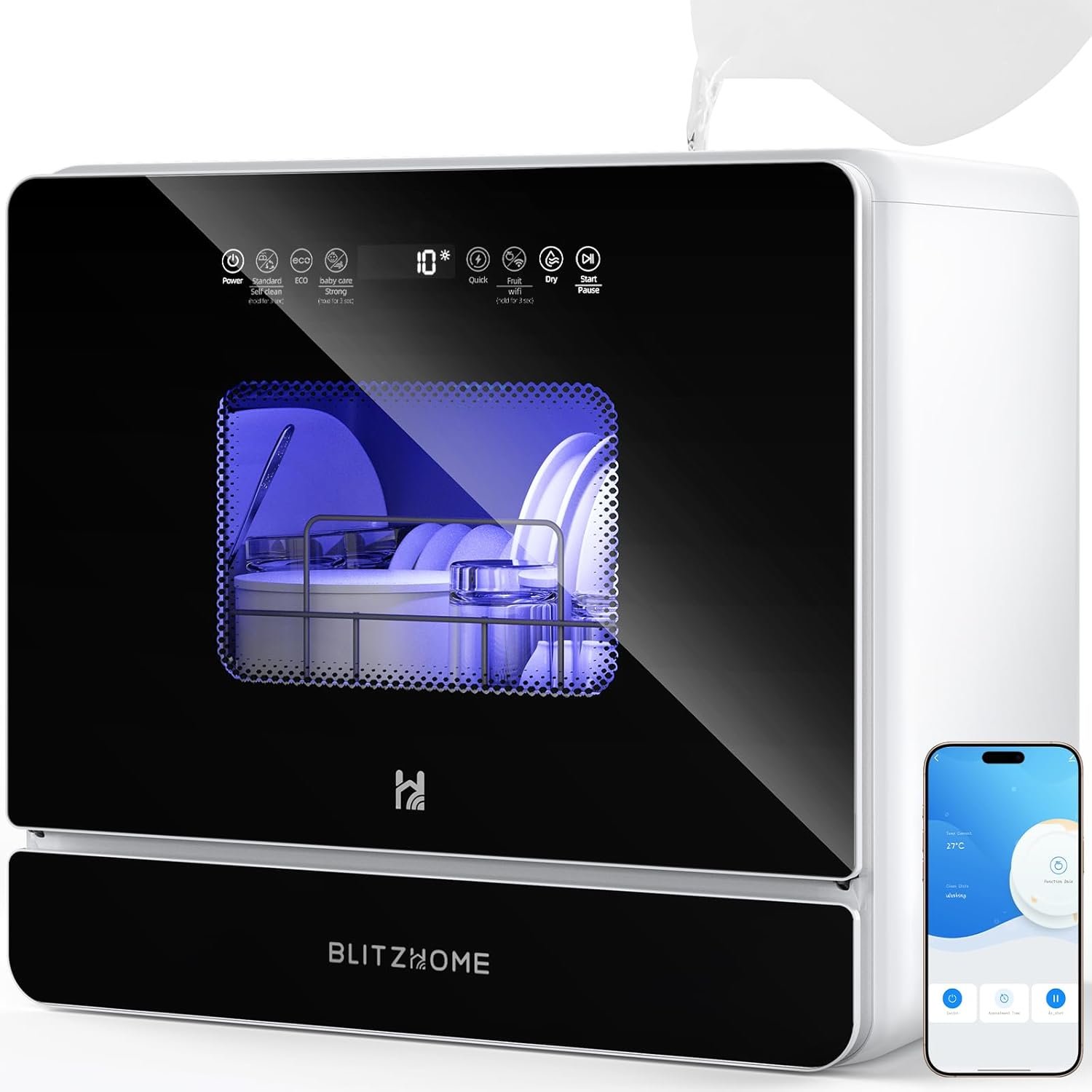
Choosing the right countertop dishwasher
Selecting a countertop dishwasher requires balancing cleaning performance, space constraints, and daily usage patterns. For apartments, RVs, and small kitchens, compact form factor and flexible water hookups matter as much as cycle options and drying effectiveness. Noise sensitivity is essential for open-plan living where a dishwasher at 56 decibels can be noticeable during conversation or media playback. Efficiency expectations include both water and energy use: built-in tanks and low-volume cycles suit intermittent use, while high-temperature washes and robust spray coverage address hygiene and grease removal. Durability hinges on materials and component design—stainless steel interiors and serviceable hoses and filters typically translate into more predictable lifespan. Buyer decisions should weigh load capacity against typical dinnerware size, evaluate control interfaces like app and touch control for convenience, and consider maintenance needs such as filter cleaning and drain access. This review interprets manufacturer specifications and common appliance evaluation principles to clarify suitability for different households.
Quick Overview
| Feature | Details |
|---|---|
| Dishwasher Type | Countertop, portable mini dishwasher |
| Capacity / Place Settings | 5.2 L internal tank; fits plates up to 11.81 inches; recommended for small households (4–6 people) |
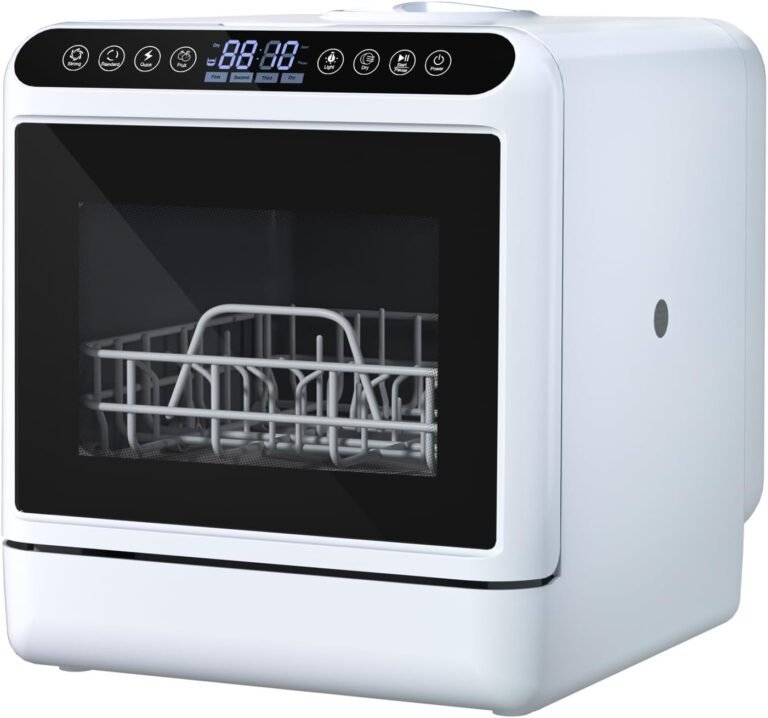
| Wash Cycles & Cleaning Tech | 9 programs (Standard, ECO, Baby Care, Strong, Quick, Fruit, Self-Clean, Dry, Delayed Start); 3 spray arms, 360° coverage; 167°F high-temp wash |
| Drying Method | PTC hot air drying (automatic 60 minutes); 72-hour air refresh feature |
| Noise Level | Manufacturer-rated 56 decibels |
| Energy / Water | Rated power 950 W; built-in tank 5.2 L per cycle; manufacturer lists water consumption as 1 gallon per hour in technical specs |
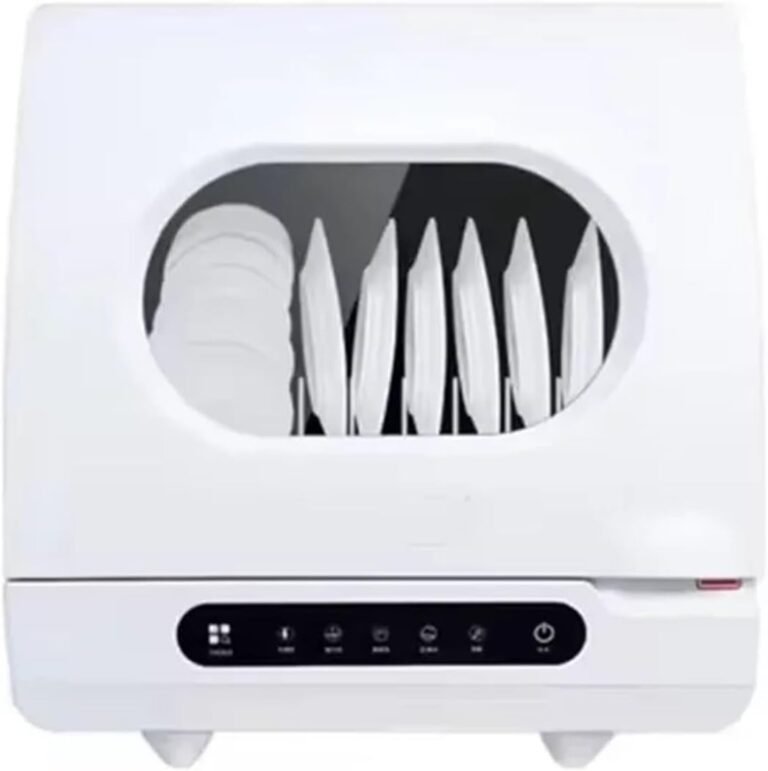
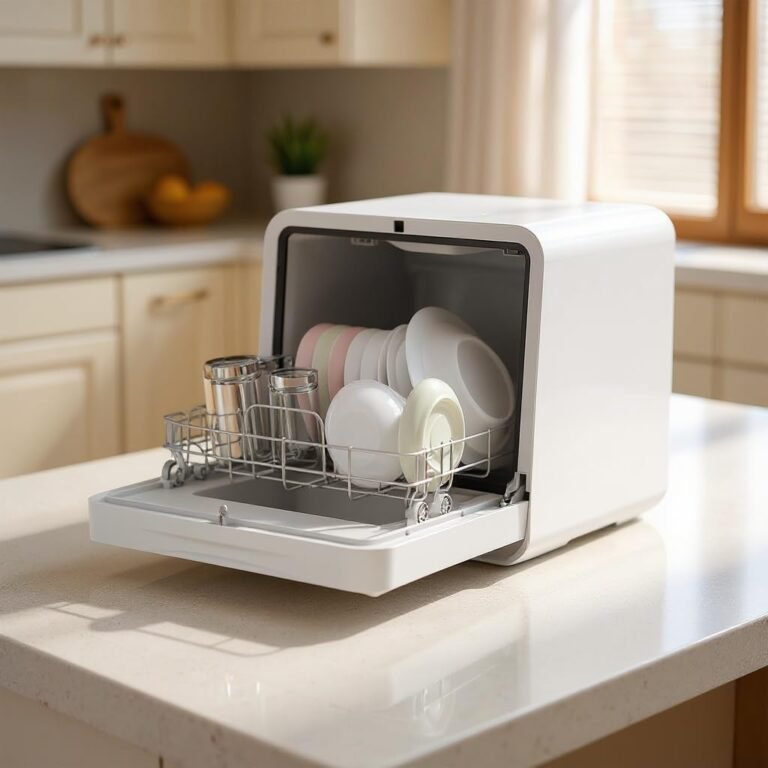
| Dimensions & Installation | 21.57″ D x 14.17″ W x 19.53″ H; countertop installation; dual water supply modes (tank or faucet) |
| Materials & Controls | Stainless steel interior; touch control and Smart App control |
| Included Accessories | Drain & inlet hoses, clamp, suction cup, measuring cup, fruit/vegetable basket |
This table summarizes manufacturer-disclosed specifications. In practice, the compact footprint and dual water modes support apartment and RV use, while the high-temperature wash and multiple cycles aim to handle common household soils. Noise and drying choices influence placement in open kitchens and the need for post-cycle towel drying.

Cleaning performance and wash coverage
The dishwasher’s cleaning model centers on three rotating spray arms with 360° coverage combined with a manufacturer-rated 167°F high-temperature wash, which targets grease and baked-on residues through elevated water temperature and pressurized spray patterns. The 9-program set includes cycles for standard, strong, quick, and specific items like fruit, which suggests variable pump speed and duration settings to balance mechanical action and soak time. Filtration and recirculation design affect soil removal; stainless steel interiors support higher wash temperatures but filter access and pore size determine how well particulates are trapped and removed. Spray geometry, arm placement, and cycle duration collectively influence coverage, with shorter programs prioritizing convenience and longer or high-temp cycles addressing heavier soils.

Spray arms, jet angles, and coverage
Three spray arms arranged for 360° coverage are intended to create overlapping water trajectories across racks, increasing the probability of direct impingement on soiled surfaces. Effective spray action depends on pump pressure, nozzle sizing, and arm RPM; higher flow and well-positioned nozzles improve mechanical cleaning but can increase water and energy use. The combination of upper and lower arms typically targets plates, bowls, and cups; a central or top-mounted arm can assist with glasses and utensils. Coverage limitations often arise at occluded zones where large pans or tightly packed items shield underlying pieces, so rack layout and loading guidelines influence real-world outcomes.
High-temperature wash and sanitization relevance
A wash temperature rated at 167°F (manufacturer-specified) enhances detergent activation and grease emulsification, improving removal of fatty residues and dried soils. Elevated temperature cycles also reduce microbial load more effectively than low-temperature washes, though certifications for sanitization depend on cycle validation rather than temperature alone. High-temp cycles demand robust seals, temperature-resistant components, and proper drain/vent strategies to handle condensate. For delicate items, lower-temperature programs or shorter cycles may be preferable to avoid thermal stress.
Capacity, rack design, and place settings
Compact internal volume and a two-level rack design aim to maximize usable space within the 21.57 x 14.17 x 19.53 inch footprint. The ability to accept plates up to 11.81 inches when the top rack is removed increases flexibility for larger dinnerware, while the 2-level system provides separation for plates, bowls, cups, and small cooking tools. The included fruit/vegetable basket and adjustable or removable rack elements can expand usable configurations for different loading needs. Capacity descriptions referencing suitability for 4–6 people assume multiple daily cycles and modest plate sizes; real-world place settings depend on plate diameter, utensil count, and pot/pan usage. Efficient rack design minimizes overlap and shadowing by spray arms to retain wash effectiveness across varied loads.

Rack layout and removable elements
A two-level rack with removable top elements facilitates alternating between maximizing plate diameter and stacking more items for smaller dishes. Folding tines or a removable rack section assists with taller glasses or mixing bowls, allowing plates up to 11.81 inches when required. Such modularity improves versatility for households that vary between full dinner service and light loads. However, space between racks influences how many items fit per cycle; compact units prioritize breadth of cycle utility over large single-cycle capacity, making loading strategy important for cleaning outcomes.
Place-setting equivalents and real-world loading
Manufacturer guidance that the unit suits 4–6 people reflects typical small household usage patterns rather than standardized place-setting counts used for full-size built-in dishwashers. In practice, multiple cycles per day or targeted loading for dinnerware sets will be necessary for families preparing full meals. The inclusion of a fruit basket and utensil space offers organization for smaller items, but larger pots and sheet pans may need pre-rinsing or separate cleaning, given limited internal volume and spray reach.
Noise levels and suitability for open kitchens
A manufacturer noise rating of 56 decibels places this countertop dishwasher in the moderate noise category, louder than ultra-quiet built-in models but within expected range for portable units. Perceived loudness depends on frequency content, casing vibration, placement on a solid countertop, and proximity to living spaces. In open-plan kitchens, 56 dB can be audible during conversations, television, or overnight use; soft-close cabinetry or isolation pads on the countertop can reduce transmitted vibration. For bedrooms or RV sleeping areas adjacent to the kitchen, noise sensitivity and cycle timing should be considered when using longer or higher-intensity programs.

Placement, installation, and vibration control
Countertop placement and surface interactions affect perceived noise: solid, level countertops transmit less vibration when supported properly, while thin laminate or movable surfaces can amplify mechanical noise. The provided suction cup and clamp for hose routing reduce movement during pump operation, and ensuring stable feet and a flat base reduces rattle. For noise-sensitive environments, choosing ECO or lower-intensity programs and scheduling cycles during periods of low occupancy minimizes interference.
Program selection impact on noise
Program type influences pump speed, heating demand, and drain operation, all contributors to noise profile. Quick or Eco cycles often run with lower pump speeds and shorter heating phases, yielding less overall noise, while Strong and high-temp cycles may increase audible levels due to longer pump operation and extended drainage. Understanding cycle trade-offs allows users to balance cleaning needs with household noise tolerance.
Drying systems and moisture control
Drying relies on a PTC hot air system that automatically runs for 60 minutes after the wash cycle, augmented by a 72-hour air refresh function designed to circulate air and reduce residual odors during storage. PTC heaters provide steady hot-air output without exposed heating elements, supporting faster evaporation than passive condensation methods. Hot-air drying performance hinges on airflow pathways, door/seal design, and interior surface temperatures; stainless steel interiors aid heat retention and reduce moisture adherence. For steam-prone loads or plastic items, post-cycle moisture may remain in recessed areas, and users may need to stagger unloading for optimal dryness.

Air refresh and storage hygiene
The 72-hour air refresh function periodically circulates air to minimize stagnant humidity and odor buildup during storage, which is useful when dishes remain inside between uses. This feature reduces the need for immediate unloading while preserving dryness, but it depends on ambient humidity and the completeness of initial drying. Proper filter maintenance and ensuring drain lines are clear help the refresh cycle function effectively, as trapped water or soiling can hamper airflow and increase odor risk.
Handling plastics and thermally sensitive items
Plastics and items with low thermal mass retain cold spots where moisture lingers after hot-air drying; the PTC system improves evaporation but may not fully dry such pieces. For optimal results, placing plastics on the top rack and allowing additional airing outside the unit may be recommended. Manufacturer guidelines and cycle selection should guide treatment of thermally sensitive items to avoid deformation.
Energy, water efficiency, maintenance, and durability
The unit’s rated power is 950 W, with a built-in 5.2 L water tank and technical documentation listing water consumption metrics; combined, these figures present trade-offs between cycle intensity and resource use. Compact dishwashers typically consume less water per cycle than full-size units, but energy per volume cleaned can be higher due to repeated cycles for multiple loads. Maintenance expectations include periodic filter cleaning, inspection of inlet and drain hoses, and descaling where water hardness is elevated. Durability factors center on stainless steel construction for interior longevity, quality of seals and pump components, and replaceability of hoses and electronic control modules. Reliability over time correlates with component quality, proper installation, and adherence to maintenance intervals.

Water use metrics and implications
Manufacturer-stated 5.2 L per cycle suggests significant water savings compared with handwashing in many scenarios, although real-world savings depend on load fullness and cycle selection. The dual water supply modes—tank or faucet—provide flexibility for locations without a permanent water connection but require attention to hose integrity and secure fittings to prevent leaks. Regular inspection of the included inlet and drain hoses and clamps reduces risk of water-related failures.
Filter access, descaling, and serviceability
Accessible filtration systems and removable traps simplify routine maintenance; clearing food traps and rinsing filters maintains circulation efficiency and spray performance. Hard water areas may necessitate periodic descaling to preserve heater and spray nozzle performance. The presence of replaceable hoses and modular components improves serviceability, but long-term reliability is influenced by manufacturer parts availability and build quality of pumps, seals, and electronics.

Pros & Cons
Pros
- Compact, flexible installation: Countertop design with dual water-supply modes (built-in tank or faucet connection) enables use in apartments, RVs, and locations without permanent plumbing. The included inlet and drain hoses plus clamp and suction cup support temporary or semi-permanent setups.
- High-temperature wash capability: A manufacturer-rated 167°F high-temp cycle supports improved grease removal and thermal sanitization potential for heavily soiled items, benefiting households focused on hygiene.
- Multiple programs and smart control: Nine program options including Baby Care, Strong, Quick, and Self-Clean, combined with touch control and Smart App connectivity, allow scheduling, remote monitoring, and program selection for varied loads.
- Hot-air drying and air refresh: PTC hot air drying with a 60-minute automatic dry cycle and a 72-hour air refresh feature reduce post-wash moisture and help limit odor during storage.
- Efficient water usage per cycle: The built-in 5.2 L water tank and manufacturer-stated low per-cycle consumption are advantageous for water-constrained environments and intermittent use.
- Stainless steel interior and compact footprint: Material choice supports higher temperature cycles and corrosion resistance, while dimensions accommodate many countertops without major modification.
Cons
- Moderate noise level: A 56 dB rating is louder than ultra-quiet built-in models and may be noticeable in open-plan living spaces or adjacent sleeping areas, requiring scheduling consideration for noise-sensitive households.
- Limited single-cycle capacity: Despite a flexible rack and removable top level, the small internal volume means multiple cycles may be required for full household dish loads, increasing cumulative energy use compared to larger models.
- Drying limitations on plastics and complex shapes: Hot-air drying improves evaporation, but low-mass plastics and recessed areas may retain moisture and require additional air-drying outside the unit.
- Power and voltage considerations: The manufacturer-rated voltage and 950 W power draw should be confirmed against local electrical standards and outlet capacity prior to purchase or installation.
- Dependence on proper maintenance for longevity: Filter cleaning, hose inspection, and potential descaling are necessary to preserve performance; constrained access or neglected maintenance can reduce effectiveness over time.
Final Verdict: Who This Dishwasher Is Best For (and Who Should Skip It)
This BLITZHOME countertop dishwasher suits small households, apartment dwellers, and RV users who prioritize compact, flexible cleaning solutions with multiple programs and high-temperature wash capability. Its 5.2 L built-in tank and dual supply modes make it practical where a direct water line is not desirable, and the PTC hot-air drying plus 72-hour air refresh improves readiness for intermittent use. Buyers who value smart controls and scheduling will appreciate app connectivity and touch controls for convenience in constrained spaces. The 56 dB noise rating and limited internal volume suggest it is less appropriate for large families seeking full-load efficiency or for users requiring ultra-quiet operation in open-plan living spaces. For households with frequent large pots, oversized bakeware, or strict low-noise requirements, a larger built-in or quieter full-size model may offer better long-term fit. Compared to similar countertop models available in 2026, this unit balances high-temperature wash and drying features with compact design, but prospective buyers should weigh loading patterns, noise tolerance, and maintenance commitment before choosing this option.

Frequently Asked Questions (FAQs)
How much water does this countertop dishwasher use per cycle?
Manufacturer specifications indicate a built-in water tank of 5.2 liters and list water consumption figures in technical data. The 5.2 L tank is used in Tank Mode for a single cycle, which positions the unit as water-efficient compared with many full-size dishwashers. Actual per-cycle consumption depends on program selection and load fullness; longer or high-temperature cycles can use more water due to additional rinses and circulation.
Can the dishwasher connect directly to a kitchen faucet?
Yes, the unit offers dual water-supply modes: Tank Mode using the built-in 5.2 L reservoir, and Faucet Mode where the supplied inlet hose connects to a tap. Faucet Mode provides continuous water supply during the cycle, while Tank Mode permits use without a fixed plumbing connection. Proper hose attachment and secure clamps are necessary to avoid leaks.
Is the 167°F high-temperature wash safe for all dishes?
A high-temperature wash rated at 167°F enhances cleaning and thermal sanitization potential but can stress delicate items such as certain plastics, decorated china, or heat-sensitive cookware. The dishwasher’s program selection includes lower-temperature or quick cycles appropriate for fragile items; manufacturer guidance should be followed to prevent thermal damage.
How loud is a 56 dB rating in daily use?
A 56 dB manufacturer rating typically corresponds to moderate noise noticeable in quiet environments. It is quieter than many portable units’ louder extremes but louder than ultra-quiet built-in models (often below 45 dB). Noise perception depends on placement, countertop stability, and proximity to living areas, so scheduling cycles during low-activity periods may reduce interference.
What maintenance is required to keep the unit running well?
Routine maintenance includes cleaning and rinsing the filter and food trap to maintain circulation and spray efficiency, inspecting and securing inlet and drain hoses, and descaling if used in hard-water areas. The PTC drying system and seals should be checked for residue buildup, and occasional self-clean cycles help preserve interior cleanliness. Adhering to manufacturer maintenance intervals supports consistent performance.
Will hot-air drying fully dry plastic items?
PTC hot-air drying improves moisture evaporation but low-mass plastics and recessed surfaces can retain moisture due to limited heat retention. For best results, place plastics on the top rack, use drying or extended cycles when available, and allow brief additional airing outside the unit if necessary. Drying effectiveness depends on load composition and cycle selection.
Is this dishwasher suitable for RV use?
The compact countertop form, 5.2 L tank, and dual water-supply modes make the unit adaptable for RVs and locations without permanent plumbing. The included inlet and drain hoses and suction cup help secure connections, but users should verify electrical compatibility and stable, level mounting to minimize vibration and ensure safe operation in a mobile environment.
How do smart app controls enhance the user experience?
Smart app control enables remote cycle selection, scheduling, monitoring of wash progress, and receiving error notifications, which enhances convenience for users who want to start or delay cycles without being near the unit. App features do not change fundamental cleaning mechanics but can improve usability and allow integration into daily routines.