Compact BLITZHOME Countertop Dishwasher — Quiet Cleaning
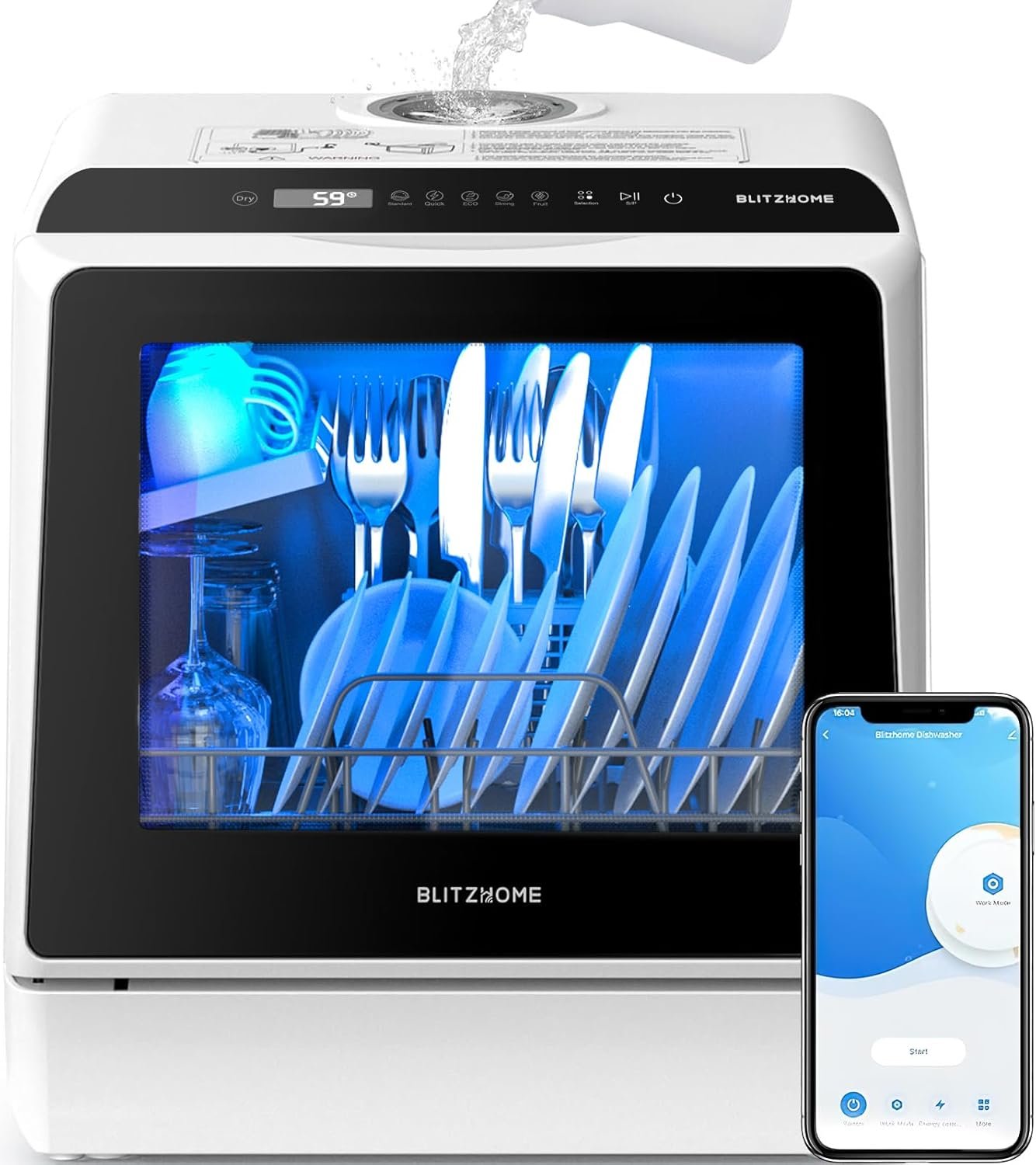
Why dishwasher selection matters for small kitchens and frequent cooks
Selecting the right dishwasher is a practical decision that affects daily chores, kitchen layout, and household routines. For compact kitchens, apartments, RVs, and small households, a countertop unit must balance cleaning performance with footprint, noise output, and water handling. Noise sensitivity and open-plan living demand attention to decibel ratings and drying cycles that limit residual moisture. Frequent cooks need reliable spray coverage and filtration to prevent redepositing soils, while occasional users prioritize easy maintenance and dual water inlet flexibility. Efficiency expectations should align with available certifications or the absence of them, and materials and component design provide clues about long-term durability. Evaluating these factors against household size and usage frequency helps determine whether a portable, tank-equipped countertop dishwasher delivers the desired trade-offs in convenience, performance, and installation simplicity.
Quick Overview
| Feature | Details |
|---|---|
| Dishwasher type | Countertop portable with built-in 5 L water tank and tap connection option |
| Capacity / place settings | Rated 5 liters; manufacturer states capacity for 4–6 sets (about 20 dishes) |
| Wash cycles | Six programs: Standard, Quick (29 minutes), Strong, ECO, Fruit, Drying |
| Cleaning technology | 360° 3D spiral spray with up/down dual spray arms and high-pressure coverage |
| Drying method | High-temperature drying (167°F) plus air-refresh function |
| Noise level | 58 decibels (manufacturer specification) |
| Energy efficiency | No ENERGY STAR certification indicated in product details |
| Dimensions / installation | 17″D x 16.9″W x 18.1″H; countertop placement, no hard plumbing required |
| Materials | Plastic exterior components with internal stainless steel elements |
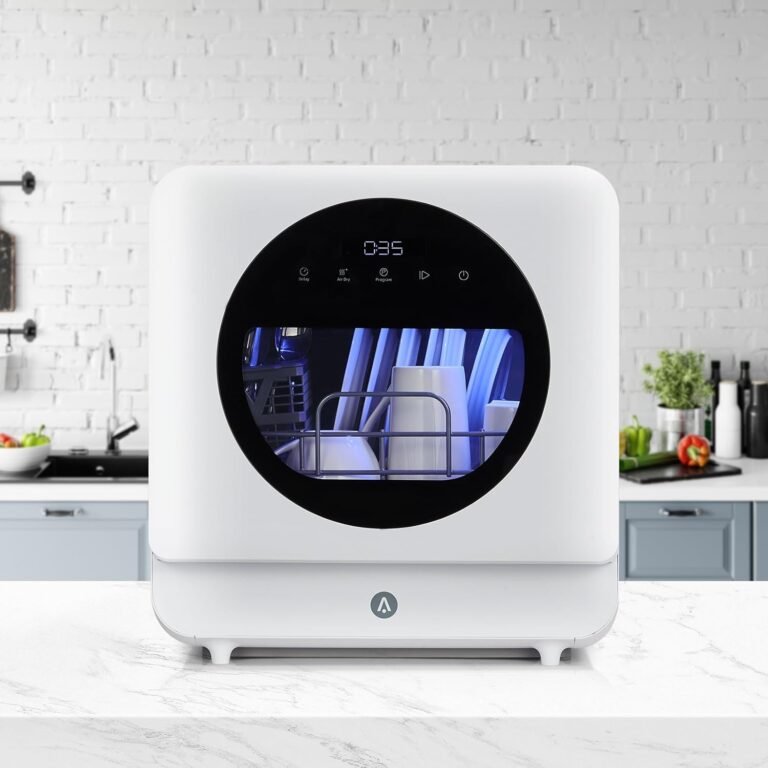
| Controls & connectivity | Touch controls with smartphone app monitoring and remote start |
| Included components | Dishwasher unit and user manual |
| Warranty | Not specified in manufacturer overview |
This feature summary translates into a compact option intended for households that need a plug-and-play cleaning solution without cabinet modifications. The dual inlet and internal tank support flexible placement in spaces lacking direct plumbing, while the small footprint suits counters and small galley kitchens. Noise and drying characteristics indicate moderate suitability for open-concept rooms but require assessment against occupant sensitivity to background sound.

Cleaning performance and spray coverage
The unit’s cleaning performance centers on a 360° 3D spiral spray and dual up-and-down spray arms intended to increase water coverage and pressure across loaded racks. High-pressure jets and multi-angle spray patterns are typical engineering approaches to compensate for smaller pump and motor sizes in portable machines; they help dislodge food soils from plates and utensils. A high-temperature wash option combined with a strong cycle can assist detergent activation and soil removal for heavier soils. Filtration and basin design influence soil separation and prevent redepositing; the presence of internal stainless steel elements supports higher-temperature cycles and reduces staining risks compared with all-plastic basins. Overall, spray arm design, jet placement, and program options determine cleaning consistency more than tank size alone.

Spray system mechanics and expected coverage
Dual spray arms operating in opposing planes increase the likelihood of water reaching both the top and bottom of typical dish configurations. Spiral or 3D spray patterns redirect flow to reduce shadowed zones behind tall items or clustered cutlery. In countertop designs with compact basins, short throw distances allow concentrated sprays to maintain cleaning force despite smaller pump volumes. However, densely loaded racks can still create occlusion where water cannot reach crevices; strategic loading and use of the recommended cycles improve results. The combination of a high-temp option and a strong wash cycle is the engineering fallback to manage stubborn residue in portable units.
Filtration, soil management, and detergent considerations
Effective soil management relies on a removable filter or trap that captures larger particles and prevents recirculation. In compact dishwashers, mechanical or mesh filters are common and must be cleared regularly to maintain performance; otherwise, particulates can redeposit during subsequent cycles. Water hardness and detergent formulation also influence cleaning outcomes: low-foaming, dishwasher-specific detergents and rinse aids assist drying and reduce spotting, while appropriate dosing avoids buildup in the small internal tank. Manufacturer guidance on detergent types and filter access should be followed to preserve pump and spray arm performance.
Capacity, rack design, and loading strategy
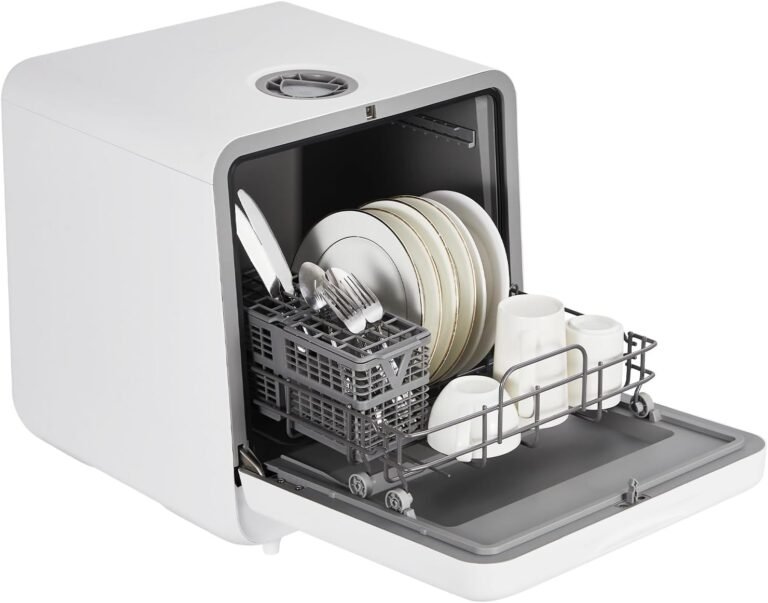
Capacity in countertop dishwashers is often expressed in plate counts or place settings rather than liters alone; the listed 5 L tank and a claimed 4–6 place settings (around 20 dishes) position this model for one- to three-person households or occasional family use. Rack geometry, basket layout for bowls and cutlery, and the presence of a dedicated knife and fork basket determine how many items can be loaded without obstructing spray coverage. Compact racks benefit from adjustable or removable elements to accommodate taller items or cookware in limited spaces, while multiple layers of spray arm reach are necessary to clean stacked bowls. Loading strategy that staggers items and keeps large pieces from shadowing smaller ones is essential for consistent results in a constrained interior.

Rack configuration and place-setting trade-offs
The inclusion of a bowl basket, cutlery basket, and storage racks suggests an attempt to mimic full-size organization in a compact footprint. Fixed baskets optimize stability but can limit flexibility when cleaning taller glasses or shallow pots. When capacity claims are evaluated, it is practical to consider not only item count but item types: plates and flatware occupy less volume than mixing bowls and utensils. For households that primarily wash standard plates and cups, the specified capacity is reasonable; those who need to clean larger cookware regularly will face trade-offs in load arrangement and may need multiple cycles.
Effect of loading on spray access and cycle selection
Loading density directly affects spray arm effectiveness—overcrowding can block jets and create untreated zones. Selecting a quick or ECO cycle for lightly soiled loads conserves time and water, while strong or standard cycles apply longer wash times and higher pump activity to confront heavier soils. The fruit cycle indicates a gentle option for delicate items but may not substitute for higher torque cycles on dried-on residues. Following manufacturer loading diagrams, spacing cutlery, and orienting bowls to expose soiled surfaces improves the likelihood of full cleaning coverage.
Noise levels and suitability for open kitchens
A rated noise level of 58 decibels places the unit in a moderate bracket for dishwashers; this level is perceptible yet not intrusive for many kitchen environments. In open-plan living areas where low background noise is desirable, sustained operation at this level may be noticeable during quiet hours. Acoustic emissions in portable units depend on motor and pump isolation, cabinet materials, and airflow paths. Plastic exteriors and slim-line designs can transmit more vibration than heavier, built-in units. For occupants sensitive to noise or for sleeping areas adjacent to the kitchen, placing the unit on a sturdy, vibration-dampening surface and scheduling cycles during active daytime may mitigate disturbance.

Decibel rating context and perceived sound
Decibel ratings are logarithmic; a difference of a few decibels can be perceptually significant. At 58 dB, the unit is comparable to an average conversation at home. Continuous noise during a wash cycle may be less noticeable in busy households but can be more evident in studio apartments or quiet evenings. The perception of noise also follows frequency content: high-frequency whines are more irritating than low-frequency hum. Design features such as motor mounts, insulated panels, and soft-close lids affect how sound is transmitted to surrounding spaces; countertop models trade some of these features for portability.
Placement, vibration, and mitigation strategies
Placement on a level, solid countertop reduces vibrational resonance that amplifies noise. Isolation pads or rubber feet can dampen transmitted vibration to counters. Avoid placing the unit on unstable surfaces or thin cabinetry that may rattle. Dual inlet and tank options allow placement away from sink edges, which can reduce echoing from adjacent hollow cabinetry. For open kitchens, evaluating noise sensitivity and selecting cycles with lower pump intensity when possible will align operation with comfort expectations.
Drying systems, moisture control, and air refresh
Drying performance in compact dishwashers commonly combines high-temperature air drying with mechanical or passive ventilation. The specified 167°F (approximately 75°C) high-temperature drying function accelerates moisture evaporation and can assist in reducing spotting when paired with appropriate rinse aids. Air-refresh functions circulate ambient air to lower humidity post-cycle, but small basins can retain pockets of moisture near seals and in cutlery baskets. Material choices, such as stainless steel interiors, aid in heat retention and reduce condensation compared with all-plastic interiors. Despite these systems, users should expect some residual moisture on plastics and deep-set items and may need to open the door briefly after the cycle to permit additional airing.

High-temperature drying effectiveness and limitations
High-temperature drying elevates basin temperature to assist in evaporation, which benefits glassware and ceramics. However, plastic items with lower thermal mass may not shed water as readily and can retain droplets despite elevated temperatures. Heat-assisted drying is more effective when combined with a rinse aid that reduces surface tension and helps water sheet off surfaces. Energy use implications and the small tank design can limit cycle duration; therefore, drying effectiveness should be weighed against the compact unit’s intended use rather than compared directly to full-size integrated models.
Moisture control, condensation, and recommended handling
Condensation tends to collect in corners and on underside of hinged lids; the air-refresh mode aims to reduce humidity but cannot eliminate all retention. Best-practice handling includes arranging items to expose surfaces to airflow, using rinse aid when compatible, and slightly opening the door after a cycle to expedite cooling and evaporation. Regular inspection of door seals and drainage passages prevents pooling and helps maintain a dry interior. For glassware and lightweight plastics, manual towel drying may still be necessary for show-quality results.
Energy, water efficiency, maintenance, and durability considerations
Energy and water efficiency expectations for portable dishwashers must reconcile smaller tank volumes with pump and heater loads. The absence of an ENERGY STAR label in product details indicates no verified independent efficiency certification; consumers should expect performance to vary by cycle and inlet mode (tank versus tap). Maintenance needs hinge on filter accessibility and regular descaling where water hardness is high. Durability depends on materials like internal stainless steel components, quality of seals, and the robustness of spray arm bearings and pump assemblies. App connectivity can aid in cycle scheduling but does not substitute for routine physical maintenance. Long-term reliability will align with frequency of use, adherence to cleaning guidelines, and the quality of replacement parts availability.

Water and energy trade-offs with built-in tank vs. tap connection
A built-in 5 L tank enables fill-and-go convenience but limits the total water available per session and may require more frequent refills for heavy loads. Connecting to a tap provides continuous water supply and can support longer or stronger cycles but requires hose management and stable pressure. Energy consumption is influenced by heater runtime during high-temp wash and drying stages; compact heater elements heat smaller volumes quickly but may cycle more frequently. Without independent efficiency ratings, comparisons rely on cycle descriptions and user needs rather than certified benchmarks.
Filter maintenance, component wear, and expected service needs
Accessible mesh or cartridge filters are standard in compact units and must be cleaned regularly to prevent clogging and maintain pump longevity. Seal condition and hinge mechanisms are common wear points in portable dishwashers; inspection and occasional seal replacement preserve water tightness. Spray arm jets may require descaling or manual clearing if mineral buildup occurs. Availability of replacement parts and clear manufacturer instructions contribute to long-term upkeep and reduce the likelihood of premature component failure.

Pros & Cons
Pros
- Flexible installation options: The integrated 5 L water tank plus a tap-connection mode allows placement where plumbing is limited, making it adaptable for apartments, dorms, RVs, and small kitchens. This flexibility removes the need for cabinet modification.
- Compact footprint with claimed 4–6 place settings: The 17″ x 16.9″ x 18.1″ dimensions position the unit for countertop use while offering organization features such as a bowl basket and cutlery compartment to optimize available space.
- 360° dual spray system: Up-and-down spray arms and a spiral spray pattern are engineered to improve coverage within a small basin, increasing cleaning reach compared with single-arm designs.
- Six program options including Quick and ECO: A 29-minute quick cycle provides a fast option for lightly soiled loads, while ECO and strong modes cater to energy/water trade-offs and heavier soils respectively.
- High-temperature wash and drying functions: A 167°F drying option and high-temp wash setting aid in better soil removal and faster drying compared with passive-only systems.
- App and touch control interface: Smartphone connectivity provides remote monitoring and scheduling, which aligns with modern smart-appliance expectations for convenience.
Cons
- Moderate noise level at 58 dB: While not exceptionally loud, this level may be noticeable in quiet, open-plan living spaces and for light sleepers in adjacent rooms.
- Limited capacity for larger cookware: The compact internal volume and fixed baskets constrain the ability to clean larger pots, baking sheets, and oversized items in a single cycle.
- No listed ENERGY STAR certification: Absence of an independent efficiency label requires buyers to rely on cycle descriptions rather than verified energy or water performance metrics.
- Plastic exterior components and potential long-term wear points: Plastic housings and compact motor assemblies in portable units can be more susceptible to wear and vibration-related issues than heavier built-in models.
- Maintenance requirements for filters and tank: Regular filter cleaning and occasional descaling are necessary to maintain consistent performance, which increases routine upkeep compared with some integrated designs.
Final Verdict: Who This Dishwasher Is Best For (and Who Should Skip It)
This BLITZHOME countertop dishwasher is best suited to small households, renters, dorm residents, and owners of small boats or RVs who need a compact, plumbing-free cleaning option. The dual water inlet and 5 L tank enable flexible placement where direct hookups are unavailable, and the 360° spray plus multiple wash programs offer reasonable cleaning capability for plates, cups, and light cookware. App connectivity and a quick 29-minute cycle provide convenience for busy users who prioritize time-saving features over full-size capacity.
Households that routinely clean large pots, frequent heavy-soil cookware, or require the quietest possible operation in an open-plan home should consider larger built-in models or units with verified low-noise ratings and ENERGY STAR certification. Similarly, users seeking minimal maintenance should weigh the need for frequent filter cleaning and potential for mineral buildup in small tanks. Overall, this model fits a niche for portable convenience with competent cleaning systems, provided expectations align with compact capacity and moderate noise characteristics.

Frequently Asked Questions (FAQs)
How many place settings does a 5 L BLITZHOME countertop dishwasher actually hold?
The manufacturer lists a capacity suitable for approximately 4–6 place settings (around 20 dishes). In practice, capacity is influenced by item types: flatware and plates use less space than mixing bowls, tall glasses, or cookware. Strategic loading—placing plates in slots, arranging bowls to face water jets, and using the cutlery basket—maximizes usable volume within the compact interior.
Is 58 dB quiet enough for open-plan living spaces?
A rating of 58 decibels is moderate and roughly comparable to normal conversation levels. In open-plan apartments it is likely noticeable but not overly intrusive during daytime. For quiet evenings or sleeping areas adjacent to the kitchen, users sensitive to background noise may find it more perceptible. Placing the unit on a solid, vibration-dampening surface can reduce perceived noise.
Does the built-in 5 L water tank limit wash cycles or performance?
A 5 L tank supports plug-and-play operation where direct plumbing is unavailable, but it limits the total water available per session. For heavier or multiple back-to-back loads, the tank may require refilling or a switch to the tap connection. Cycle selection and detergent use affect performance; stronger cycles may consume more water if connected to a tap versus the tank mode.
How effective is the 360° dual spray system for tough, baked-on food?
The 360° spiral spray and opposing spray arms increase coverage and are engineered to improve soil removal in compact basins. For baked-on residues, selecting the strong or high-temperature wash cycle enhances detergent activation and mechanical action. Dense loading or occluded areas can still impede spray access, so pre-rinsing or soaking heavily soiled items may be advisable for optimal results.
What maintenance is required to keep the dishwasher performing well?
Regular cleaning of the removable mesh filter and inspection of spray arm jets for mineral buildup are primary maintenance tasks. Descaling may be necessary in hard-water areas to prevent clogging. Checking door seals and drainage passages helps avoid pooling and preserves pump life. Following manufacturer cleaning guidance and using suitable dishwasher detergent and rinse aid prolongs consistent performance.
Is the high-temperature drying at 167°F safe for all dishware?
High-temperature drying at around 167°F (75°C) improves evaporation for heat-resistant items like glass and ceramics. However, certain plastics and delicate items may warp or retain water during heat cycles; manufacturer care labels should be consulted. For plastic items, lower-temperature cycles or manual drying is recommended to prevent deformation and ensure even drying.
Can the dishwasher be connected directly to a kitchen tap?
Yes, the unit supports dual inlet modes: filling the internal 5 L tank or attaching the dishwasher to a tap. Tap connection allows continuous water supply for longer or heavier cycles, while the tank option offers portability and installation-free use. Proper hose management and adherence to tap adapter instructions are necessary for a secure connection.
Are there energy or water efficiency certifications for this model?
Product details do not list ENERGY STAR or similar independent efficiency certifications. Without verified ratings, energy and water usage depends on selected cycles, inlet mode (tank versus tap), and frequency of use. Consumers seeking certified efficiency should compare models that carry established labels or provide detailed consumption data.