
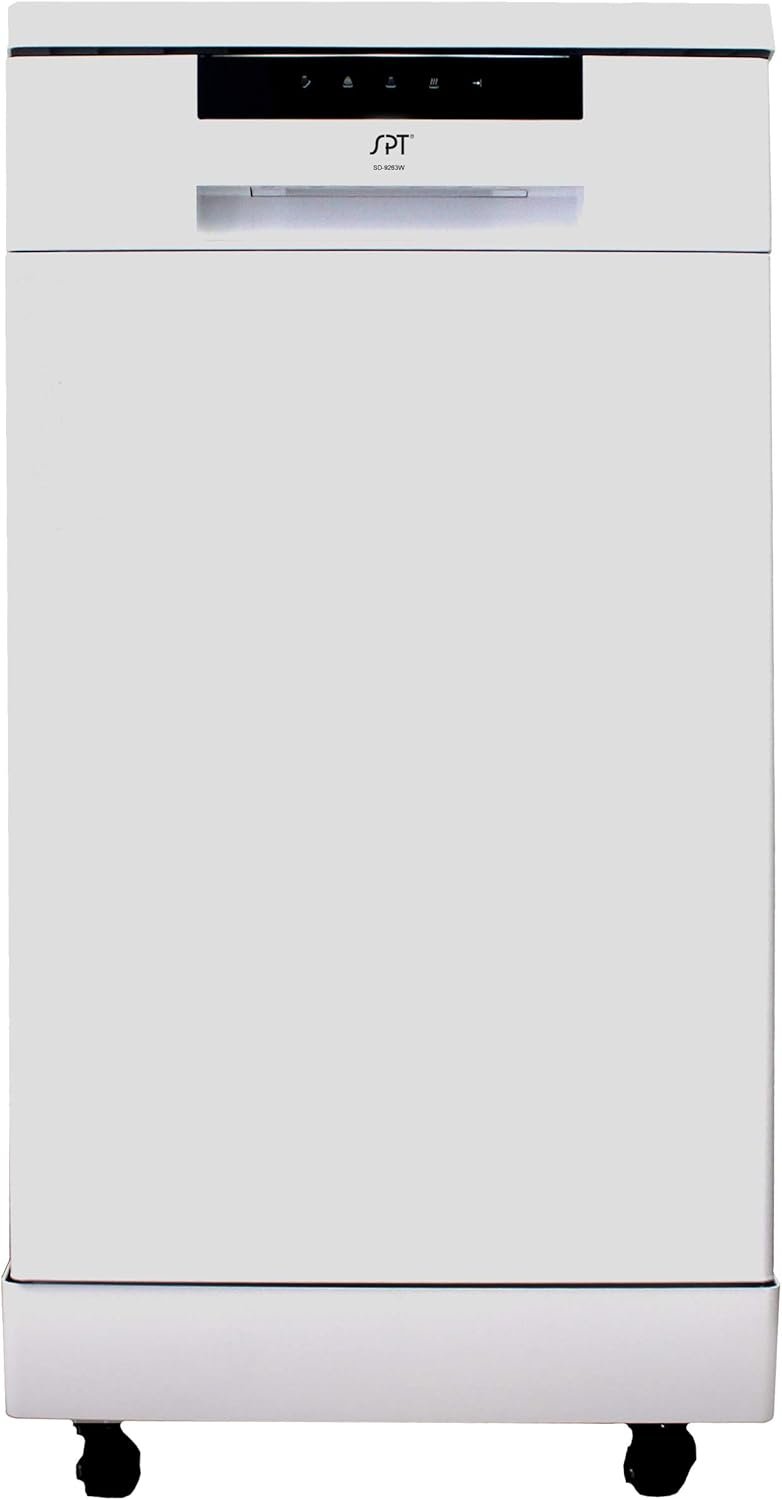
Choosing the right dishwasher for a small kitchen
Selecting a dishwasher requires balancing cleaning performance, space constraints, noise tolerance, and long-term efficiency. For households in apartments, small homes, or houses with limited cabinet access, an 18-inch portable dishwasher presents a space-conscious alternative to full-size built-in units while still handling everyday dishware and cookware. Noise sensitivity matters for open-plan living or kitchens adjacent to living rooms; a listed 52 dB rating indicates moderate background sound rather than whisper-quiet operation. Frequency of use and typical soil levels should drive cycle choice—multiple wash programs and soil-handling options help tailor cleaning intensity. Energy and water efficiency expectations are increasingly relevant; Energy Star certification and the manufacturer’s annual energy consumption figure provide measurable baselines. Maintenance needs and durability expectations also influence purchase decisions, particularly in portable models that rely on faucet adapters and lighter-duty plumbing connections compared with permanent installations.
Quick Overview
| Feature | Details |
|---|---|
| Dishwasher type | Portable, freestanding 18-inch unit |
| Capacity | 8 place settings |
| Wash cycles | 6 programs: Heavy, Normal, Eco, Glass, 90 Min, Rapid |
| Drying method | Not specified by manufacturer (rinse aid indicator present) |
| Interior material | Stainless steel tub |
| Noise level | 52 decibels (manufacturer rating) |
| Energy efficiency | ENERGY STAR certified; annual energy consumption 237 kWh/year |
| Dimensions & installation | 24″ D x 18″ W x 36″ H; quick-connect faucet adapter, no permanent plumbing required |
| Controls & features | Full console, time delay (1–24 hours), error alarm, adjustable upper rack |
| Warranty | Not specified in available product details |
The table highlights the unit’s suitability for small households and temporary or renter-friendly kitchens: an 8-place capacity and compact footprint fit limited spaces, while a faucet adapter enables use without direct plumbing. ENERGY STAR certification and multiple wash programs address efficiency and cleaning flexibility; the stainless steel tub supports durability and heat retention even though the explicit drying system is not detailed by the manufacturer.

Cleaning performance and wash coverage
The SD-9263WA presents a mix of programmable cycles and a stainless steel interior intended to support effective soil removal and wash coverage throughout the cavity. Multiple cycle choices—Heavy, Normal, Eco, Glass, 90 Min, and Rapid—allow selection of longer, higher-temperature washes for baked-on soils and shorter, lower-energy cycles for lighter loads. A stainless steel tub improves heat retention and can help maintain wash temperatures during the cycle, supporting detergent action. A rinse aid indicator signals when to replenish surfactant to promote sheeting and reduce spotting on glassware. Spray arm geometry, pump pressure, and filter arrangement are not detailed beyond the interior material, so expectations for wash coverage should be aligned with typical portable dishwasher engineering: targeted spray arms and program-dependent pump timing rather than high-flow commercial systems.

Spray arms, pump flow, and filtration
Portable dishwashers of this form factor usually rely on one or two spray arms fed by a mid-range circulation pump; the SD-9263WA’s specifications do not list pump flow rates or spray arm count. In such designs, cleaning effectiveness depends on spray arm reach and nozzle arrangement, as well as the selected program’s duration and temperature profile. Filtration systems in compact dishwashers often combine a removable coarse filter with a fine mesh or microfilter to catch food particles and protect the pump. Regular filter clearing maintains spray pressure and avoids redeposition of soils; the unit’s error alarm and full-console controls may display fault codes if circulation becomes restricted, aiding diagnosis.
Cycle selection, soil handling, and rinse aid role
Cycle selection is central to matching soil levels to wash intensity. The Heavy cycle provides extended soak and wash periods for heavily soiled pots and bakeware, while Normal and Eco balance cleaning with energy use. The Rapid cycle shortens total time for lightly soiled loads, and Glass offers gentler action and lower temperatures for delicate stemware. The 90-min program provides a compromise between time and intensity. The rinse aid indicator supports drying and spot reduction by reducing surface tension on water; using rinse aid in conjunction with appropriate cycles helps control mineral spotting, especially in regions with harder water.
Capacity, rack design, and place settings
An 8-place setting capacity targets single individuals, couples, or small households that generate modest daily dish volume. A compact footprint (18 inches wide) limits interior volume compared with standard 24-inch units, so loading strategy becomes important: prioritize plate orientation, nest mugs on the top rack, and load cutlery with spacing to avoid nesting. The adjustable upper rack expands flexibility for taller glasses or small pots, and dedicated tines should secure plates vertically for circulation. Capacity comments from customers are mixed, reflecting trade-offs between space savings and reduced simultaneous load size compared with full-size dishwashers. For households that run the machine more frequently or wash larger cookware by hand, the 8-place configuration can be an efficient compromise.

Rack layout, adjustability, and utensil handling
The adjustable upper rack increases the range of detectable item heights and can free vertical space on the lower rack for larger plates or shallow pans. Typical portable-rack designs include fold-down tines on the lower basket to accommodate pots or larger serving dishes, though manufacturer-supplied diagrams should be consulted for exact tine counts and folding patterns. Utensils are commonly placed in a removable cutlery basket on the lower rack; separating forks, spoons, and knives and avoiding nesting maximizes exposure to spray and reduces washing time. Where the upper rack is raised for tall items, the overall plate capacity on the lower rack will decrease, which is an expected trade-off in compact systems.
Suitability for pots, pans, and mixed loads
Portable dishwashers typically handle everyday cookware but are not optimized for very large or deeply soiled bakeware. The Heavy cycle targets higher soil loads, yet large casserole dishes or oversized skillets may still obstruct spray arm rotation or prevent adequate water flow to adjacent items. Stainless steel tub construction tolerates higher internal temperatures and supports robust wash cycles, but users should plan mixed loads with an understanding that very large items reduce effective capacity. Frequent running with partial loads is a plausible strategy for small households to manage both capacity limitations and cleanliness without long-term overpacking.
Noise levels and suitability for open kitchens
A manufacturer-stated 52 dB places the SD-9263WA in a moderate noise category—noticeable in quiet environments but generally unobtrusive during active living. For open-plan layouts where the kitchen flows into living spaces, a 52 dB sound level may be acceptable during daytime use or while conversational noise is present, but in late-evening scenarios or when silence is desired, it will be more perceptible than lower-decibel models. Portable units can transmit vibration into adjacent cabinetry or flooring; installation location, platform stability, and leveling can influence perceived loudness. Noise ratings offer a comparative baseline, but actual perception varies with room acoustics, distance, and placement near seating or sleeping areas.

Acoustic considerations and distance from living areas
Sound intensity drops with distance and can be damped by cabinetry, carpets, and soft furnishings. A 52 dB dishwasher positioned farther from primary living spaces or separated by doors will be less intrusive. Portable placement frequently locates the unit near countertops and sink areas, which in small apartments may be adjacent to seating zones; in such layouts, plan for cycle timing during active periods rather than quiet hours. Vibration-transmitted noise is mitigated by level feet and sturdy floor surfaces; uneven floors or thin subfloors can amplify hum or rattle, and additional anti-vibration pads may be warranted in sensitive installations.
Build materials, insulation, and perceived sound
The stainless steel tub contributes to thermal performance and may marginally affect acoustic damping relative to plastic tubs, although sound insulation depends more on cabinet design and integrated insulation layers than tub material alone. Portable units often have lighter outer cabinet panels and less mass overall than built-in units, which can make them more perceptible in quieter environments. Manufacturers sometimes add foam or layered insulation to reduce both noise and heat transfer; since specific insulation details are not provided, the listed 52 dB rating should be used as the primary guide for noise expectations rather than inferred damping properties.
Drying systems and moisture control
Manufacturer documentation does not specify a dedicated active drying technology for the SD-9263WA, so drying expectations align with common portable dishwasher approaches: condensation drying aided by the stainless steel tub and the use of rinse aid to promote sheeting and faster water runoff. Stainless steel surfaces shed moisture more efficiently than some plastics and retain heat through the cycle, which encourages evaporative and condensation-based drying during the cool-down phase. The presence of a rinse aid indicator supports improved drying performance by reducing surface tension and limiting spotting. Without a specified heated drying element or fan-assisted drying claim, moisture control will depend primarily on cycle selection, rinse aid use, and post-cycle door-opening practices.

Rinse aid, cycle choice, and spot control
Rinse aid plays a central role in reducing film and spots by allowing water to form continuous sheets that drain to the sump rather than bead on surfaces. For households in hard-water areas, consistent use of rinse aid is especially important to manage mineral deposits on glassware. Selecting cycles with higher final temperatures can accelerate evaporation and improve drying outcomes, while shorter or eco cycles may compromise dryness to save energy. The unit’s rinse aid warning indicator reduces guesswork about when to replenish, supporting consistent spot control when used as indicated.
Post-cycle handling and moisture management in compact units
In many portable dishwashers without active fan drying, opening the door slightly after the final rinse helps vent moist air and reduce residual dampness inside the tub. The stainless steel interior reduces retention of odors and moisture compared with some polymer tubs, though leaving wet items inside closed cavities for extended periods can still foster lingering moisture. For glassware and plastics, unloading promptly and allowing items to air-dry outside the machine or on a rack may improve final dryness. These practices align with standard appliance engineering recommendations where explicit drying specifications are not provided by the manufacturer.
Energy, water efficiency, and maintenance expectations
ENERGY STAR certification and the listed annual energy consumption of 237 kWh per year provide measurable efficiency references for the SD-9263WA. Portable dishwashers often optimize water and energy use through shorter eco programs and sensor-driven cycles in more advanced models, although manufacturer documentation for this unit emphasizes standard cycle choices without explicit sensor claims. Maintenance expectations for compact units emphasize regular filter cleaning, monitoring the rinse aid reservoir, and checking connections at the faucet adapter. The unit’s error alarm and fault codes are useful for diagnosing issues quickly; adherence to basic maintenance extends service life and preserves cleaning performance in the long term.

Filter access, routine cleaning, and clog prevention
Compact dishwashers commonly include a removable coarse filter and sometimes a secondary fine filter to trap food debris. Routine removal of accumulated solids from the filter prevents pump strain, maintains spray pressure, and avoids unpleasant odors. Running a rinse cycle to clear particulates before starting a full wash or scraping large food remnants into the trash helps reduce filter load. Because this model connects to a faucet via adapter rather than direct plumbing, periodic inspection of the adapter and inlet hose for wear or leaks is part of preventive maintenance and can prevent service interruptions.
Energy and water expectations relative to household use
Annual energy consumption figures provide a comparative baseline against other models; the 237 kWh/year figure aligns with moderate energy use for compact dishwashers, with actual energy and water consumption varying by cycle choice and frequency of operation. Eco cycles generally reduce both energy and water use by extending run time while lowering temperature and flow; households seeking minimal environmental footprint should favor those programs. For renters or homes where permanent installation is not possible, the portability and quick-connect faucet adapter allow efficient operation without altering existing plumbing, though users should account for the need to connect and disconnect when relocating the unit.
Pros & Cons
Pros
- Compact, renter-friendly form factor: The 18-inch portable design and quick-connect faucet adapter allow use where permanent plumbing or cabinet cutouts are not available. This supports temporary installations or small kitchens that cannot accommodate a full-size built-in unit.
- ENERGY STAR certified: Energy Star listing and a published annual energy consumption figure provide clear efficiency metrics for buyers comparing models on electricity use. Certification suggests compliance with established performance and efficiency criteria.
- Multiple wash programs: Six selectable cycles—from Heavy to Rapid and a Glass program—offer flexibility to match soil levels and fragility of items. This enables tailoring of temperature and duration to optimize cleaning without excessive energy use.
- Stainless steel tub: A stainless steel interior improves heat retention during cycles, resists staining and odor absorption, and supports long-term material durability compared with many polymer tubs.
- Rinse aid indicator and time delay: A visible reminder for rinse aid refills and a 1–24 hour delay start provide convenience and help improve spot-free drying and scheduling flexibility.
- Error alarm and fault codes: Diagnostic signaling helps identify malfunctions or operational issues quickly, making maintenance and troubleshooting more straightforward for owners and service technicians.
- Moderate noise rating for a portable unit: The 52 dB rating positions the unit as acceptable for many household scenarios where absolute quiet is not required, suitable for daytime use in apartments and small homes.
Cons
- Limited capacity for larger households: The 8-place setting capacity is modest compared with standard 24-inch dishwashers and may require more frequent cycles for families or homes that generate larger daily dish loads.
- Drying system not specified: Manufacturer documentation does not state an active heated or fan-assisted drying method, so final dryness can depend heavily on rinse aid use and cycle choice, which may not meet expectations for fully dry plastics or heavy glassware.
- Faucet adapter reliance: Quick-connect installation is convenient but can be less robust than direct plumbing; repeated connecting and disconnecting may accelerate wear on hoses or adapters and could be less suitable for heavy, permanent use.
- Perceived noise in quiet settings: At 52 dB, operation will be noticeable in very quiet environments or at night, making the unit less ideal for bedrooms or adjoining living spaces that require low background noise.
Final Verdict: Who This Dishwasher Is Best For (and Who Should Skip It)
The SPT SD-9263WA is well suited to small households, apartments, and renter situations where a compact, non-permanent dishwasher is required. Its 18-inch portable footprint, ENERGY STAR certification, stainless steel tub, and multiple wash programs make it a pragmatic choice for singles, couples, or households that prioritize space efficiency and moderate energy use. The rinse aid indicator, time delay, and error-alarm features increase convenience and help maintain consistent performance without dramatic user intervention. Those who value a balance between cleaning flexibility and small-kitchen compatibility will find the unit aligns with typical portable dishwasher engineering trade-offs.
This model is less appropriate for larger families, households that require high-capacity simultaneous loads, or users who demand the quietest possible operation in open-plan living areas. The modest 8-place capacity and an unspecified active drying technology mean frequent cycles or supplemental drying may be necessary for heavy or mixed loads. For buyers seeking the quietest operation, highest capacity, or a built-in permanent installation, standard 24-inch built-in models or higher-tier portable units with explicit fan or heated drying claims may be a better fit in 2026 comparisons.
Frequently Asked Questions (FAQs)
How many place settings does the SPT SD-9263WA hold and what does that mean for a small household?
The unit is rated for 8 place settings, which generally suits single occupants, couples, or very small households. This capacity handles a typical meal’s worth of plates and cutlery but is smaller than standard 24-inch dishwashers, so larger households may need multiple cycles each day or supplement with manual washing for oversized cookware.
Is the SD-9263WA quiet enough for open-plan living areas?
The manufacturer rates the dishwasher at 52 decibels, a moderate level that will be noticeable in very quiet rooms but acceptable for daytime use in open living areas. Placement distance, flooring type, and nearby furnishings influence perceived sound, so positioning farther from primary seating or using level supports can reduce disturbance.
Does the dishwasher include a heated or fan-assisted drying system?
Manufacturer documentation does not specify an active heated or fan-assisted drying method. Drying performance is therefore likely to rely on condensation-assisted drying, stainless steel tub heat retention, and the use of rinse aid. Users seeking rapid, fully dry results for plastics may need to open the door post-cycle or towel-dry some items.
What maintenance tasks are required to keep cleaning performance consistent?
Routine maintenance includes clearing the removable filter of food debris, inspecting the spray arms for blockages, replenishing rinse aid as indicated by the warning light, and checking the faucet adapter and inlet hose for tight connections and wear. Keeping drains clear and avoiding excessive food solids extends pump life and maintains spray pressure.
How does the Energy Star rating affect expectations for this model?
ENERGY STAR certification and the published annual energy consumption (237 kWh/year) indicate that the unit meets established efficiency standards for small dishwashers. These figures provide a baseline for comparing electricity use, but actual consumption varies with cycle selection and frequency. Eco cycles typically reduce both energy and water per cycle.
Can the unit handle pots and pans effectively?
The Heavy cycle is designed for more soiled items, but the compact 18-inch footprint limits space for very large or deep bakeware. Fold-down tines and adjustable racks help accommodate medium-sized pots and pans, yet oversized items may obstruct spray patterns or reduce the number of usable plate positions.
Is permanent plumbing required for installation?
No permanent plumbing is required. The dishwasher includes a faucet adapter for quick-connect use with existing kitchen faucets, making it suitable for renters or locations where direct plumbing is not feasible. Regular inspection of the adapter and hose is recommended to avoid leaks and wear from repeated connections.