
Choosing the right dishwasher for a small kitchen or RV
Selecting a dishwasher for a small home, apartment, or recreational vehicle requires balancing cleaning performance, footprint, power source, and noise sensitivity. Compact countertop units shift focus from place settings to task-specific cleaning: utensils, small bowls, travel mugs, makeup brushes, or produce. Kitchen layout and whether the space is open to living areas influence acceptable noise and vibration levels, while frequency of use determines how durable and easy to maintain a small unit must be. Energy and water expectations differ from full-size appliances; portable, battery-powered options prioritize low electrical draw and short cycles over heavy soil removal. For potential buyers, the decision matrix centers on whether the unit’s cleaning technology, capacity, and mounting options align with typical loads and the household’s tolerance for residual moisture and drying time.
Quick Overview
| Feature | Details |
|---|---|
| Dishwasher type | Mini countertop / portable, freestanding (countertop bucket form factor) |
| Capacity / place settings | Designed for small items; manufacturer recommends batch cleaning small bowls and dishes (no formal place-setting rating) |
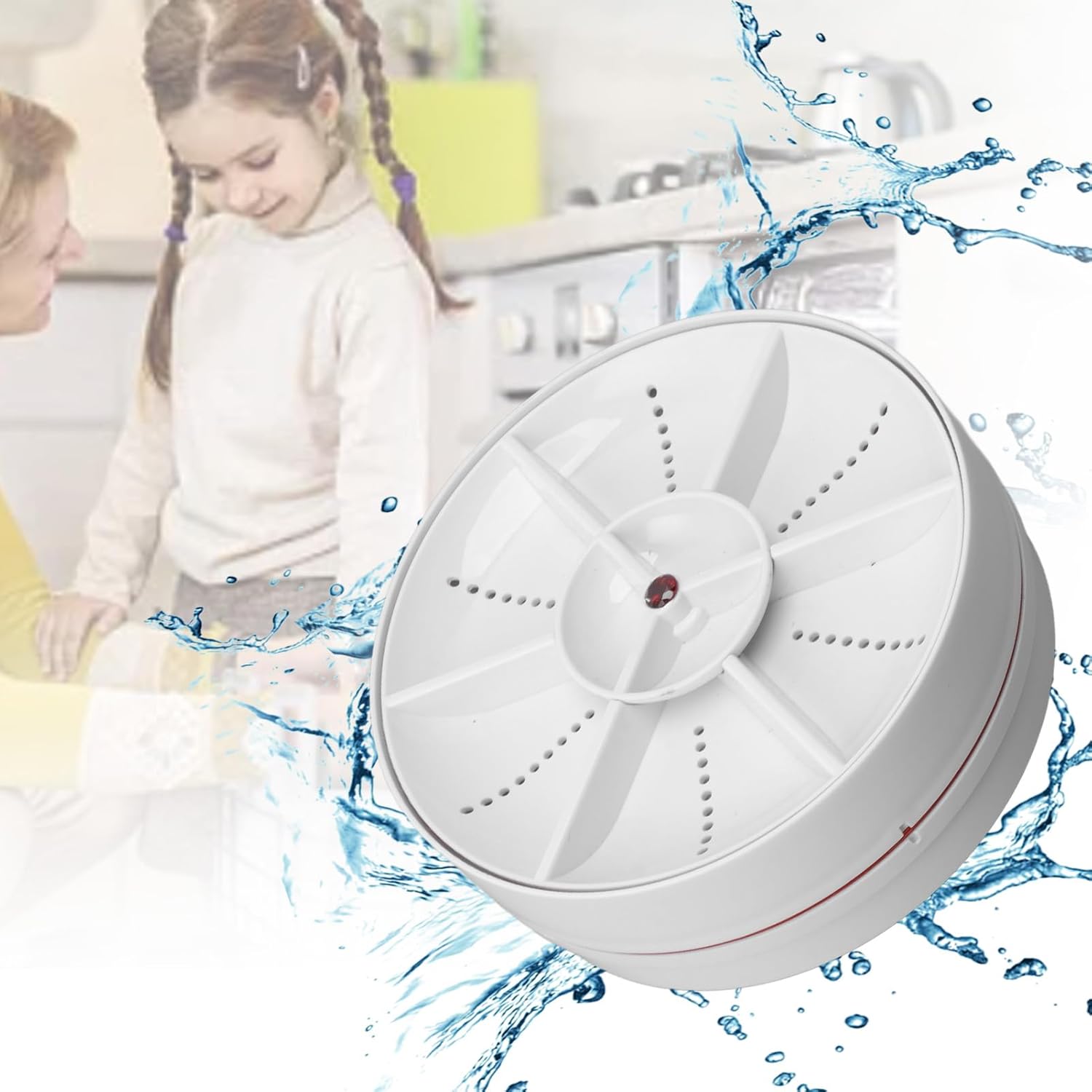
| Wash cycles and cleaning technology | 2 cycle options (Normal, Quick); features advertised as vortex + sonic emulsification with 360° coverage and 45 KPa suction |
| Drying method | Not specified by manufacturer; likely passive air-dry (no heated drying reported) |
| Noise level rating | Not specified by manufacturer |
| Energy efficiency certifications | None specified |
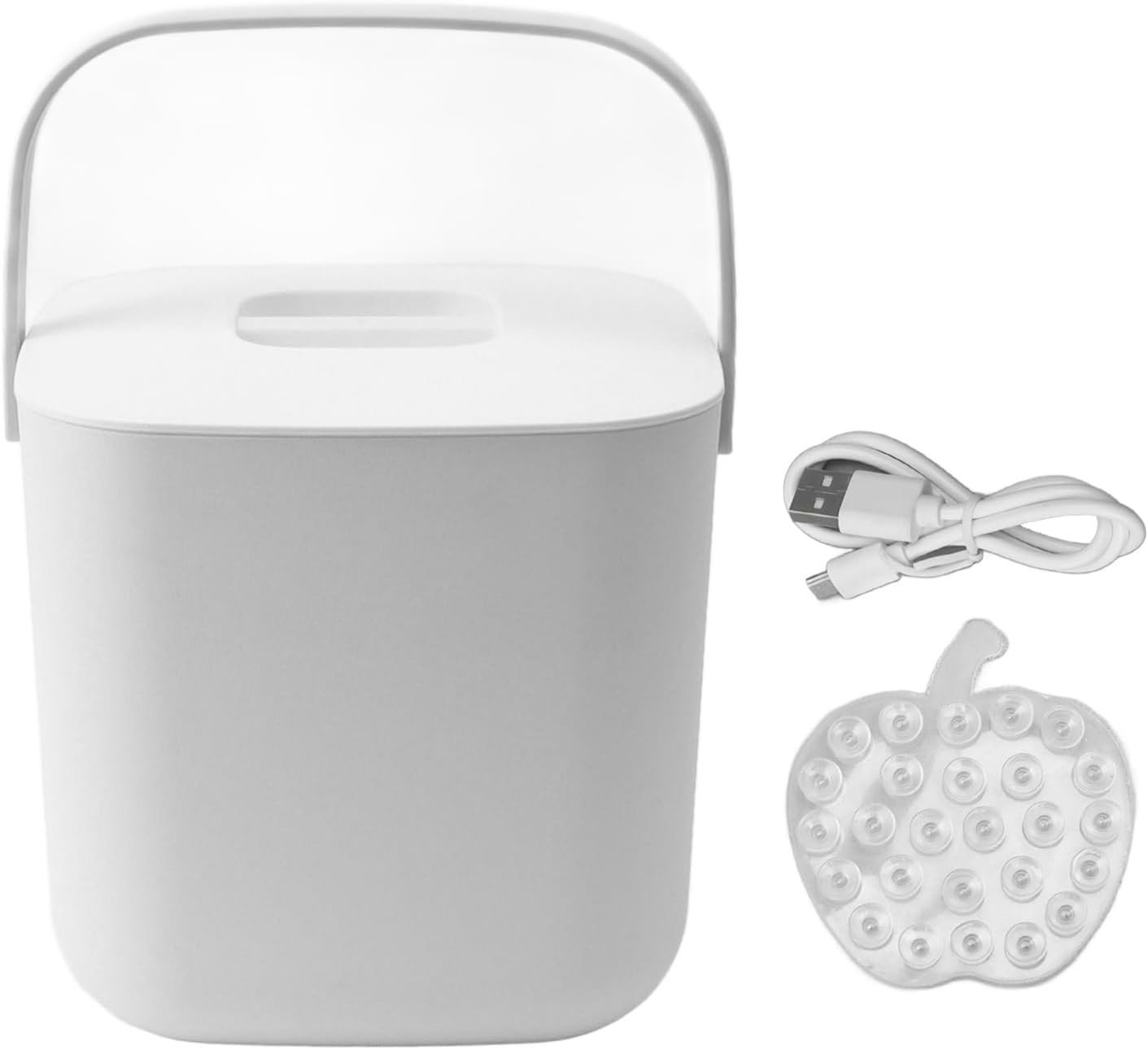
| Dimensions & installation | 7.87″ x 7.87″ x 7.87″; countertop; suction-cup mounting accessory included |
| Power & battery | 18 W input, 8.5 V / 2 A input; built-in 18650 Li-ion battery (2,000 mAh) listed by manufacturer |
| Materials & build | ABS and PC plastics |
| Warranty | Not specified by manufacturer |
These specifications frame the product as a highly compact cleaning device for light, intermittent loads. The built-in battery and low-power design support portability and temporary use in kitchens, apartments, or RVs, while the small internal volume limits load size and necessitates batch washing. Lack of a formal noise rating and absence of heated drying means placement and post-cycle handling should be considered when integrating this unit into open-plan living areas.

Cleaning performance and wash coverage
The manufacturer lists a combination of artificial vortex flow and sonic emulsification as the primary cleaning mechanisms, plus 360-degree coverage and a 45 KPa suction figure. Those features suggest agitation-driven soil breakdown and fluid movement are used to dislodge food particles and emulsify grease. For compact devices, spray geometry and the generation of fine cavitation or micro-bubbles (sonic-assisted) can improve wetting and reach in tight arrangements, but removal of baked-on residues depends on cycle time, water temperature, and detergent chemistry. The advertised 15-minute auto shut-off implies relatively short cycles that are tailored to light soils; heavier residues or dried-on grease typically require longer durations, higher temperatures, or pre-soaking to loosen tenacious soils before using a mini unit.

Spray system design and emulsification claims
The described vortex plus sonic emulsification design implies two complementary mechanisms: bulk water movement to physically dislodge debris and high-frequency agitation to break oil films. In small, sealed wash chambers this can create effective mechanical action across exposed surfaces, particularly for utensils and lightly soiled plates. Emulsification aids surfactant action from detergents, helping grease to disperse into solution. Limitations arise with complex geometries, deeply recessed rims, or encrusted proteins where access and mechanical impingement are reduced. Given the unit’s low 18 W power draw and short cycle durations, expectations should be aligned with light cleaning tasks rather than heavy-duty degreasing.
Filtration, particle capture, and rinse clarity
Compact countertop units typically use simple particulate traps or mesh filters rather than multi-stage filtration seen in full-size dishwashers. In this design context, removal of dislodged solids relies on chamber drainage and small filters to retain larger debris. Without a heated rinse and with limited water volume, suspended particles can re-deposit if not flushed effectively, so particle capture quality and ease of cleaning the filter are important. The manufacturer’s materials (ABS, PC) are chemically compatible with common dishwasher detergents, but routine filter inspection and manual removal of trapped debris will preserve wash clarity and minimize redeposition across successive batches.
Capacity, rack design, and typical load handling
The product dimensions and manufacturer guidance indicate a very small internal volume optimized for single-serve items, small bowls, utensils, cosmetics tools, and produce. There is no formal place-setting metric; instead, load planning is necessary: flatware and narrow items orienting towards spray paths will clean most effectively while overlapping items or stacked cookware will block flow and degrade results. A bucket-style interior has advantages for oddly shaped items and brushes, but lacks the adjustable tines and multi-level racks of larger machines. Users should expect to batch-clean several cycles for a family or for multiple categories of items, and to stage pre-soaking where soils are stubborn, since the form factor prioritizes portability over continuous full-kitchen throughput.

Load geometry and effective spray coverage
Effective cleaning in compact devices depends on how items are arranged relative to spray sources and vortex flow. Small plates, cups, and utensils should be spaced to allow rotational or radial flow to reach all surfaces; conjoined stacks or nested bowls reduce exposure and create shadowed areas. Fragile glassware benefits from separation to avoid chipping and to permit detergent contact. The unit’s 360-degree claim suggests multi-directional agitation, but the limited chamber size means that items must be oriented deliberately to get uniform wetting. For mixed loads, grouping similar items together reduces the risk of incomplete cleaning and simplifies drying.
Batch washing and cycle planning for small households
Because the device is designed for light, intermittent use, households should plan for multiple short cycles rather than a single full-load approach. This modular workflow suits single occupants, couples, or RV users who generate small quantities of soiled items, but it is less efficient for larger families or for cookware that requires extended soaking or high-temperature cycles. The manufacturer’s 15-minute automatic shut-off and Normal/Quick cycle options favor rapid turnover; however, repeated cycles will increase total time and handling compared with larger dishwashers. Accepting a batch-based routine and pre-soaking heavy soils will help align performance with household needs.
Power, battery, and energy expectations
Manufacturer specifications list an 18 W power consumption and a built-in 18650-type Li-ion battery at 2,000 mAh, with an 8.5 V/2 A input for charging. These figures indicate a low-power design optimized for portability and limited-duration operation rather than continuous high-heat or long rinses. Battery-powered operation enables use where mains access is limited, but runtime will be constrained by cycle length and battery capacity; repeated consecutive cycles will depend on recharge time and available charging method (USB cable included). The lack of explicit energy efficiency certifications is common for niche portable appliances, and buyers should interpret manufacturer power figures as indicative of modest electrical draw but not as a certified measure of overall energy efficiency when compared to full-size, ENERGY STAR-rated dishwashers.

Battery life, charging, and cycle budgeting
With a 2,000 mAh cell and an 18 W draw, theoretical run time will be limited; cycle selection and frequency impact how many loads are possible per charge. Short Quick cycles are likely intended to maximize per-charge throughput, while Normal cycles may consume more power and reduce the number of usable cycles between charges. Charging via USB enables flexible recharging but increases dependency on external power sources for sustained use. For users planning off-grid or RV use, estimating cycle count per charge and planning access to mains or vehicle charging are key operational considerations.
Water usage and portability trade-offs
Tiny wash chambers by design use a small volume of water per cycle, which conserves water compared with full-size machines but also reduces rinse dilution and heat capacity. Limited water volume can limit soil suspension and removal, increasing the importance of detergent selection and pre-soaking. As a portable appliance, this unit’s water handling is suited to quick spot-cleaning or sanitizing of small items rather than replacing a full kitchen dishwasher. The trade-off between portability and thoroughness is central: the device trades continuous heavy-soil capability for lower water and power requirements and a smaller footprint.
Noise levels and placement suitability in open kitchens
No manufacturer decibel rating is provided, leaving noise expectations to be inferred from the design: low-power motors and small pump assemblies generally produce mid-to-high frequency noise that can be noticeable in confined, quiet spaces. In open-plan kitchens, any continuous mechanical noise may compete with conversation and media; the short cycle durations mitigate exposure time but do not eliminate the potential for distraction. Suction-cup mounting and a freestanding bucket form factor help isolate the unit from direct counter contact, but vibration transfer through the surface and resonance in thin cabinetry can amplify audible output. Buyers should evaluate placement options where the machine’s frequency profile will be less intrusive, or use it during times when minor noise is acceptable.

Noise character and open-plan suitability
Small pumps often emit a higher-pitched whine and intermittent motor sounds different from the low-frequency hum of larger appliances. In open-plan living areas, pitch and tonal characteristics matter: high-frequency noise tends to be more perceptible and fatiguing at close range. The lack of an official dB rating makes subjective tolerance the primary determinant; however, short Quick cycles reduce total exposure and the suction mount reduces mechanical coupling if applied correctly. For noise-sensitive environments, locating the unit in a corner, on rubber isolation pads, or running cycles during less quiet periods will improve household compatibility.
Vibration, mounting, and stability considerations
Stability is critical for both cleaning effectiveness and acoustic performance. The included sucker (suction cup) mounting accessory is intended to anchor the unit to smooth surfaces, limiting movement during the vortex action and reducing sloshing. Proper seating on a flat, rigid counter will minimize bounce and mitigate noise amplification through countertops. Uneven surfaces, fragile countertops, or makeshift supports can allow shift or tilt during operation, risking poorer spray coverage and increased vibration noise. Attention to placement and surface compatibility enhances both cleaning results and noise control.
Maintenance, drying approach, and long-term reliability
The manufacturer lists ABS and PC plastics as the primary materials, which are common in compact appliances for impact resistance and chemical compatibility. These materials are durable when maintained but are vulnerable to repeated high-temperature exposures beyond typical small-unit operation. Routine maintenance should focus on clearing mesh filters, inspecting seals, and ensuring the suction mounting remains clean to preserve adhesion. The absence of a heated drying system indicates that moisture management requires post-cycle handling: open the lid promptly, towel-dry delicate items, or allow extended air-dry time to prevent water spotting and microbial growth in persistent damp conditions.

Filter care, seals, and chemical compatibility
Simple mesh or trap filters in compact units require regular emptying and rinsing to prevent clogging and redeposition of soils. The ABS/PC construction tolerates common detergent chemistries, but consistent use of abrasive or high-alkaline formulations may accelerate wear on seals and gaskets. Inspecting and cleaning the suction cup, lid seal, and any drain conduits keeps the suction mounting effective and prevents leaks. Replaceable filter components or accessible trap areas simplify maintenance; however, the design appears to favor manual cleaning access points rather than complex filter housings found in larger dishwashers.
Expected longevity and durability signals
Durability expectations for miniature countertop appliances are shaped by motor and battery life cycles, seal longevity, and the resilience of plastic components. Low power operation reduces thermal stress on motors, but frequent short cycles and repeated charging can shorten battery lifespan relative to infrequent use. The lack of a specified warranty reduces visibility into manufacturer-supported longevity; buyers should plan for conservative service life and consider availability of replacement parts, particularly the battery and any plastic components exposed to detergent and mechanical abrasion.

Pros & Cons
Pros
- Extremely compact and portable form factor makes it suitable for tight countertops, RVs, and small apartments. The small footprint and included suction mounting permit placement flexibility where a full-size dishwasher is impractical.
- Built-in 18650 Li-ion battery and USB charging capability enable operation without direct mains connection for short cycles. This supports temporary or off-grid use scenarios and adds convenience for travel and RV applications.
- Low power draw (18 W) favors energy-conservative operation compared with full-sized machines, suitable for short-cycle cleaning of light soils. The design prioritizes portability and short-duration use.
- Advertised vortex and sonic emulsification technologies suggest multi-mechanism cleaning action that can improve removal of light grease and surface soils on small items. Multi-directional agitation helps wetting and detergent action in a compact chamber.
- Two cycle options (Normal, Quick) and three settings offer basic flexibility for varying soil levels and item types, enabling faster turnaround for lightly soiled loads.
- Lightweight construction (ABS, PC) and included accessories (suction cup, USB cable, lid) simplify storage and transport, making the unit adaptable to seasonal or mobile living arrangements.
- Manufacturer-specified 360° coverage and 45 KPa suction point to deliberate design choices aimed at maximizing internal flow patterns and component stability during operation.
Cons
- Very limited internal capacity and absence of a place-setting rating make the device unsuitable as a primary dishwasher for typical families; batch washing across multiple cycles is required for larger households. Small volume restricts throughput and increases handling time.
- No manufacturer-provided noise rating or heated drying system is listed, leaving noise expectations and moisture control unclear. Passive drying may increase post-cycle labor and potential for spotting or residual moisture.
- Battery capacity and run-time are constrained by the listed 2,000 mAh 18650 cell and 18 W draw; frequent use will demand regular recharging and may shorten battery lifetime over time. Continuous or heavy use is not the intended application.
- Energy efficiency certifications and a stated warranty are not specified, limiting independent validation of energy performance and manufacturer support for long-term reliability.
- Simple filtration and drain design typical of mini units increases maintenance frequency; mesh traps require regular cleaning to maintain performance and prevent redeposition of soils.
Final Verdict: Who This Dishwasher Is Best For (and Who Should Skip It)
This mini countertop dishwasher is best suited for single occupants, couples, and RV or travel users who need an ultra-compact cleaning device for light, frequent loads like cups, utensils, small bowls, makeup brushes, and produce. The built-in 18650 battery, low 18 W power draw, and included suction mounting support portability and temporary placement where mains connections are limited. Buyers prioritizing portability, short-cycle convenience, and minimal footprint will find the product aligned with those priorities, provided workloads remain light and pre-soaking is accepted for tougher soils.
Conversely, households that regularly generate large volumes of soiled dishes, require heated drying, or need certified energy and noise performance should skip this model. The absence of a formal place-setting capacity, no specified dB rating, limited battery runtime, and simple filtration design make the device an adjunct cleaning tool rather than a full replacement for conventional dishwashers in 2026. For users seeking full-kitchen throughput, heated drying, or robust warranties, conventional countertop or built-in dishwashers with certified efficiency and higher-capacity racks will be a better match.
Frequently Asked Questions (FAQs)
How effective is a battery-powered mini countertop dishwasher at removing grease?
A battery-powered mini countertop dishwasher relies on mechanical agitation, surfactant action from detergent, and any advertised sonic emulsification to disperse and remove grease. For lightly soiled or recently used items this combination can be effective. Heavily baked-on grease typically requires pre-soaking, stronger detergents, or longer, higher-temperature cycles that are outside the design scope of most compact battery-powered units.
Can this compact dishwasher handle plates, cups, and utensils in a single cycle?
The device is designed for small items and explicitly recommends batch washing. While a mixed load of a few cups, utensils, and small plates can fit, arranging items to avoid nesting or blocking spray paths is essential. Larger plates, pans, or heavily soiled cookware are not suitable for single-cycle cleaning in this form factor.
Is there a heated drying function in mini countertop dishwashers?
Many ultra-compact countertop dishwashers do not include a heated drying system due to power and battery constraints. In such units, drying is typically passive air-dry and may require opening the lid after the cycle or towel-drying delicate items to avoid spots and residual moisture. Buyers seeking active heated drying should consider larger countertop or built-in models.
How noisy are small battery-powered dishwashers and are they suitable for open-plan living?
Noise levels for compact battery-powered dishwashers vary and are often not specified by manufacturers. Small pumps and motors can create noticeable mid-to-high frequency noise that may be distracting in open-plan living areas. Short cycle durations reduce exposure, but placement on stable surfaces and use of isolation pads or suction mounting can help minimize transmitted vibration and perceived noise.
What maintenance does a portable mini dishwasher require?
Maintenance typically includes emptying and rinsing a mesh filter or debris trap after cycles, wiping seals and the lid to prevent buildup, and ensuring the suction mount stays clean for secure placement. Periodic inspection of the battery charging port and electrical connections, plus occasional detergent residue removal from the chamber, prolongs service life.
Is a 2,000 mAh 18650 battery sufficient for regular use?
A 2,000 mAh 18650 cell supports short cycles and occasional portable operation but limits consecutive cycle counts between charges. For infrequent, light use or for users who can recharge regularly, it is sufficient. Heavy daily use will require frequent recharging and can accelerate battery aging, making it less ideal as a primary dishwasher solution.
Can small countertop dishwashers be used in RVs?
Yes, compact battery-powered countertop dishwashers are well suited to RV use when space and access to mains power are limited. Their low power draw and USB charging options facilitate mobile operation. Users should plan for water handling, secure mounting, and charge availability to match intended cycle frequency while traveling.
Are replacement parts and warranties commonly available for mini dishwashers?
Availability of replacement parts and explicit warranty details varies by manufacturer and model. Many compact units have limited or unspecified warranties and fewer aftermarket parts compared with mainstream full-size appliances. Prospective buyers should verify warranty terms and parts availability with the seller or manufacturer before purchase if long-term support is a priority.