
Why dishwasher selection matters for everyday kitchens
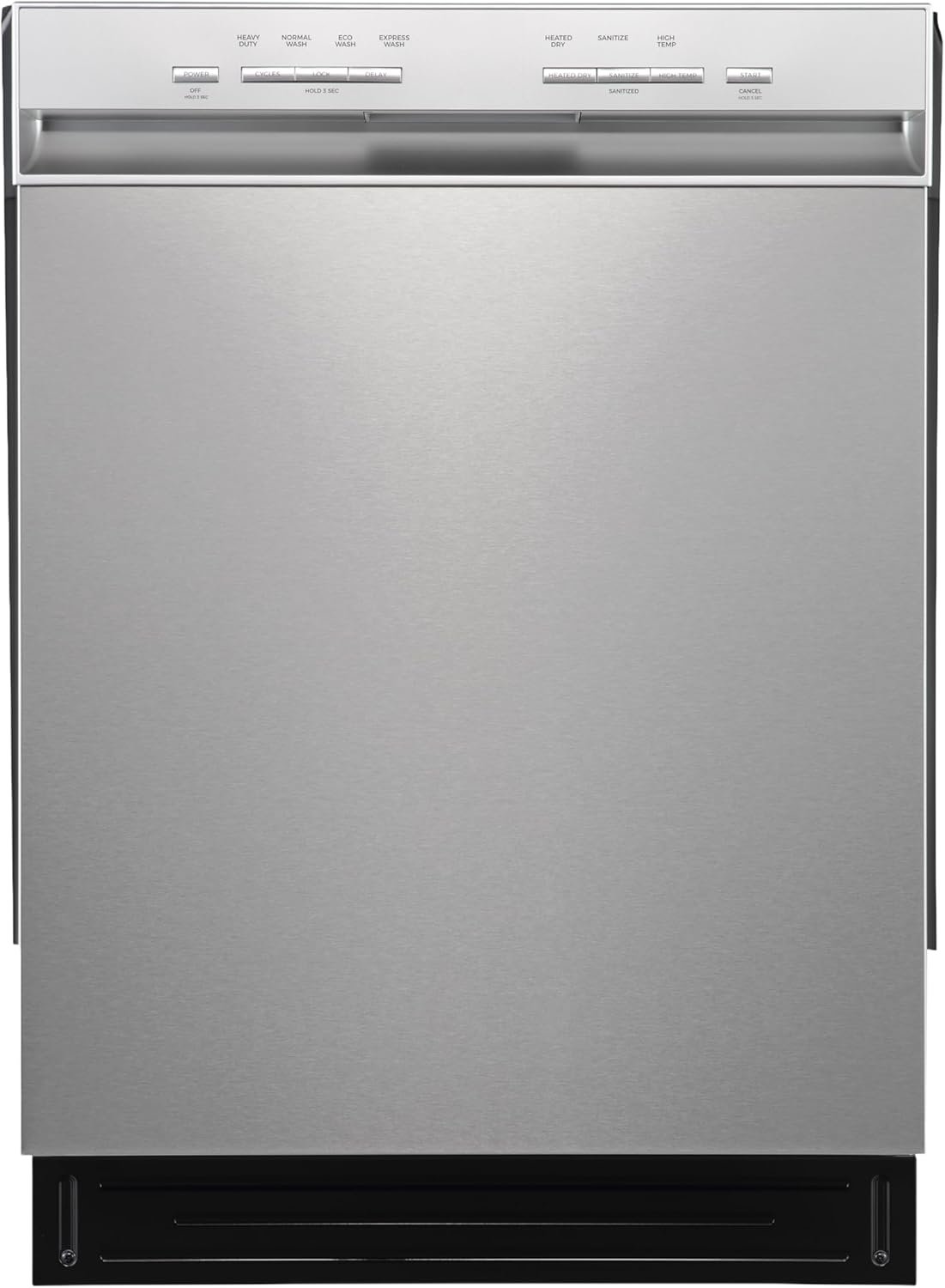
Choosing a dishwasher shapes daily kitchen routines, household hygiene, and kitchen layout decisions. Selection matters when household size, meal frequency, and the presence of delicate serveware or heavy cookware drive expectations for capacity, cycle variety, and rack flexibility. Noise sensitivity and open-plan living influence whether a 54 dBA unit remains unobtrusive during occupied hours. Energy and water efficiency expectations govern running frequency and long-term utility impacts, while sensor-driven cycles and high-temperature options determine suitability for heavily soiled pots and sanitized glassware. Durability and maintenance requirements inform service schedules and ease of ownership. For buyers balancing compact footprint, moderate capacity, and relatively quiet operation, the Kenmore 24″ Premium Hybrid Tub model positions specific trade-offs across cleaning systems, rack adaptability, and certified efficiency.
Quick Overview
| Feature | Details |
|---|---|
| Dishwasher type | Built-in, flush-front with pocket handle |
| Capacity | 12 place settings |
| Wash cycles & cleaning tech | Normal, Heavy Duty, Express Wash, Eco Wash, High Temp, Sani Rinse, SmartWash sensor, UltraWash with 2 pressurized spray arms |
| Filtration | 3-stage UltraWash filter capturing fine particles; removable for cleaning |
| Drying method | Heated Dry option; heated/evaporative-assisted drying |
| Noise level | 54 dBA (conversation-level) |
| Energy efficiency | ENERGY STAR Certified; Annual energy consumption listed as 240 kWh/year |
| Dimensions & installation | 22.6″ D x 23.6″ W x 33.7″ H; built-in installation |
| Materials | Hybrid tub construction; plastic and stainless steel components; fingerprint-resistant stainless steel finish |
| Warranty | Not specified in manufacturer disclosures |
The table summarizes core specifications relevant to household fit: a 12-place capacity suits small to medium households, UltraWash and SmartWash technologies target varied soil levels, and a 54 dBA rating positions the unit as conversation-quiet. Built-in form factor and adjustable rack geometry make it appropriate for kitchens prioritizing a flush look and flexible loading, while ENERGY STAR certification signals efficiency expectations but requires consideration of cycle choices for real-world energy use.
Cleaning performance and wash coverage
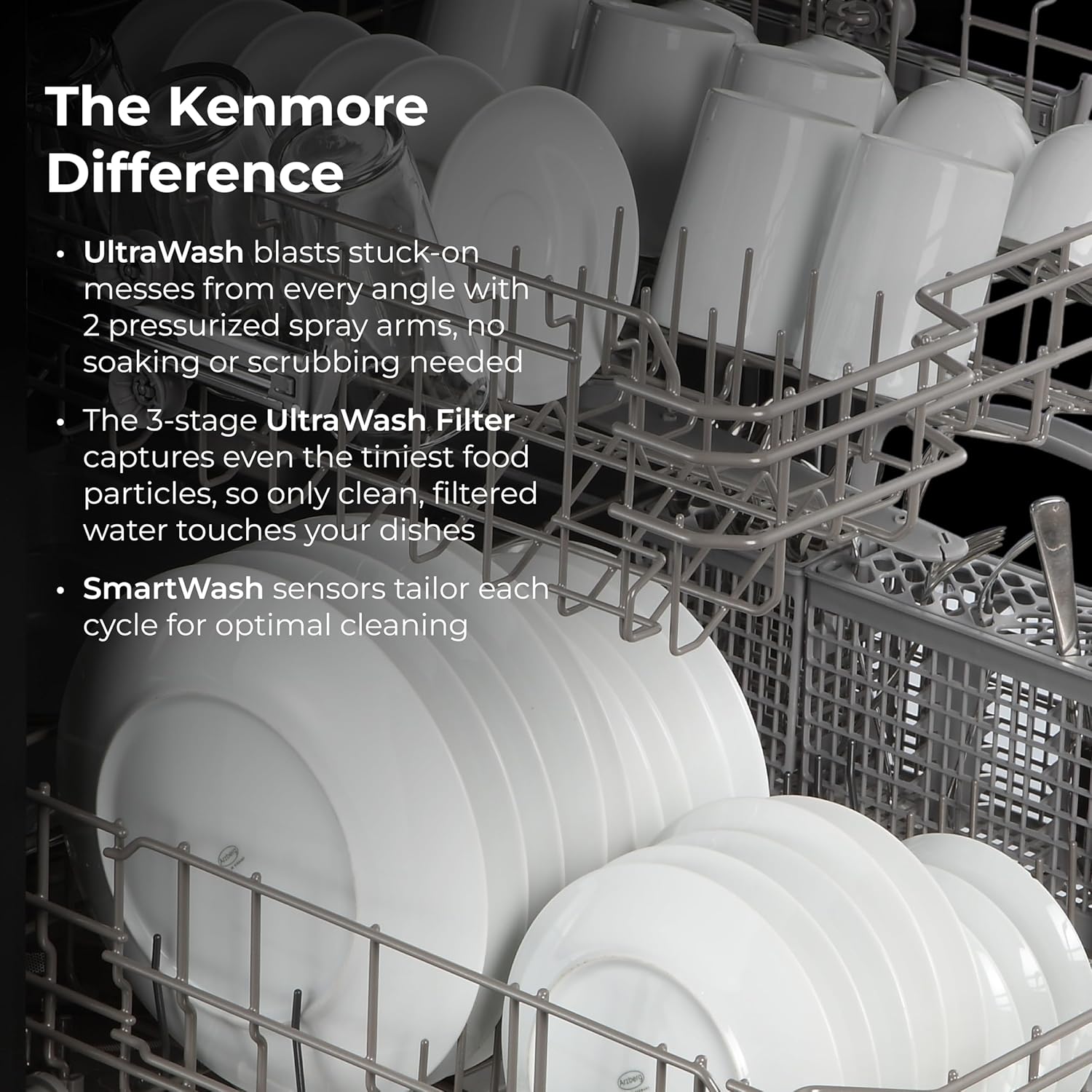
The dishwasher’s cleaning approach combines pressurized spray delivery, a multi-stage filter, and soil-sensing to target residue across a typical cookware mix. Two pressurized spray arms concentrated by an UltraWash system increase kinetic energy delivered to dish surfaces, improving mechanical removal of stuck-on food when combined with heated water. The 3-stage filter traps particles down to fine-grain sizes and keeps recirculated water clearer through a drain-and-filter cycle, which helps maintain spray effectiveness through a load. SmartWash sensing adjusts pressure, temperature and time, reducing the need to choose cycles manually, while specialized cycles such as Heavy Duty and High Temp raise soak temperature and extend soak/agitation phases for bakes and pots.
Spray system, arm layout, and wash coverage
The UltraWash system relies on two pressurized spray arms to increase targeted water jets, creating overlapping coverage zones across racks. Higher local pressure combined with narrower spray nozzles produces greater shear force on soiled surfaces, which is effective for baked-on residues when detergent chemistry and hot water are present. Spray arm reach and vertical spacing determine blind spots behind tall items; lifting the MoreSpace adjustable rack reduces interference for taller pots and allows more direct spray paths. Mechanical coverage is augmented by cycle timing and sensor-driven adjustments that extend wash duration on dirtier loads to compensate for heavier soils.
Filtration, soil removal, and water clarity
A three-stage UltraWash filter removes larger food debris, finer particulates and prevents recirculation of grit into the wash stream, preserving spray integrity and reducing redeposition. The filter’s design channels heavy particles to a separator while trapping fine sediment in a mesh or screen; periodic access and removal are required to prevent performance degradation. Filtering works alongside the drain routine to expel captured solids; a clogged or neglected filter will reduce spray arm flow distribution and can lead to poorer rinse results. The removable filter is intended for monthly cleaning as part of routine maintenance and to sustain consistent wash quality.
Cycle selection and sanitization options
The SmartWash sensor automatically evaluates soil load and modifies water temperature, pressure and cycle duration, which is designed to optimize cleaning for mixed loads without manual selection. For heavily soiled cookware and bakeware, Heavy Duty and High Temp options increase incoming water temperature and extend soaking or wash phases to improve grease and starch breakdown. The UL-certified Sani Rinse option elevates rinse temperatures to meet sanitization thresholds specified by regulatory standards, useful when sterilization is a priority. Cycle choice still matters: Eco Wash conserves energy and often extends duration, while Express Wash shortens time at the expense of some cleaning aggressiveness.
Capacity, rack design, and place settings
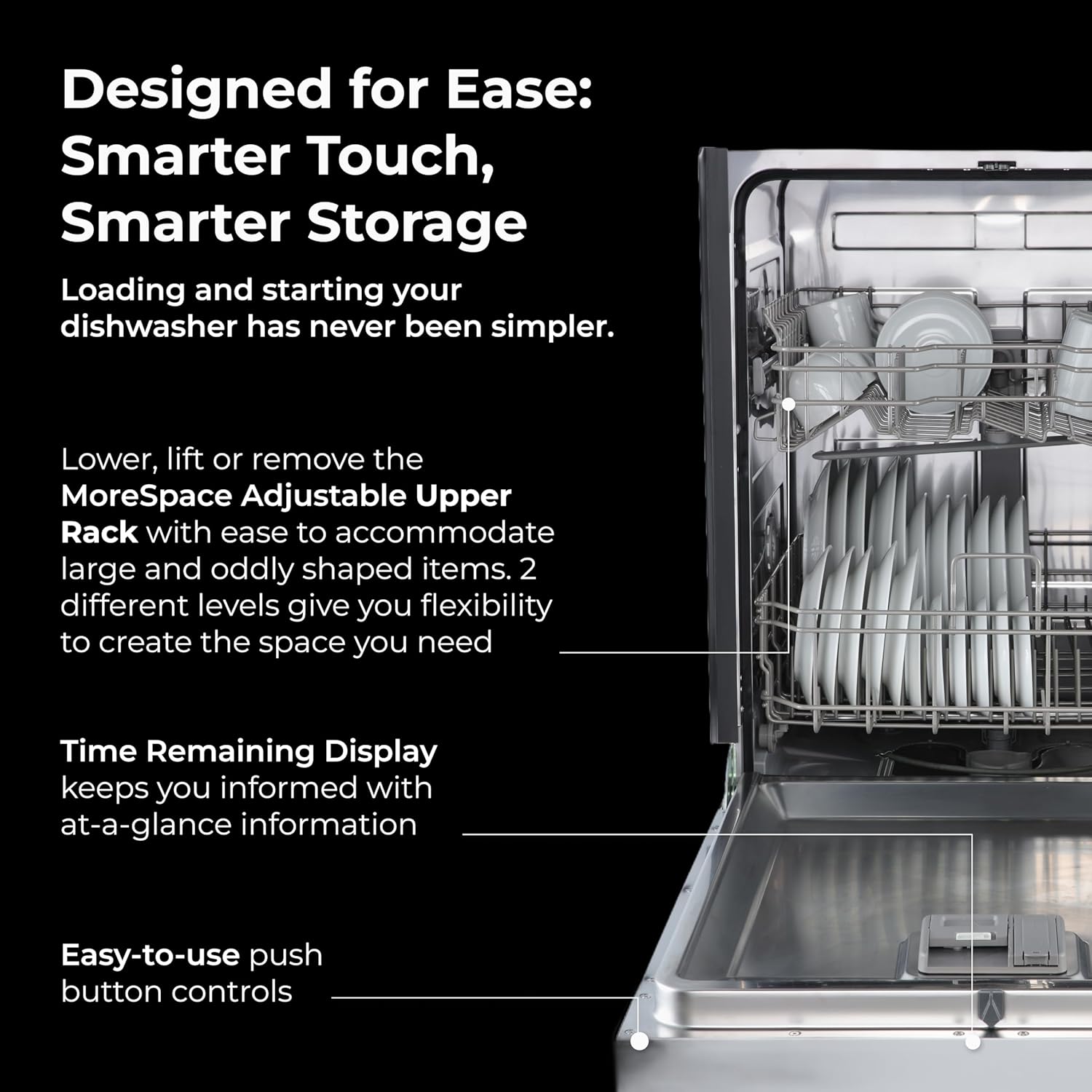
Capacity influences how often the dishwasher runs and how bulky items are accommodated; this model’s 12-place setting design targets two- to four-person households or smaller families. The MoreSpace Adjustable Upper Rack offers two distinct height settings and can be lifted, lowered, or removed entirely, allowing large pots or tall stemware to occupy the lower area without obstructing spray paths. Rack tines and fold-down options affect the ability to accommodate square casserole dishes and deep skillets; flexible tine layouts reduce load-shifting and improve wash angle exposure. A separate cutlery basket provides straightforward separation of utensils but requires mindful placement to avoid blocking lower spray coverage when loaded densely.

Place setting count and real-world loading
Twelve place settings denote the number of standard dish settings the shelves will accept, typically counting dinner plates, glasses, bowls and flatware in manufacturer test arrangements. Real-world loading must account for irregular shapes, nesting, and spacing needs for effective spray coverage; overpacking reduces water and detergent penetration and can cause lower rinse performance. The combination of adjustable rack height and removable top rack enables customized volume allocation between racks, useful for alternating between full dinnerware loads and mixed loads with a few larger items.
MoreSpace adjustable rack functionality
The adjustable rack has two vertical positions to maximize clearance or increase upper-rack capacity. Raising the rack keeps taller items below unobstructed but may limit tall stemware clearance above; lowering it increases upper-rack load height for mugs or glasses. Complete removal of the top rack provides full lower-cavity flexibility for oversized bakeware and stockpots, but this reduces overall place-setting capacity. The mechanism for lifting and lowering should operate smoothly to prevent misalignment that could obstruct door closing or spray arm rotation.
Cutlery basket and heavy cookware considerations
The included cutlery basket offers compartmentalized storage for forks, spoons, and knives; basket placement affects lower spray exposure and may require relocating for larger items. Heavier cookware benefits from positioning on the lower rack with openings angled downward to encourage drainage. When washing heavily soiled pans, spacing between cookware items matters to allow spray penetration; using high-temperature or Heavy Duty cycles improves grease loosening, but mechanical access and detergent choice remain important variables for repeatable results.
Noise levels and suitability for open kitchens
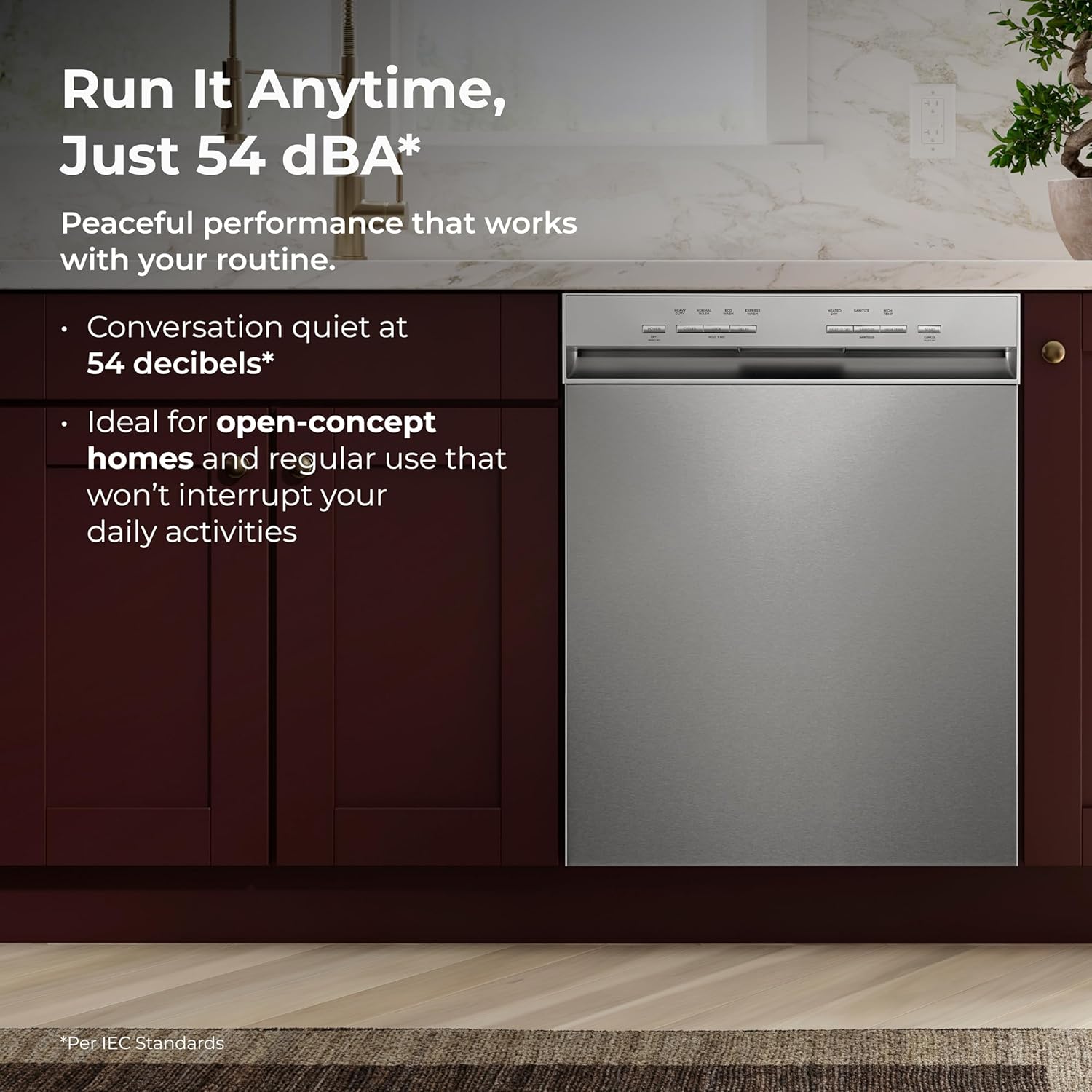
A 54 dBA rating places this unit in the conversation-quiet category, meaning it operates at roughly the level of a moderate conversation in a living area. Decibel ratings are measured under standardized conditions and perceived loudness depends on kitchen layout, cabinetry acoustics, and room volume; open-plan kitchens will transmit more sound than enclosed ones, making insulated cabinets and placement distance relevant. Noise character — the balance of motor hum, water movement and pump clatter — can affect subjective tolerance even at similar dBA levels. For households with frequent daytime activity or adjacent living spaces, a 54 dBA machine typically remains background noise, though not as silent as premium sub-45 dBA models.

What a 54 dBA rating means in practical terms
Decibel scales are logarithmic; a 54 dBA rating indicates noticeable operation but not intrusive in typical kitchen environments. In open-plan designs, the dishwasher will be audible in adjacent living spaces, especially during certain cycle phases like pump start-up or drain sequences. Acoustic transmission depends on cabinetry fronting, floor plans, and shared wall conditions; users seeking near-silent operation for bedrooms or media activities might prefer models with lower rated dBA or additional noise-dampening features.
Motor, pump design, and vibration control
Quiet operation results from motor insulation, pump balancing and anti-vibration mounting; hybrid tub construction can also alter resonant behavior compared with full stainless steel tubs. Brushless or inverter-driven pumps typically run smoother and with less tonal variation, while conventional induction motors may generate broader frequency noise. Mechanical isolation of pumps and spray components reduces structure-borne sound through cabinets and adjacent surfaces. The manufacturer’s listed 54 dBA reflects assembled performance under test conditions, and real-world installation factors will influence perceived quietness.
Placement, cabinetry, and installation effects on noise
Built-in installation with tight door seals and sturdy mounting reduces rattle and amplifying cavities behind the unit. Flush-front designs and pocket handles avoid recessed panels that can act as acoustic resonators. Sound attenuation improves when the dishwasher is mounted to solid cabinetry and flooring; loose trim, unsecured kickplates or gaps allow noise to escape. For consumers in open-concept layouts, acoustic considerations during installation can meaningfully influence perceived noise more than small differences in rated decibels.
Energy efficiency, water use, and operating expectations
ENERGY STAR certification and a listed annual energy consumption of 240 kWh per year offer a baseline for efficiency expectations, but actual energy and water use depend on cycle selection, load density, and local water temperature. Sensor-driven SmartWash cycles optimize water and temperature dynamically, which can reduce unnecessary hot-water usage on light loads compared with fixed-time cycles. Eco Wash typically reduces energy per cycle by lowering wash temperatures and extending cycle time; conversely, High Temp, Sani Rinse and Heated Dry options increase energy consumption but improve sanitization and drying outcomes. Users should balance cycle selection against desired cleanliness and drying performance to manage household energy patterns.

Interpreting annual energy consumption and ENERGY STAR
An annual energy consumption rating provides a projected baseline under standardized use assumptions; actual usage will vary with run frequency and selected options. ENERGY STAR certification indicates compliance with efficiency thresholds for typical usage but does not guarantee best-in-class performance across every cycle. Sensor-assisted cycles contribute to lowering runtime and water use on moderate loads; heavy or soiled loads that trigger extended cycles will raise per-cycle energy and water consumption compared with gentle or eco-oriented settings.
Water use expectations and sensor impact
Specific per-cycle water consumption is not provided in manufacturer disclosures, but soil sensors can curtail unnecessary fill and drain sequences by reducing cycle duration when water clears quickly. For households seeking to minimize water use, selecting shorter or eco-oriented cycles for lightly soiled loads and leveraging SmartWash sensing can provide meaningful reductions compared with default heavy programs. However, very soiled pans still require more water and agitation to avoid rewash, offsetting sensor benefits.
Options, heated dry, and their efficiency trade-offs
Heated Dry accelerates moisture removal but increases energy use relative to air-dry or leak-away drying. For efficiency-oriented households, disabling Heated Dry and opening the dishwasher door slightly after a hot rinse can aid evaporation with minimal energy. The presence of high-temperature sanitization and heated drying provides flexible options to prioritize either sanitization and dryness or lower resource consumption, depending on household priorities.
Maintenance, durability, and service considerations
Durability hinges on component materials, accessibility for routine maintenance, and parts availability. Hybrid tub construction and a stainless steel-facing finish combine corrosion resistance with reduced noise but may use plastic tub elements that behave differently than full stainless interiors; thermal expansion and long-term staining characteristics differ between materials. The removable UltraWash filter is a key maintenance item: regular inspection and scheduled cleaning preserve spray arm flow and prevent recirculation of debris. Controls and electronic sensors require dry-environment protection; failure modes often relate to water quality, detergent residue, or mechanical blockage rather than inherent design shortcomings.
Filter access, cleaning cadence, and common maintenance tasks
The three-stage removable filter is intended to be accessible from the lower rack area and should be checked monthly depending on usage and soil levels. Clearing trapped food, running a maintenance rinse and ensuring spray arm holes remain unobstructed helps maintain consistent pressure distribution. Door gasket inspection and cleaning prevents odor development and ensures a reliable seal. Hard water regions benefit from periodic descaling or use of water-softening agents compatible with dishwashers to reduce mineral buildup on spray nozzles and heating elements.
Materials, hybrid tub implications, and expected wear
Hybrid tubs typically combine a stainless steel door and/or interior panels with molded polymer tub components; stainless surfaces resist staining and heat cycling while polymer interiors reduce noise and manufacturing cost. Plastic tubs can be more resistant to impact but may retain staining more readily than full stainless interiors. Common wear points include pump seals, spray arm bearing points, and door hinges; these are serviceable parts but depend on parts supply and service networks for long-term repairability.
Repairability, parts availability, and who may face service limitations
Repairability depends on replacement part access and local service networks. Units sold under established brands typically have parts catalogs and third-party service compatibility, but turnkey or lower-volume components may prolong repair timelines. Households in remote areas or those requiring minimal downtime should verify service coverage and spare-part availability prior to purchase, especially if continuity of use is critical.

Pros & Cons
Pros
- Quiet operation at 54 dBA that keeps noise at conversation level, making it suitable for many open kitchens while remaining audible during certain cycle phases. Two-sentence explanation: The rated noise level balances performance with affordability, allowing daytime use without overwhelming adjacent living areas. Acoustic characteristics will vary with installation details and cabinetry.
- SmartWash soil sensing that adjusts temperature, pressure, and time for mixed loads, reducing the need to manually choose specialized cycles. Two-sentence explanation: Sensor-driven adjustments can improve cleaning outcomes on variable loads and reduce wasted runtime, especially for routine everyday dishware. Effectiveness depends on load arrangement and initial soil levels.
- UltraWash system with two pressurized spray arms and a 3-stage removable filter for improved mechanical cleaning and reduced particle recirculation. Two-sentence explanation: Pressurized spray arms increase shear forces on stuck-on soils while the filter helps maintain clear wash water. Regular filter maintenance is necessary to sustain performance.
- Flexible MoreSpace adjustable upper rack that lifts, lowers, or removes to accommodate taller items and awkward shapes. Two-sentence explanation: Adjustable rack geometry increases versatility for pots, pans and stemware, improving real-world loading options. Removal of the top rack sacrifices place-setting count for larger item clearance.
- ENERGY STAR certification and a published annual energy consumption rating provide a baseline for efficiency expectations. Two-sentence explanation: Certification signals adherence to efficiency benchmarks and helps compare units across models. Actual energy use will vary with cycle choices and frequency of use.
- Sani Rinse and High Temp options for elevated sanitization needs and cleaner results on heavily soiled items. Two-sentence explanation: These options raise rinse temperatures and extend cycles to meet sanitization thresholds, useful for households prioritizing germ reduction. Higher temp cycles consume more energy and water.
- Fingerprint-resistant stainless steel finish for lower visible smudging and an integrated flush-front design for a neat built-in look. Two-sentence explanation: The finish maintains appearance with typical kitchen use, reducing the need for frequent surface wiping. Flush-front styling suits modern cabinetry alignments.
Cons
- 12-place capacity limits suitability for larger households or frequent entertaining, requiring more frequent runs or partial handwashing for oversized loads. Two-sentence explanation: Smaller place-setting counts reduce per-cycle throughput compared with 14–16 place units, which can increase cumulative water and energy use over multiple runs. Buyers who routinely host large meals may find this limiting.
- Hybrid tub construction may be less robust for long-term high-heat cycles compared with full stainless steel interiors. Two-sentence explanation: Plastic components can differ in thermal behavior and staining propensity relative to stainless steel, potentially affecting long-term appearance and drying characteristics. Material choice impacts weight, cost and acoustic performance.
- Heated Dry option increases energy usage and may require manual door-opening to fully clear residual moisture for plastics and deep-draw items. Two-sentence explanation: Energy-conscious users may prefer air-dry or partial drying techniques to reduce consumption. Some items still retain moisture without additional drying strategies.
- Limited explicit warranty information in manufacturer disclosures requires buyers to verify coverage and service access prior to purchase. Two-sentence explanation: Unspecified warranty terms make it harder to anticipate repair-cost exposure or service timelines. Checking retailer and manufacturer support policies is recommended before committing.
Final Verdict: Who This Dishwasher Is Best For (and Who Should Skip It)
This Kenmore 24-inch Premium Hybrid Tub dishwasher is tailored to small-to-moderate households that prioritize a balance of cleaning capability, adjustable loading and a conversation-quiet operation. The UltraWash pressurized spray arms paired with a three-stage removable filter and SmartWash sensing provide a technical foundation for effective cleaning across typical daily dishes, while the MoreSpace adjustable upper rack supports flexible loading for mixed cookware and stemware. ENERGY STAR certification and an annual energy figure offer a baseline for efficiency-conscious buyers who will manage cycle choices to match cleaning needs.
Households that frequently entertain large groups, require the quietest possible operation for adjacent sleeping areas, or prefer a full stainless steel tub for heavy-duty daily commercial-style use may find this model limiting. Those who need explicit warranty transparency or who lack local service support should verify coverage before purchasing. Overall, the unit suits buyers seeking a compact, flexible built-in dishwasher with sensor-assisted cleaning and respectable noise and efficiency credentials compared with similarly spec’d models in 2026.

Frequently Asked Questions (FAQs)
How effective is the UltraWash system at removing baked-on food?
UltraWash combines two pressurized spray arms with higher local shear forces and targeted flow to mechanically dislodge stuck-on residues. When paired with appropriate detergent, elevated temperatures (High Temp) and longer Heavy Duty cycles, the system increases the probability of removing baked-on soils, although load arrangement and pre-rinsing practices influence repeatable outcomes.
What does a 54 dBA noise rating mean for open-plan kitchens?
A 54 dBA rating is considered conversation-level and will be audible but generally unobtrusive in most kitchen-living areas. Acoustic perception depends on cabinetry, room volume and proximity; open-plan spaces will transmit more sound than closed kitchens, so installation details can significantly affect perceived loudness.
How often should the UltraWash filter be cleaned?
The removable three-stage filter is recommended for regular inspection and cleaning on a monthly cadence under typical household use to maintain spray arm flow and prevent redeposition. Households with heavy soiling or high solids loads may need to clean the filter more frequently to sustain consistent wash performance.
Does the SmartWash sensor reduce water and energy use?
SmartWash sensing adjusts temperature, pressure and cycle time based on soil measurements, which can reduce unnecessary runtime and hot water usage for lighter loads. Water and energy savings depend on load composition and cycle selection; heavy loads that trigger extended cycles will use more resources despite sensor control.
Is the hybrid tub less durable than a full stainless steel tub?
Hybrid tub designs blend stainless steel elements with polymer components; while stainless surfaces resist staining and high temperatures, polymer parts can offer impact resistance and noise dampening. Long-term durability differences hinge on usage patterns, exposure to high-heat cycles and maintenance; neither construction inherently guarantees longer life without proper care.
Can the MoreSpace adjustable rack hold tall stemware and large pots together?
The adjustable rack offers two height settings and can be removed to create more lower-rack clearance, enabling a mix of tall stemware or large pots as needed. Real-world loading requires strategic placement to avoid blocking spray arms and to maintain adequate spacing for water and detergent penetration.
Will using Heated Dry significantly increase energy consumption?
Heated Dry accelerates moisture removal by adding electrical heat, which raises per-cycle energy consumption compared with air-dry or door-assisted evaporation. For households prioritizing efficiency, disabling Heated Dry and allowing residual heat to dissipate with a slightly opened door can achieve acceptable drying with lower energy use.